
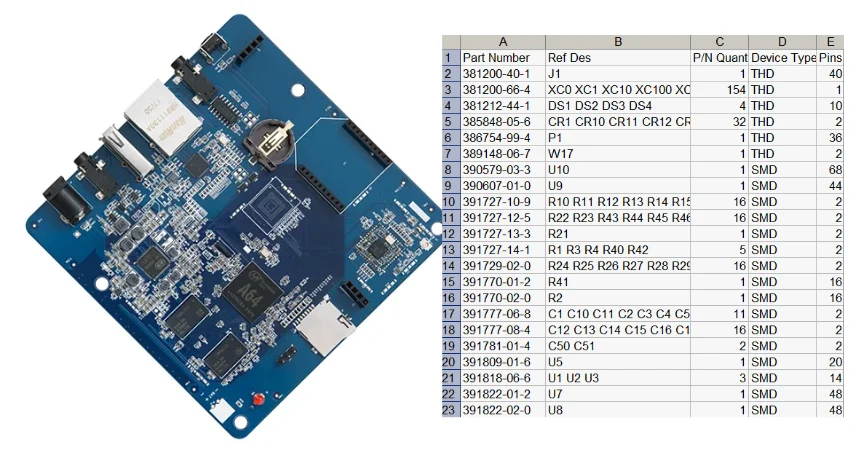
PCB assembly BOM cost is the extended cost of the approved materials required to build one PCBA at a stated quantity, date, sourcing policy, and yield assumption. It is not automatically the same as the fully loaded PCBA cost, purchase cash requirement, or selling price.
Key Takeaways
- Separate component BOM cost, bare-PCB cost, conversion/assembly cost, NRE, test, logistics, overhead, and margin instead of calling every number “BOM cost.”
- Cost each manufacturer part number at the build quantity and effective purchase quantity, including MOQ, pack size, attrition, usable inventory, fees, and treatment of excess material.
- A distributor web price is a timestamped offer, not a production commitment. Record currency, validity, lead time, source, lifecycle status, and commercial terms.
- Approved alternates reduce supply risk only after electrical, mechanical, firmware, manufacturing, quality, and compliance validation.
- Normalize EMS quotes line by line. A low unit price can exclude stencil, tooling, programming, test, freight, duties, component overage, or non-recurring charges.
- Selling price and gross margin are commercial outputs, not manufacturing cost elements. Do not add a margin percentage to cost and call the result “fully loaded cost.”
- Optimize total landed and lifecycle cost, not only the cheapest component column. A lower part price can create requalification, yield, rework, inventory, or field risk.
- Re-cost at design gates and when quantity, forecast, revision, supply status, currency, logistics, or manufacturing route changes.
Contents
- What Does BOM Cost Include?
- Which Fields Make a BOM Costable?
- How Is Component Cost Calculated?
- How Do PCB, Assembly, Test, and NRE Enter the Model?
- How Do You Calculate Fully Loaded PCBA Cost?
- How Should EMS Quotes Be Compared?
- When Is a BOM Cost Reduction Worth It?
- How Do Lifecycle and Alternates Affect Cost?
- How Does Cost Change from Prototype to Volume?
- What BOM Costing Errors Cause Quote Surprises?
- What Should a BOM Cost RFQ Include?
What Does BOM Cost Include?
Engineering, purchasing, manufacturing, and finance often use the same term for different cost views. Define the boundary before comparing spreadsheets or supplier quotes.
| Cost view | Included items | Primary use | Common mistake |
|---|---|---|---|
| Electronic BOM material cost | Approved components multiplied by quantity per assembly, with agreed sourcing assumptions | Design cost target and component sourcing | Treating spot prices as committed production prices |
| Manufacturing BOM material cost | Electronic BOM plus process consumables, labels, fasteners, shields, thermal materials, packaging, and other factory-issued items | Kitting and material planning | Omitting non-schematic items |
| Bare-PCB cost | Fabricated board based on released stackup, panel, finish, via, tolerance, test, and yield assumptions | Fabrication quote and PCBA roll-up | Assuming two boards of equal size cost the same |
| Conversion cost | SMT/THT setup and placement, soldering, inspection, programming, coating, mechanical work, test, and pack-out | EMS manufacturing quote | Calling assembly labor part of component BOM cost |
| Fully loaded PCBA cost | Materials, PCB, conversion, test, allocated NRE, logistics/duties, handling/overhead, and specified yield/scrap treatment | Product costing and supplier comparison | Mixing recurring and non-recurring costs without disclosure |
| Purchase cash requirement | Actual reels, trays, tubes, MOQ, NCNR buys, tooling, deposits, freight, tax/duty, and excess inventory | Cash-flow planning | Dividing all purchased material by the first build even when excess remains usable |
| Selling price | Fully loaded cost plus the company’s pricing and margin policy | Commercial quotation | Confusing markup with gross margin |
The bare PCB may appear as a BOM line in an ERP or manufacturing BOM, but it is normally clearer to show it as its own cost bucket. This exposes stackup and panel drivers instead of hiding them inside “materials.”
Which Fields Make a BOM Costable?
A costable BOM identifies an exact approved item and the conditions under which it may be purchased. “10 k resistor, 0402” is not enough when voltage rating, tolerance, temperature coefficient, qualification, terminal finish, or approved manufacturer matters.
Each line should contain:
- item and revision, reference designators, quantity per board, do-not-fit state, and assembly variant
- manufacturer name and manufacturer part number; internal part number if controlled in PLM/ERP
- description plus critical electrical, mechanical, environmental, and compliance attributes
- package, footprint, polarity/orientation, moisture sensitivity or special handling where applicable
- approved supplier/manufacturer list, validated alternates, and who may authorize substitution
- target build quantity, annual usage, price-break quantity, MOQ, order multiple, pack type, currency, source, quote date, validity, lead time, and commercial terms
- lifecycle status, product/process change and discontinuance monitoring, material declaration needs, and traceability requirements
Engineering owns design suitability. Procurement owns the approved sourcing transaction. Manufacturing owns the released manufacturing BOM and process consumables. Configuration control must keep the eBOM, mBOM, AVL, drawings, firmware, and product revision synchronized.
How Is Component Cost Calculated?
For component line i, the simple extended usage cost is:
Usage cost per board = quantity per board × quoted unit price
That formula is useful only when the quoted quantity, packaging, source, and order terms match the build. A production model also calculates how many parts must actually be purchased.
Required quantity = build quantity × quantity per board × (1 + approved attrition rate)
Then subtract qualified usable inventory and round the remainder to the supplier’s MOQ and order multiple. Attrition is not one universal percentage: it depends on package, feeder/reel constraints, setup, process, loss history, supplier policy, and build quantity. Customer-supplied material may need a different overage rule from turnkey material.
Effective purchase-cost worksheet
| Field | Why it changes cost |
|---|---|
| Unit price and price tier | Price must correspond to the purchased quantity, not only annual forecast |
| MOQ and order multiple | A board may consume 120 pieces while the supplier requires a full reel or tray multiple |
| Attrition/overage | Additional material covers setup and expected process loss under an agreed rule |
| Existing usable stock | Correct revision, date code, storage, traceability, moisture condition, and ownership must be confirmed |
| Line, cut-tape, reel, expedite, or small-order fees | Fees can dominate low-quantity passives and prototypes |
| Excess disposition | Return, customer-owned stock, supplier-held stock, transfer to next build, or charge-off changes cash and unit cost |
| Currency and validity | Exchange movement and expired quotes make two otherwise identical cost roll-ups differ |
| Freight, duty, tax, insurance, and brokerage | These create landed cost and depend on route and Incoterms |
Maintain two views when MOQ creates excess: the cash purchase for the build and the material consumed by the build. State how remaining inventory is valued and who owns obsolescence risk. Otherwise one quote may charge the full reel immediately while another allocates it across a forecast, making unit prices appear comparable when they are not.
How Do PCB, Assembly, Test, and NRE Enter the Model?
Bare-PCB cost follows the released construction: dimensions, panel utilization, layer count, materials, finished copper, controlled impedance, line/space, drill and via structure, surface finish, solder mask, routing/V-score, tolerances, electrical test, coupons, documentation, quantity, and lead time. Compare a multilayer PCB quote only after these inputs match.
Cost per good board is affected by panel utilization and expected yield, but do not invent a yield factor on top of a supplier’s quoted good-board price. Ask whether the quote is per ordered board, per panel, or based on delivered-good quantity and how tooling or engineering charges are shown.
Assembly cost is driven by setup and unique line items, total placements, board sides, package mix, fine pitch/BGA or bottom-terminated components, solder-paste steps, SMT plus through-hole processes, hand work, selective solder, cleaning, coating, mechanical assembly, inspection, programming, test, traceability, and pack-out. Placement count alone cannot normalize two assemblies with different process routes.
NRE includes stencils, fixtures, programming adapters, test development, special tooling, first-article work, and one-time engineering. Keep it visible. For a scenario view, allocated NRE per board equals total applicable NRE divided by the planned quantity, but purchase approval must still recognize when the cash is due and whether tooling can be reused after a revision.
How Do You Calculate Fully Loaded PCBA Cost?
Use a cost waterfall with named owners and assumptions:
Fully loaded PCBA cost per board = components + bare PCB + recurring assembly/process + recurring inspection/test + allocated NRE + inbound/outbound logistics and duties + agreed handling/overhead + expected scrap/rework allocation
Do not double-count. An EMS turnkey price may already include sourcing overhead, material overage, PCB, assembly, inspection, and margin. Request a breakdown or at least an inclusion matrix before adding internal allowances.
Selling price is calculated after cost. If g is target gross-margin fraction, price = cost ÷ (1 − g). If m is markup fraction, price = cost × (1 + m). A 20% markup and a 20% gross margin are not the same calculation.
Run scenarios rather than one “final” cell: prototype quantity, pilot quantity, forecast volume, high/low component price, exchange-rate case, alternate logistics route, and demand downside. Show recurring unit cost, one-time cash, inventory created, quote validity, and major risks separately.
How Should EMS Quotes Be Compared?
Normalize each supplier response to the same revision, quantity, delivery schedule, currency, Incoterm, sourcing scope, test scope, and validity date.
EMS quote normalization matrix
| Comparison row | Questions to resolve before ranking |
|---|---|
| Components | Exact MPNs and alternates? Authorized source? MOQ/pack, overage, fees, excess ownership, traceability, lifecycle and lead time included? |
| Bare PCB | Same stackup, materials, copper, finish, impedance, via process, panel, electrical test, coupons, tolerances and delivery quantity? |
| Assembly | Same sides, placements, THT/manual steps, solder process, cleaning, coating, mechanical work, inspection, rework and pack-out? |
| Test/programming | Firmware version, fixture, coverage, loads, calibration, takt time, data retention, failure analysis and retest policy included? |
| NRE/tooling | Stencil, fixtures, programming adapters, engineering, first article and ownership/reuse listed separately? |
| Logistics/commercial | Currency, tax/duty, freight, Incoterm, payment, cancellation, NCNR exposure, validity, schedule and expedite assumptions? |
| Quality/change control | Workmanship class, approved substitutions, lot/date-code rules, PCN/PDN handling, traceability, change notice and corrective action? |
The best quote is the lowest risk-adjusted cost for the required product and schedule, not necessarily the smallest headline price.
When Is a BOM Cost Reduction Worth It?
Every proposed change needs a savings case and an engineering release path. Calculate recurring saving across realistic demand, then subtract validation, tooling, firmware, documentation, inventory write-off, requalification, production disruption, and expected risk.
Cost-change decision gate
| Gate | Required answer |
|---|---|
| Functional equivalence | Do ratings, tolerances, interfaces, timing, power, thermal behavior and failure modes meet the design? |
| Physical/manufacturing fit | Do footprint, pinout, height, polarity, land pattern, soldering, MSL, inspection and test remain valid? |
| Supply and quality | Is the source approved, authentic and traceable? Are lifecycle, capacity, lead time, PCN/PDN and quality history acceptable? |
| Compliance | Do safety, EMC, radio, environmental declarations, customer approvals and product certifications remain valid? |
| Economics | What is annual saving at downside/base/upside demand, one-time change cost, payback, excess exposure and reversibility? |
| Release evidence | Who approves the change, which tests repeat, which documents update, and from which serial/lot does it take effect? |
Standardizing passives, consolidating values, selecting available packages, improving panel utilization, reducing unnecessary unique line items, and designing accessible test points can lower total cost. Do not remove protection, test coverage, copper, thermal margin, or qualification requirements merely because their value is not visible in the BOM price column.
How Do Lifecycle and Alternates Affect Cost?
A low-cost part near discontinuance can be more expensive than an active part once last-time-buy cash, storage, forecast error, redesign, requalification, and shortage exposure are included. Track lifecycle and change notices throughout development and production, not only during quotation.
Alternates must be approved at the correct level. A passive may be interchangeable only after rating, tolerance, dielectric or temperature behavior, package and qualification checks. An MCU, converter, memory, sensor, connector, oscillator, or RF device may require schematic, layout, firmware, EMC, safety, calibration, thermal, and production-test changes.
Maintain an alternate matrix with approval status and evidence. “Cross-reference” suggestions from a search tool are candidates, not release authority. Link product/process change notifications and discontinuance notices to engineering-change and inventory decisions so procurement cannot silently substitute a part because it is cheaper or available.
How Does Cost Change from Prototype to Volume?
Prototype cost emphasizes speed, cut tape, setup, rapid fabrication, manual handling, and flexible sourcing. Volume cost emphasizes negotiated tiers, panel and line efficiency, fixtures, stable process control, scheduled deliveries, quality data, inventory policy, and forecast commitment. Neither should be extrapolated blindly to the other.
At each gate—prototype, design verification, pilot, production release, and major volume change—refresh:
- released design revision and assembly variants
- component quotes, availability, lifecycle, alternates, lead time, MOQ and commercial terms
- PCB stackup, panel, yield assumptions, tooling and lead time
- assembly/test route, fixture readiness, cycle time, quality plan and expected fallout
- forecast, delivery cadence, inventory ownership, cancellation exposure, currency and logistics
Track purchase-price variance and manufacturing variance against the frozen baseline. A favorable component variance can be erased by excess inventory or lower yield; an apparently higher component can reduce placement, test, heatsink, enclosure, or field cost.
What BOM Costing Errors Cause Quote Surprises?
- ambiguous descriptions without exact MPNs, quantities, variants, DNP state, or revision
- duplicate internal parts, inconsistent reference designators, and eBOM/mBOM mismatch
- pricing at annual volume while ordering a prototype or small pilot
- ignoring MOQ, full-reel requirements, attrition, fees, NCNR terms, excess ownership, freight, duty, and currency
- unapproved alternates or broker sources treated as equivalent to authorized supply
- bare-PCB quotes based on different stackups, panels, tolerances, test, finishes, or lead times
- assembly quotes that exclude THT, hand work, coating, programming, functional test, fixtures, pack-out, or failure analysis
- amortizing NRE across an optimistic forecast while ignoring upfront cash and revision risk
- adding both supplier-included overhead and an internal duplicate allowance
- confusing markup, gross margin, and cost
What Should a BOM Cost RFQ Include?
Product and volume
- product/revision, build variants, prototype/pilot/production quantities, annual forecast, lot size, delivery cadence, target date, and quote-validity requirement
- turnkey, consigned, or hybrid sourcing; inventory ownership; excess, cancellation, and NCNR treatment
Released data
- controlled BOM with exact MPNs, approved alternates and attributes; Gerber/ODB++/IPC-2581 data; drawings; centroid; stackup; panel; assembly notes; firmware and test package
- PCB materials, copper, impedance, vias, finish, tolerances, coupons, electrical test, quality and traceability requirements
Manufacturing and evidence
- SMT/THT/manual processes, cleaning/coating, inspection, X-ray, programming, test coverage, fixtures, data records, packaging and failure-analysis expectations
- source authorization, lot/date-code controls, material declarations, lifecycle/PCN/PDN monitoring, change approval, workmanship and acceptance criteria
Commercial normalization
- currency, price breaks, MOQ/order multiple, attrition, line fees, NRE, freight, duties/tax, Incoterm, payment, lead time, validity, expedite, excess ownership and tooling ownership
HILPCB can quote SMT assembly or a turnkey assembly scope after these inputs are aligned. Final component availability and price remain time-sensitive until the sourcing commitment is accepted.
Reference Standards and Specifications
- IEC 62402 — International Electrotechnical Commission
- J-STD-046 — JEDEC
- J-STD-048 — JEDEC
- J-STD-033 — IPC / JEDEC
- IPC-1752A — IPC
- IPC-2581 — IPC
- J-STD-001 and IPC-A-610 — IPC
Applicable editions, customer specifications, regulatory declarations, and workmanship class must be stated in the contract. These references support data, change, handling, and manufacturing control; they do not define one universal BOM price.
Frequently Asked Questions
What is the simplest BOM cost formula?
For each approved part, multiply quantity per board by the valid unit price, then sum all lines. For a production decision, also model MOQ/order multiples, attrition, inventory, fees, excess disposition, logistics, and quote validity.
Is PCB fabrication included in BOM cost?
It depends on the company’s cost structure. The bare PCB may be an mBOM item, but showing it separately makes stackup, panel, tooling, test, and yield assumptions visible. Always define the boundary.
Is assembly labor part of BOM cost?
Assembly is normally a conversion cost, not electronic-component BOM cost. It belongs in fully loaded PCBA cost together with inspection, programming, test, and other manufacturing processes.
Why do EMS BOM quotes differ for the same board?
They may use different sources, price tiers, MOQ, overage, alternates, excess-material policies, currencies, validity periods, logistics, or included services. Normalize the inclusion matrix before comparing totals.
How often should BOM cost be updated?
Refresh it at project gates and whenever revision, quantity, forecast, supplier status, price validity, lifecycle, currency, logistics, or manufacturing route changes. Fast-moving or constrained parts need more frequent review.
How can BOM cost be reduced without lowering quality?
Standardize justified parts, validate alternates early, improve sourcing and panel strategy, simplify assembly, and design efficient test coverage. Approve a change only after its recurring saving exceeds its validation, inventory, qualification, and risk costs.
Turn the BOM into a Controlled Cost Model
A reliable cost roll-up states what is included, when prices were valid, how much must be purchased, who owns excess, and what evidence permits each part and process. That makes the model auditable by engineering, purchasing, manufacturing, finance, and the EMS supplier.
Send HILPCB the released data package, sourcing rules, volume scenarios, quality/test requirements, and quote-normalization sheet. You will receive a more useful PCBA quotation—and a clear record of which assumptions must be refreshed before the next build.