
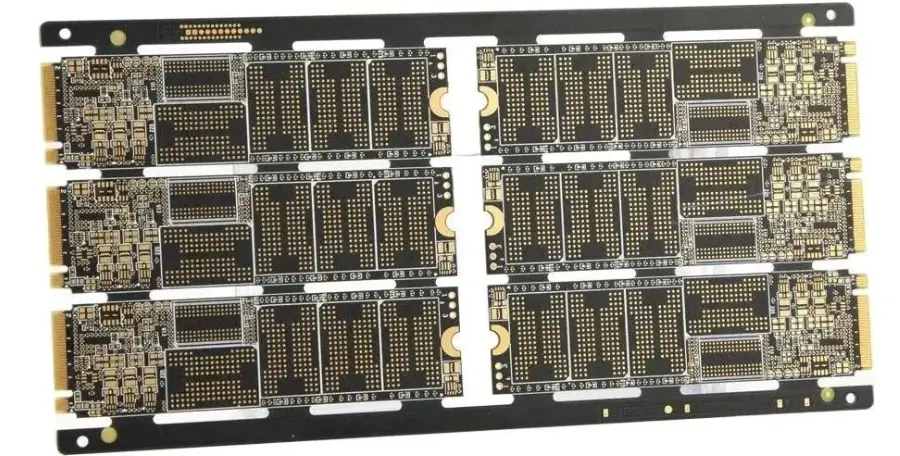
- A microvia PCB should be reviewed as an HDI system whose stackup, dielectric thickness, copper structure, and reliability margin must all be designed together.
- The first checks are HDI build-up strategy, microvia aspect ratio, stacked versus staggered structure, via fill requirement, pad geometry, and routing density around fine-pitch parts.
- Most failures show up as weak yield, target-pad separation, via cracking after reflow, poor fill behavior, or a design that only works on paper because fabrication margin was never realistic.
- Microvias help with density, but they do not remove the need for disciplined fanout, reference-plane control, and DFM planning.
- Prototype success depends on freezing the intended HDI process early, especially when the design depends on sequential lamination, via-in-pad, or stacked microvia structures.
A microvia is a small blind via used in HDI printed circuit boards to connect adjacent layers in a build-up structure. In practice, microvia design is not only about making holes smaller. It is about managing HDI stackup, dielectric thickness, laser drilling, metallization, fill strategy, and reliability risk so the finished board can be fabricated and survive assembly and use.
Contents
- What to review first on a microvia PCB
- Key design and manufacturing rule table
- Early engineering trade-off table
- How stackup, aspect ratio, and structure choice affect reliability
- How HDI fabrication and release planning should be handled
- What teams should lock down before prototype release
- FAQ
- Next steps
- References
- Author and review
What to review first on a microvia PCB
Microvia designs usually start because conventional through-via fanout no longer fits the package density. That is a valid reason, but it is not enough by itself. Once a board depends on microvias, the entire HDI construction has to become part of the design review.The first review points are usually:
- whether the product truly needs HDI and microvia density or could still be routed with simpler constructions
- which HDI build-up strategy is intended, such as 1+N+1 or a more complex sequential structure
- whether the dielectric thickness and via size keep aspect ratio and plating expectations realistic
- whether stacked or staggered microvias are appropriate for the density and reliability target
- whether via-in-pad, copper fill, and planarization are needed around fine-pitch BGAs or CSPs
For dense designs, it is usually worth aligning the review with HDI PCB, multilayer PCB, and Gerber viewer checks before release.
Key design and manufacturing rule table
| Rule / parameter | What to check first | Why it matters | How to verify | If ignored | | --- | --- | --- | --- | --- | | HDI stackup fit | Match the build-up structure to routing density and fabrication reality | The stackup determines where microvias can actually work | Stackup review and fabricator review | Layout assumes structures the board shop cannot support cleanly | | Aspect ratio | Keep microvia depth and diameter in a realistic range | Reliability and plating quality depend on controllable geometry | Dielectric review and DFM review | Weak via formation and low yield | | Stacked vs staggered choice | Use stacking only where density justifies the added risk and process burden | Stacked microvias usually demand tighter process control | Fanout review and fabrication review | Unnecessary reliability exposure | | Via fill and planarization | Decide early whether via-in-pad or stacked structures need copper fill | Assembly and routing assumptions depend on flat, stable pads | Pad-stack review and assembly review | BGA soldering or routing fails late | | Target-pad geometry | Preserve enough landing area and registration margin | Microvia reliability is sensitive to target alignment and capture geometry | Footprint review and [PCB viewer](/tools/pcb-viewer/) check | Opens or weak interconnects after build | | Sequential lamination plan | Freeze lamination order and layer usage before layout grows | HDI process count affects cost, yield, and turn time directly | Fabrication-flow review | Prototype cost and schedule surprise the team |Early engineering trade-off table
| Design choice | Usually stronger for | Main trade-off | What to confirm early | | --- | --- | --- | --- | | Simpler 1+N+1 HDI | Moderate density with better manufacturability | Less routing freedom than deeper build-up | Actual fanout need | | Stacked microvias | Maximum density around fine-pitch packages | Higher reliability and process burden | Whether density truly requires it | | Staggered microvias | Better mechanical margin in many cases | More routing area can be consumed | Package escape pattern | | Via-in-pad with fill | Tight BGA fanout and shortest breakout paths | Higher process cost and stricter flatness expectations | Package pitch and assembly plan |How stackup, aspect ratio, and structure choice affect reliability
Microvia PCBs often fail when density goals are treated as the only design objective. Reliability comes from using only as much HDI complexity as the product actually needs.Three review questions usually matter most.
1. Is the dielectric thickness matched to the microvia geometry?
Microvia structures are not infinitely scalable. If the dielectric is too thick for the chosen via size, the design may look routable but become weak in fabrication or reliability testing.
2. Does the design rely on stacked structures only where necessary?
Stacked microvias can be valid, but they increase process sensitivity. If a design can meet routing goals with simpler staggered or limited-stack structures, that usually reduces risk.
3. Is the package fanout honest about manufacturing margin?
Fine-pitch BGA escape routing often drives teams toward aggressive microvia use. That is where Gerber viewer and PCB viewer review matters, because the difference between a routable concept and a manufacturable one is often just a few geometry decisions.
How HDI fabrication and release planning should be handled
A microvia PCB is not ready when the CAD looks dense and elegant. It is ready when the intended fabricator process, stackup, and reliability expectations are explicit.The most common release questions are:
- whether the chosen shop supports the intended HDI lamination count, laser-via process, fill method, and registration tolerance
- whether the design needs copper-filled vias for assembly and stacking reasons
- whether the first build is proving routing feasibility, assembly behavior, or long-term interconnect reliability
- whether material, lamination count, and turnaround assumptions are aligned before quoting
If the board is still early in development, PCB prototype, quick-turn PCB, and HDI PCB planning usually saves more time than refining fanout patterns without a real process target.
What teams should lock down before prototype release
Microvia projects become expensive when the board reaches RFQ without a frozen HDI intent. Before release, the team should know what the first build is actually proving.A practical release checklist usually includes:
- HDI construction frozen Define the intended build-up structure, lamination count, and layer usage before detailed routing expands.
- Microvia geometry approved Confirm via size, dielectric thickness, aspect-ratio assumptions, and target-pad strategy.
- Package fanout approach approved Freeze where stacked, staggered, or via-in-pad structures are required and where they are not.
- Fabrication path defined Align with the intended shop on laser drilling, filling, planarization, and reliability expectations.
- Assembly and test assumptions recorded Keep BGA package assumptions, stencil plan, flatness needs, and revision history aligned. A BOM viewer review helps prevent package substitutions that break the fanout plan.
FAQ
What is the first thing to check on a microvia PCB?
Start with whether the design really needs HDI, then review stackup, dielectric thickness, and microvia geometry together. Those choices usually determine whether the rest of the layout is realistic.
Are stacked microvias always better than staggered microvias?
No. Stacked microvias can improve density, but they also raise process and reliability demands. They should be used where routing truly needs them, not by default.
Why does aspect ratio matter so much for microvias?
Because via depth relative to diameter affects formation, plating, and long-term reliability. A design outside realistic process limits may fail even if the CAD looks correct.
Does microvia technology automatically improve signal integrity?
Not automatically. It can shorten escape paths and reduce routing congestion, but signal integrity still depends on reference planes, return paths, and overall stackup discipline.
What should be frozen before the first prototype release?
Freeze the HDI structure, microvia geometry, fanout approach, fabrication process assumptions, and assembly requirements for the fine-pitch parts driving the design.
How do stacked and staggered microvias differ?
Stacked microvias align across buildup layers; staggered microvias are offset. The required fill, planarization and interconnect qualification depend on the actual buildup, via-in-pad use and fabrication process. Staggering alone does not establish that filling is unnecessary.
Next steps
If you are developing a microvia PCB, the most useful next step is usually to review stackup, fanout, via structure, and fabrication capability as one HDI decision instead of as separate layout tasks.HILPCB can support that process through:
- HDI PCB planning for dense package fanout
- Multilayer PCB review when sequential build-up must fit a broader stackup
- PCB prototype and quick-turn PCB support for early HDI validation
- Gerber viewer and PCB viewer checks before fabrication release
- Request a quote when your stackup, fanout, and fabrication assumptions are ready for review