
The designation "no-clean" (typically J-STD-004 ROL0 or REL0) does not mean a solder paste or liquid flux leaves zero residue on a finished PCBA, nor does it guarantee that the residue is harmless under every operating environment, rework procedure, or conformal coating system. Chemically, a no-clean flux relies on its thermal history during soldering: as the board passes through a properly tuned reflow profile, volatile solvents evaporate and the remaining rosin or synthetic resin polymerizes into a hard, hydrophobic shell that encapsulates the weak organic acid (WOA) activators.
When that protective resin shell is compromised—because low-standoff QFN/BGA bodies trapped unheated flux volatiles, because a technician applied extra tacky flux with a hand soldering iron, or because a conformal coating was sprayed directly over an incompatible flux fillet—the retained residue can trigger electrochemical migration (dendritic growth), parasitic RF detuning, or coating delamination. For laboratory test methods (ROSE, Ion Chromatography, and SIR), see our PCB cleanliness testing guide.
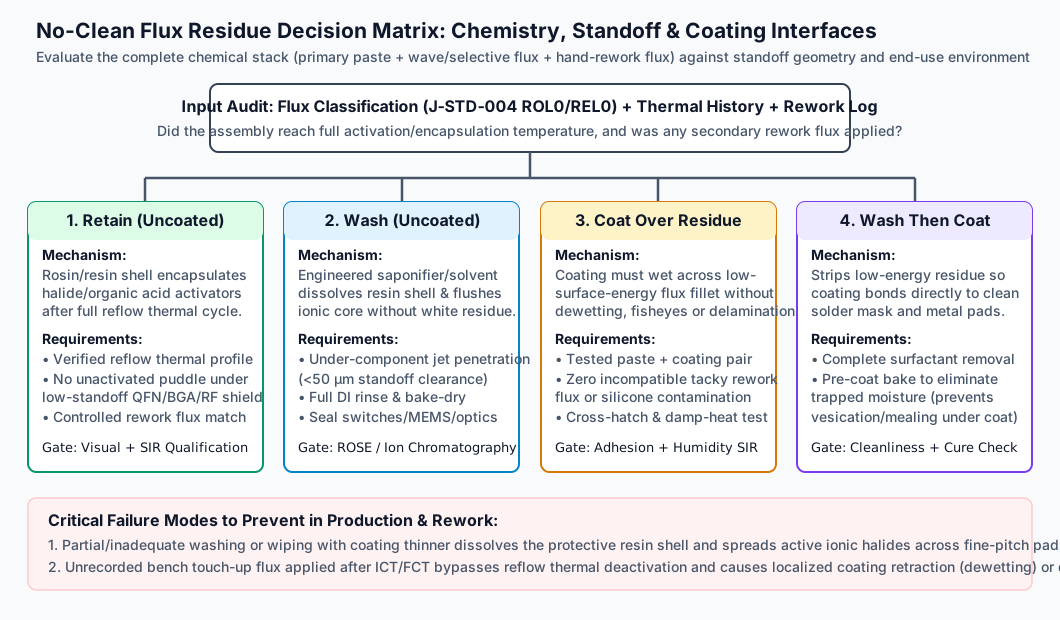
1. The Chemistry of No-Clean Flux: Why Thermal History and Product Scope Matter
Every flux must perform an aggressive chemical reaction during soldering—stripping metal oxides from copper pads and component terminations—and then become electrically benign once the joint cools. No-clean formulations achieve this balance only within their validated process window:
- SMT Solder Paste vs. Wave Flux vs. Rework Tacky Flux Are Not Interchangeable: A board assembled with a low-residue no-clean SMT solder paste frequently encounters secondary fluxes during through-hole wave/selective soldering or manual bench touch-up. For instance, Kester 951 is a low-solids, rosin-free no-clean liquid flux engineered specifically for wave soldering pallets where the entire board bottom passes over a preheater and molten solder wave. Conversely, Chemtronics CircuitWorks No-Clean Tacky Flux is formulated for localized hot-air or iron rework and leaves a translucent amber/clear protective film. Qualifying your primary SMT paste alone does not qualify the multi-flux chemical mixture left after wave soldering or manual rework.
- Why Unactivated Flux Is Dangerous: Weak organic acids (such as succinic, adipic, or glutaric acid) require sustained exposure to peak reflow temperatures (215--245°C) to thermally decompose or lock inside the cured resin matrix. If liquid flux flows under a cold component body or shielding can that never reaches activation temperature, hygroscopic acid activators remain free to absorb atmospheric moisture and form conductive ionic paths under DC bias.
2. Comparing the Four Engineering Process Routes
Selecting whether to leave no-clean residue as-is, wash the assembly, conformal coat directly over residue, or wash then coat requires matching the chemical stack to your product's electrical sensitivity, component standoff geometry, and environmental sealing requirements (05-flux-decision.csv):
| Process Route | Target Hardware & Environment | Interfacial & Chemical Mechanism | Required Verification Evidence | Critical Failure Mode (Hold Trigger) |
|---|---|---|---|---|
| 1. Retain Residue (Uncoated) | Standard industrial/commercial enclosures; normal component standoff; no conformal coating | Polymerized rosin/resin matrix locks up ionic activators and repels ambient humidity | Flux TDS (ROL0/REL0); verified reflow profile; SIR/IC qualification on high-impedance nodes |
Unactivated flux trapped under low-standoff QFN/RF shields, or unapproved bench rework flux added |
| 2. Wash No-Clean Residue (Uncoated) | High-frequency RF/mmWave, pA/nA high-impedance sensor front-ends, high-voltage creepage, or optical/cosmetic boards | Engineered saponifier or co-solvent dissolves cross-linked resin shell and flushes ionic core completely | Wash chemistry compatibility with specific resin; under-component penetration check (<50 μm gap); post-wash ROSE/IC/SIR | Partial washing: weak wash dissolves outer resin shell and spreads active ionic core as conductive white residue |
| 3. Conformal Coat Over Residue | Harsh automotive/industrial environments requiring coating without aqueous wash equipment | Coating polymer must wet across low-surface-energy flux residue without dewetting or osmotic blistering (Indium coating study) | Cross-vendor compatibility test (exact paste + rework flux + coating type); cross-hatch adhesion; damp-heat SIR | Coating retracts ("fisheyes" / dewetting) over solder fillets or blisters during temperature-humidity cycling |
| 4. Wash, Bake-Dry, Then Coat | High-reliability aerospace, medical, defense, EV traction, or potted outdoor assemblies | Stripping low-energy flux exposes high-surface-energy solder mask and metal for direct polymer bonding | Validated wash + DI rinse (>10 MΩ·cm) + pre-coat dehydration bake + coating thickness/adhesion check | Trapped rinse moisture or surfactant under QFN/BGA causes coating vesication (mealing) during cure |
3. Three High-Risk Scenarios Where "No-Clean" Requires Special Engineering Control
Scenario A: Low-Standoff Packages (QFN, LGA, DFN, Fine-Pitch BGA, RF Shields)
Modern bottom-terminated components (BTCs) such as QFNs, LGAs, and 0201/01005 passives sit only 25--50 μm (1--2 mil) above the PCB surface. During reflow, outgassing flux volatiles cannot easily escape from beneath a large QFN thermal pad or an unvented metal RF shield can, condensing as soft, unpolymerized flux pools bridging between the ground paddle and perimeter signal pins.
- If Retaining Residue: Use windowpane stencil segmentation (50--70% area) on thermal pads to reduce total flux volume and provide outgassing channels.
- If Washing: Water alone cannot wash a no-clean resin, nor can low-pressure spray penetrate a 35 μm gap. Specify an engineered aqueous saponifier or vapor-phase/co-solvent system with validated under-component impingement pressure, followed by destructive pry-off inspection during NPI to confirm zero trapped wash chemistry or white saponifier salts underneath the QFN body.
Scenario B: The Conformal Coating Interface (Surface Energy &Dewetting)
Applying acrylic, polyurethane, silicone, or parylene conformal coating directly over no-clean flux residue introduces a classic surface-energy mismatch. As explained in Chemtronics' analysis of conformal coating defects and Indium's coating compatibility guidance:
- Liquid conformal coating will only wet smoothly across a surface if the surface energy of the substrate (γS) is higher than the surface tension of the liquid coating (γL).
- Many cured no-clean rosin/resin fillets—especially those modified with plasticizers or exposed to silicone mould-release agents—have a much lower surface energy than bare LPI solder mask. When sprayed, the liquid coating pulls back from the solder fillet (dewetting / fisheyes), leaving the sharp metal component leads completely uncoated.
- Even if the coating initially bridges over a thick no-clean residue pocket, subsequent thermal cycling or damp heat (85°C / 85% RH) draws water vapor through the semi-permeable coating into the hygroscopic flux residue underneath, creating osmotic blisters (mealing) that lift the coating off the PCB.
Scenario C: Hand-Solder Touch-Up and Spot-Cleaning Mistakes
The single most frequent cause of field corrosion and coating delamination on "no-clean" boards is uncontrolled bench rework. Consider an assembly whose primary SMT paste was fully qualified for Route 3 (coat over residue):
- After ICT/AOI, a technician touches up a connector or replaces a QFP using a cored wire solder or a syringe of tacky rework flux from a different vendor.
- Because a manual soldering iron heats only the single pin for 3--5 seconds, excess flux flows onto adjacent cold solder mask without ever experiencing full reflow thermal deactivation.
- Even worse, if the operator wipes the sticky spot with a cotton swab dipped in ordinary isopropyl alcohol (IPA) or conformal coating thinner (Chemtronics coating defect warning), the solvent partially dissolves the resin matrix and smears a thin, invisible layer of active ionic halides across the surrounding fine-pitch pads—causing immediate coating retraction or dendritic shorting in humid service.
Engineering Rule for Rework: Lock the permitted rework flux in the assembly BOM alongside the primary solder paste (see our solder paste selection guide). If localized spot-cleaning is performed after rework, use a matched flux remover explicitly validated for that flux chemistry, blot/flush away the dissolved residue completely rather than smearing it, and re-verify cleanliness before conformal coating.
4. Evaluating Supplier Quotes and Specifying Cleanliness in Your PCBA RFQ
When comparing PCBA quotations from two contract manufacturers, a lower unit price often assumes Route 1 (unwashed, uncoated no-clean) with zero ionic cleanliness testing, whereas a higher quote includes inline aqueous saponifier washing, DI water rinse monitoring, pre-coat baking, and lot-level cleanliness certification. Normalize the process scope in your PCB assembly RFQ by specifying:
- Selected Residue & Coating Route: State explicitly whether the build is No-Clean Retained (Uncoated), No-Clean Washed (Uncoated), Conformal Coated Over Qualified No-Clean, or Washed + Baked + Conformal Coated.
- Locked Flux & Paste Chemistry: Require the assembler to declare the exact SMT solder paste, wave/selective liquid flux, and rework flux/wire part numbers (and J-STD-004 classifications) before first-article build, prohibiting unapproved substitutions.
- Cleanliness & Interface Verification Gate: Where washing or high-reliability qualification applies, specify the acceptance standard and test method—such as ionic contamination ≤ 1.56 μg/cm2 NaCl equivalent via ROSE (IPC-TM-650 2.3.25), Ion Chromatography (2.3.28) for specific weak organic acids/halides, or SIR (2.6.3.7)—plus cross-hatch adhesion testing (IPC-TM-650 2.4.1) for coated boards.
- Downloadable Decision Matrix: Attach 05-flux-decision.csv to align design, quality, and manufacturing engineers on the exact verification gate for your assembly.
HILPCB's PCB assembly and SMT assembly operations maintain strict BOM-locked solder paste and rework-flux controls, multi-zone reflow profiling, automated wash/rinse/dry lines for cleaned assemblies, and ionic contamination verification (held ≤ 1.56 μg/cm2 NaCl equivalent on qualified builds). Upload your Gerber, BOM, and coating/cleanliness specifications when you request a quote so our process engineers can lock the right flux and validation route for your hardware.
Frequently Asked Questions
Why is it often harder to wash off "no-clean" flux residue than water-soluble flux?
Water-soluble (OA) fluxes are chemically designed to dissolve rapidly in plain deionized (DI) water, and must be washed immediately because their residues are highly corrosive. No-clean (ROL0/REL0) fluxes are formulated with hydrophobic rosins and synthetic resins designed to resist moisture in service; washing them requires heated chemical saponifiers or engineered co-solvents capable of breaking down the polymerized resin shell without leaving insoluble white metal-soap precipitates.
Is wiping no-clean flux residue with a brush and 99% IPA sufficient before conformal coating?
Often no—especially on modern synthetic no-clean pastes and tacky rework fluxes. Room-temperature manual wiping with IPA frequently dissolves only the outer resin surface and smears a thin, tacky film across the surrounding solder mask and pads, which reduces surface energy and triggers conformal coating dewetting or mealing. Always use a validated wash process or a flux remover matched to the specific flux TDS, followed by complete removal/rinsing of the dissolved soils.
What causes white powdery or crystalline residue after cleaning a no-clean PCBA?
White residue typically indicates incomplete saponification or premature rinsing: either the wash chemical concentration/temperature was too low to fully dissolve the polymerized rosin/resin, the flux was over-oxidized by an excessive reflow profile, or the dissolved resin precipitated back out of solution when hit by cold DI rinse water.
When is leaving no-clean flux residue unwashed the better engineering choice?
When your assembly operates in a controlled environment without conformal coating, uses components that cannot tolerate aqueous immersion or ultrasonic washing (such as unsealed MEMS microphones, Buzzers, relays, optical sensors, or batteries), and uses a locked ROL0 paste + reflow profile with verified SIR performance, retaining the intact no-clean residue avoids the risk of trapping wash water or partially dissolved ionic residues underneath low-standoff packages.