
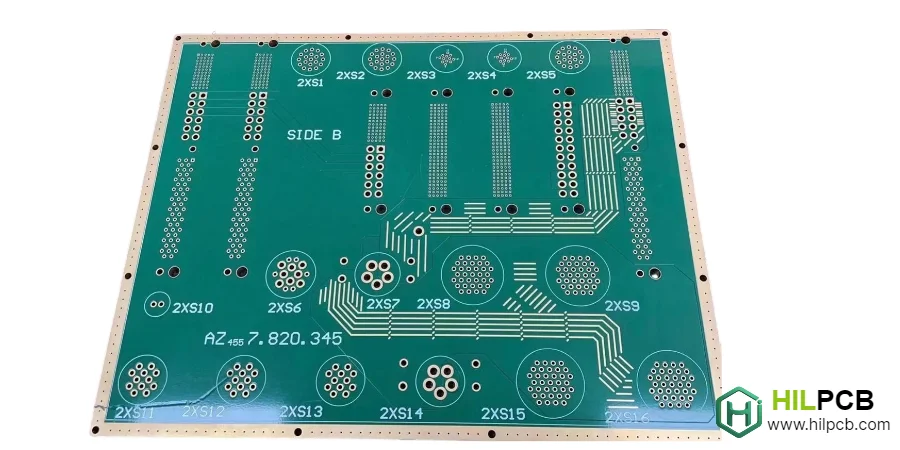
The soundboard defines an acoustic piano's voice—transforming string vibrations into the rich, complex sound that pianists treasure. Soundboard Keyboard PCB design implements sophisticated modeling algorithms that simulate string resonance, soundboard response, and room acoustics in real-time, requiring high-performance DSP systems with demanding fabrication requirements.
HILPCB provides professional PCB fabrication and PCBA assembly services for DSP-intensive music products, including the high-speed interfaces and thermal management these systems demand.
Menu Navigation
- DSP System Architecture and Fabrication
- Physical Modeling Circuit Implementation
- Audio Output System Requirements
- System Integration and Thermal Management
- High-Speed PCB Manufacturing for DSP Systems
DSP System Architecture and Fabrication
Acoustic modeling demands substantial processing power with strict real-time constraints. DSP boards require high-speed memory interfaces, controlled impedance routing, and proper power delivery—fabrication quality directly impacts system stability and performance.
Complex DSP systems require advanced fabrication capabilities and careful attention to signal integrity.
DSP Fabrication Requirements
- High-Speed Memory Interfaces: DDR3/DDR4 routing with matched trace lengths (±25mil tolerance), controlled impedance (50Ω single-ended, 100Ω differential), and proper termination.
- Multi-Layer Stack-Up: 6-8 layer construction with dedicated power and ground planes for adequate decoupling and signal return paths.
- BGA Breakout Routing: Fine-pitch DSP and memory packages requiring dog-bone or via-in-pad breakout strategies with appropriate via sizes.
- Clock Distribution: Low-jitter clock routing with controlled impedance, adequate ground reference, and isolation from noisy digital signals.
- Power Delivery: Multiple voltage rails (1.0V core, 1.8V I/O, 3.3V peripherals) with proper plane allocation and decoupling strategy.
- Thermal Via Arrays: Dense via patterns under power components for heat transfer to inner layers or bottom-side cooling.
Manufacturing for DSP Performance
DSP boards require tight impedance control (±10% tolerance) and consistent dielectric properties for reliable high-speed operation. Multi-layer fabrication maintains these specifications across production runs.
Physical Modeling Circuit Implementation
Physical modeling mathematically simulates acoustic instrument behavior through digital waveguide synthesis, modal soundboard modeling, and sympathetic resonance algorithms. These computationally intensive algorithms require high memory bandwidth and low-latency audio paths.
PCB quality affects both processing reliability and audio output quality.
Modeling System Elements
- Digital Waveguide Circuits: Delay line memory interfaces for efficient string simulation, requiring high-bandwidth SRAM or SDRAM access with low latency.
- DSP Processor Selection: SHARC, Blackfin, or ARM Cortex-A platforms with appropriate package footprints and power requirements.
- Memory Bandwidth: Sample RAM (2-4GB typical) with adequate data bus width and clock rate for real-time streaming.
- Coefficient Storage: Flash memory for filter coefficients, convolution kernels, and configuration data with appropriate interface routing.
- Audio Codec Connection: I2S interface to high-quality DAC with proper clock distribution and ground isolation.
- Control Interface: SPI or I2C connections to main keyboard system for parameter control and keybed data.
Assembly for High-Speed Systems
DSP boards often feature fine-pitch BGA packages requiring X-ray inspection for hidden solder joints. Proper reflow profiles for mixed thermal mass assemblies ensure reliable connections.
Audio Output System Requirements
Modeling quality must translate to audible results through proper audio output implementation. DAC performance, analog stage quality, and output drive capability determine whether sophisticated algorithms produce professional audio.
Audio output stages require clean power, proper grounding, and thorough post-assembly cleaning.
Audio Output Elements
- High-Resolution DAC Interface: 24-bit/96kHz+ converters (AK4493, ES9038PRO) with proper I2S routing, power supply isolation, and reference voltage stability.
- Multi-Channel Capability: Separate DAC outputs for stereo main, assignable outputs, and headphone with independent routing.
- Analog Output Stages: Premium op-amps (OPA1612, AD797) in I-V conversion and buffering maintaining DAC performance through output connectors.
- Headphone Optimization: Dedicated amplifiers with adequate drive capability for various headphone impedances.
- Ground Isolation: Careful analog/digital domain separation with single-point connection minimizing noise coupling.
- Power Supply Filtering: Multi-stage filtering and separate regulators for DAC and analog stages achieving >100dB SNR.
Audio-Grade Assembly Practices
Audio output boards require thorough cleaning to remove flux residues, careful handling of precision audio components, and proper ESD protection throughout assembly.
System Integration and Thermal Management
DSP-based modeling systems generate significant heat requiring proper thermal design. Sustained operation for extended performances depends on adequate heat dissipation—thermal issues cause processing throttling, audio artifacts, and reliability problems.
PCB thermal design and assembly quality affect long-term reliability.
Integration and Thermal Elements
- Keybed Interface: High-speed connection to main keyboard system receiving velocity, aftertouch, and release velocity data with proper signal integrity.
- Pedal Data Connection: Continuous pedal position data for half-pedaling and expression control with appropriate ADC interfaces.
- User Interface Connection: Parameter adjustment interface for resonance depth, room character, and modeling options.
- Thermal Via Design: Dense via arrays under DSP and power components transferring heat to inner planes or heatsink mounting surfaces.
- Component Placement: Hot components positioned for adequate airflow and thermal spreading, avoiding heat transfer to temperature-sensitive audio circuits.
- Heatsink Mounting: Proper provisions for heatsink attachment including thermal via arrays, mounting holes, and appropriate surface finish.
Manufacturing for Thermal Performance
Proper thermal via design and copper plane connection ensure heat transfer as intended. Assembly includes thermal interface material application when specified for heatsink-mounted components.
High-Speed PCB Manufacturing for DSP Systems
Piano modeling DSP boards push PCB fabrication limits with high-speed memory interfaces, fine-pitch BGA packages, and demanding thermal requirements. HILPCB provides the advanced capabilities these systems demand.
Why Choose HILPCB for DSP Piano Boards
DDR Memory Interface Expertise
Our multilayer PCB production achieves the tight length matching (±25mil) and impedance control (±5%) that DDR3/DDR4 interfaces require. TDR-verified coupons confirm impedance accuracy before your DSP boards ship.
Fine-Pitch BGA Assembly
SHARC and high-performance ARM processors often use 0.8mm or 0.65mm pitch BGA packages. Our SMT assembly with X-ray inspection verifies hidden solder balls—catching voiding and shorts before power-on.
Sequential Lamination for HDI
When routing density demands it, HDI PCB with stacked microvias enables via-in-pad under fine-pitch memory and DSP packages. Sequential lamination with process control ensures reliable microvia connections.
Thermal Management Integration
Dense via arrays under DSP packages transfer heat to internal planes or heatsink interfaces. We verify thermal via fill and plating continuity ensuring the heat paths your thermal engineer designed actually work.
Combined Audio + Digital Quality
DSP piano boards combine high-speed digital with audio-grade analog sections. Our fabrication and assembly processes address both requirements—maintaining signal integrity on DDR buses while achieving low noise floors on audio outputs.
Engineering Support
- DFM review for high-speed routing and thermal design
- Stack-up consultation for impedance and layer allocation
- Assembly optimization for mixed thermal mass components
Small batch assembly validates your DSP design before production commitment. Turnkey assembly handles component sourcing including allocation-constrained DSP chips.
Submit your DSP board files for high-speed manufacturing feasibility review.
Common Questions
Why is a soundboard keyboard PCB harder to build than a typical controller board?
Because it often combines high-speed DSP or memory interfaces with low-noise audio sections on the same design. That means fabrication and assembly have to protect both signal integrity and analog performance at the same time.
Why do BGA quality, HDI structure, and thermal design matter on DSP keyboard boards?
Fine-pitch DSP packages can hide solder issues, HDI features may be required to route dense devices, and thermal paths affect long-term stability under sustained processing load. If any one of those areas is weak, the board may pass initial bring-up but fail later in use.
What should be validated before releasing a soundboard keyboard PCB to production?
Teams should validate high-speed interface behavior, hidden-joint assembly quality, thermal path effectiveness, and audio-plus-digital coexistence before release. Production is more predictable when the board is reviewed as a DSP system rather than only as a generic audio PCB.