
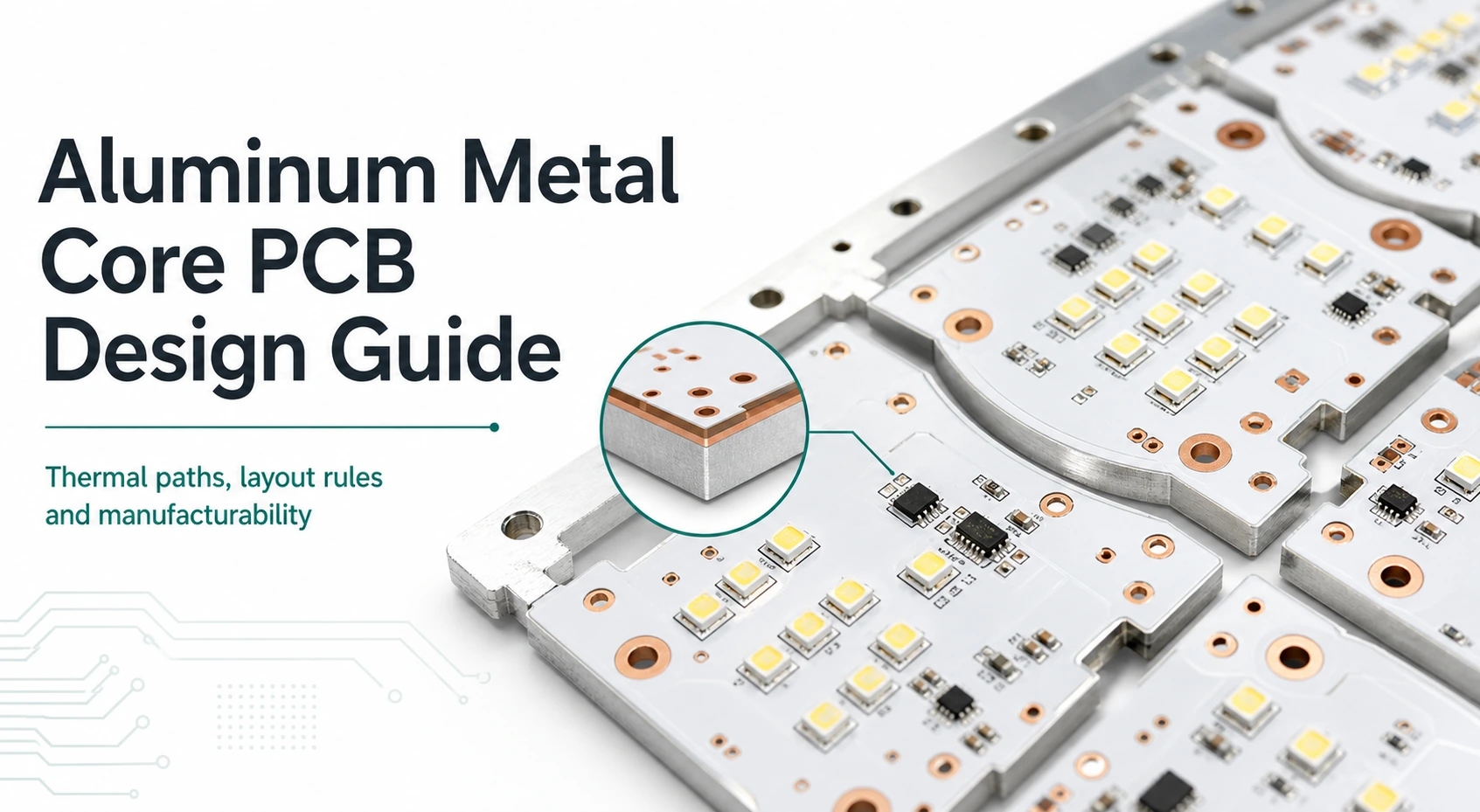
- Treat aluminum PCB selection as a board-platform decision, not as a material shortcut. The real review is deciding whether the product needs a metal-base heat path, what isolation layer it depends on, and how assembly will be validated.
- Separate naming before release.
Aluminum PCBusually points to one common metal-core route, whilemetal core PCB,MCPCB, andIMScan cover a broader platform family with different base and dielectric assumptions. - Do not move to metal core only because the design runs hot. Some boards should stay on FR-4 or move toward heavy copper if current spreading, interconnect density, or stackup flexibility matters more than a metal base.
- Keep ceramic in scope as a separate thermal platform, not as a premium version of MCPCB. Ceramic enters when the isolation, substrate family, and package interaction need a different route than IMS.
- Assembly is part of the decision. Reflow planning for MCPCB is paste-specific only, depends on board thermal mass, and needs explicit profiling ownership rather than a borrowed universal profile.
- The release package should hand off one validation question: why this thermal platform was chosen, how the first build will be profiled and inspected, and what must be confirmed before the next revision freeze.
An aluminum PCB or metal core PCB review is a thermal-platform selection check. It decides whether the board should use an insulated metal substrate, a heavy-copper or thermal FR-4 route, or a ceramic route based on heat path, dielectric isolation, assembly behavior, and the validation handoff needed before release.
In This Guide
- What Does an Aluminum or Metal-Core PCB Review Actually Decide?
- Why Does Aluminum PCB, MCPCB, and IMS Vocabulary Change the Review?
- How Do Heat Path, Dielectric Isolation, and Assembly Route Influence the Choice?
- When Should You Avoid Moving to a Metal Core PCB?
- How Should Validation Handoff Manage Prototype, Profiling, and Inspection Boundaries?
- What Should Be Included in an Aluminum/Metal Core PCB RFQ Checklist?
- FAQ
- Next Steps
What Does an Aluminum or Metal-Core PCB Review Actually Decide?
An aluminum PCB review is often framed too narrowly, as if the team were only choosing a board material with better heat handling. That framing is weak. Before release, the real decision is whether the product is entering a different board platform with its own heat path, isolation layer, assembly route, and validation burden.
That distinction matters because vocabulary around aluminum base PCB, aluminum board, aluminum circuit board, and metal core PCB mixes several different questions into one label. Some of those phrases describe the base metal. Some describe the full insulated structure. Some are really shorthand for a thermal-management objective. A release review has to separate those ideas before the board package is frozen.
At board level, the first question is not "is aluminum better?" The first question is what the board is supposed to do for the thermal path. If the platform needs heat to move vertically into a base structure while maintaining electrical separation, then MCPCB or IMS may be the right branch. If the board instead needs more lateral spreading, current-carrying cross-section, or ordinary multilayer freedom, then thermal-platform review may still resolve into heavy copper or an upgraded FR-4 route rather than a metal core.
The second question is what layer actually provides isolation. In IMS language, the dielectric is not a side note. It is the electrical separation layer that sits between circuit copper and the metal base, so it directly affects how the team thinks about heat path and assembly. A board cannot be approved as "aluminum PCB" if the release notes never clarify what insulation approach the design depends on.
The third question is whether the assembly route still fits the product architecture. MCPCB is not only a materials topic, and reflow is not only a process note. Public IMS material references and solder-paste guidance point in the same direction: once a board depends on a metal-base thermal platform, profiling, paste selection, inspection, and first-build interpretation become part of the release review rather than an afterthought (Ventec IMS family overview; Indium reflow note; Kester reflow profile note). That is why the project cannot treat the thermal platform decision as complete until assembly ownership is named.
The fourth question is what the prototype is meant to prove. A safe release does not promise finished-board thermal performance, junction outcomes, or field reliability. It states which platform branch the project has chosen and what first-build evidence is needed to confirm the branch is appropriate. That may be confirmation of the heat path, confirmation of assembly behavior, or confirmation that the isolation-and-base combination still supports the intended package layout.
In practical terms, an aluminum or metal-core PCB review is therefore approving one coherent platform route:
- what the board is using the base structure for
- how electrical isolation is being preserved
- what assembly method will carry the platform through first build
- how the prototype result will be interpreted at board level
If those items are still vague, the project does not yet have an aluminum PCB decision. It only has a thermal concern.
Decision Matrix: Early Rules for Thermal-Platform Selection
| Review area | What to decide | Why it matters | How to verify | If ignored |
|---|---|---|---|---|
| Thermal job of the board | Decide whether the board needs vertical transfer into a base, lateral spreading in copper, or a different substrate family | Different heat-path goals lead to different platform branches | Review the heat source locations, mounting concept, and what the board is expected to do in the thermal stack | Teams move to metal core before defining the actual thermal job |
| Platform naming | Decide whether the design is really aluminum PCB, broader MCPCB / IMS, heavy copper, ceramic, or thermal FR-4 | Naming determines which material and validation questions are relevant | Freeze platform vocabulary in the design review notes and quote package | Supplier and engineering teams discuss different board classes using the same shorthand |
| Dielectric isolation | Confirm what isolation layer separates circuit copper from the base or substrate | Isolation is central to both safety of the board structure and thermal-path interpretation | Review the intended insulated structure, not just the base metal name | Heat-path assumptions are made without a defined isolation model |
| Assembly route | Decide whether SMT, paste, profile, fixture, and inspection posture still fit the thermal platform | Metal-base boards change thermal mass and profiling behavior | Review the assembly package together with board platform selection | Reflow or soldering issues are discovered after the platform has already been frozen |
| Alternative route check | Ask whether heavy copper, thermal FR-4, or ceramic is the better branch for this board | Not every hot board should become MCPCB | Compare the real board burden: current path, density, stackup freedom, package interaction, and substrate needs | Metal core becomes a default instead of a justified choice |
| Prototype objective | Decide what the first build must confirm about the platform | Prototype evidence should answer a specific board-level question | State the first-build goal in release notes and pilot intake | The first build produces data that cannot clearly approve or reject the route |
Teams usually get more value from this table when they use it early, before quote comparison and before layout notes harden into assumptions. The point is not to score platforms. The point is to decide which branch the project is actually entering and what proof that branch requires.
Why Does Aluminum PCB, MCPCB, and IMS Vocabulary Change the Review?
The naming problem around this topic is not cosmetic. It changes what the release team thinks it is approving.
Aluminum PCB often describes the most familiar metal-core route: circuit copper on an insulated layer over an aluminum base. That phrase is useful when the design really is tied to that common route. It becomes misleading when the team uses it as a blanket synonym for every thermally managed board.
Metal core PCB and MCPCB are broader. They describe a metal-base thermal-management family rather than only one base-metal choice. That is why these terms are safer when the review still needs to distinguish among base options, dielectric direction, and assembly consequences. IMS, or insulated metal substrate, is more specific again: it calls attention to the insulated structure itself, which is usually the real engineering question.
That vocabulary hierarchy is useful because it prevents the project from collapsing platform class into board nickname:
- use
aluminum PCBwhen the platform is already clearly an aluminum-base insulated structure - use
MCPCBormetal core PCBwhen the review is still centered on the metal-base family rather than one base choice - use
IMSwhen the isolation layer and insulated stack are the main point of the conversation
It is equally important to keep adjacent platform lanes separate. Public material-family references already separate ceramic-substrate routes from IMS routes, so those names should not be treated as interchangeable shorthand in release notes (CeramTec ceramic substrates page; Ventec IMS family overview). A board that needs metal-core framing is not automatically a ceramic decision, and a ceramic discussion should not be rewritten as if it were only a higher-end aluminum PCB.
- `Aluminum board` language usually points to a common thermal route, not to the whole decision tree.
- `IMS` language is stronger when dielectric isolation is the deciding mechanism.
- `Ceramic` belongs to a separate substrate category and should enter only when that category is truly under review.
This naming discipline also protects the article from unsupported claims. If the review says only "aluminum board," teams are tempted to jump straight to promises about operating temperature, reliability, or speed of manufacture. A better naming posture keeps the discussion at board-platform level, where the real review questions are heat path, insulation, assembly, and validation ownership.
How Do Heat Path, Dielectric Isolation, and Assembly Route Influence the Choice?
Once the vocabulary is cleaned up, the platform decision becomes more specific. Three linked questions drive most of the review burden.
The first is the heat path. A metal-core route makes sense when the board needs a deliberate path from heat source through the insulated structure into a base that can couple to the rest of the mechanical system. That is different from a board whose main need is copper cross-section, local spreading, or thermal distribution across a more conventional stackup. The review should ask where the dominant heat leaves the component and what role the board is supposed to play after that.
The second is dielectric isolation. In IMS or MCPCB work, the insulation layer is not just an electrical requirement. It is part of the platform identity. A board may have an efficient mechanical heat path and still be the wrong route if the insulation assumptions are poorly defined, if package spacing and land pattern decisions do not match the structure, or if the release package describes the board only as "aluminum base" without saying what insulated construction the design depends on.
The third is assembly route. A boundary that is easy to miss is that MCPCB reflow guidance needs both material context and solder-paste-specific process guidance. That means a release review should not publish or inherit a universal reflow recipe for metal-core work. Reflow windows are paste-specific only, and the measured profile still depends on the board's thermal mass, component mix, and build objective (Indium reflow note; Indium8.9HF paste data sheet; Kester reflow profile note). The useful release question is therefore not "what profile does MCPCB use?" but "who owns the profile, what paste specification is in scope, and what does the first build need to confirm?"
These three questions also explain why validation handoff belongs inside the selection discussion. If the board is entering a metal-base route, the handoff should cover:
- the intended heat path through the board structure
- the insulation model the board depends on
- the assembly method and profile ownership
- the inspection boundary for the first build
This is where exact-product IMS material examples can be useful, but only within boundary. Ventec IMS cards can support material-scope only discussion of product families, especially when the article preserves the exact product context rather than turning it into a generic board-performance promise (Ventec VT-4B7 datasheet). They are not finished-board proof, and they do not authorize broad thermal promises, reliability guarantees, or a supplier-neutral ranking table. The same discipline applies to profile examples: paste data sheets and reflow notes can frame process planning, but they remain paste-specific only and are not universal process rules.
For projects still converging on that combined structure, the most honest public routing is usually to treat the work as a thermal-platform discussion rather than a finalized material decision. That is why many teams benefit from reviewing assembly expectations at the same time they compare board-platform routes.
When Should You Avoid Moving to a Metal Core PCB?
A useful aluminum PCB article has to say when the answer is no. Many thermal programs do not fail because they ignored metal core. They fail because they entered the wrong platform branch too early.
Stay with FR-4 when the product still needs ordinary multilayer freedom, conventional routing density, or signal and control integration that would become awkward on a metal-base branch. If the thermal issue is still local and the broader stackup is doing the real system work, the better route may be to keep the board in FR-4 and tighten the board-level thermal design review instead of changing the whole platform.
Stay with heavy copper when the board problem is primarily current distribution, copper cross-section, or lateral spreading rather than insulated transfer into a base. Heavy copper and MCPCB can live near the same application families, especially in power and energy hardware, but they solve different board burdens and should be reviewed as separate option families. The safe question is not "which is better?" It is "does this board mainly need a metal-base thermal route or a current-and-spreading route with more conventional stack freedom?"
Move toward ceramic when the project is no longer arguing about base metal at all. Ceramic belongs to a different substrate category, and it enters when package interaction, substrate family, or thermal-and-isolation behavior calls for that category rather than for IMS. This should not be written as a premium ranking over MCPCB. It is a route change. Once the project is in that category, the review vocabulary, material family, and validation burden all shift.
Thermal FR-4 belongs in the discussion for the same reason. Some programs need more thermal margin than baseline FR-4 but do not need a metal base or a ceramic substrate. In those cases the review should ask whether the problem can still be solved inside the conventional rigid-board branch before escalating to a metal-core route.
Decision Matrix: Alternative Route Handoffs
| Platform route | Enter this route when the board is mainly deciding... | What still needs review next |
|---|---|---|
| Thermal FR-4 | Whether an upgraded conventional stack can absorb the heat burden without changing the board family | Stackup discipline, copper distribution, and prototype intent |
| Heavy copper | Whether current path and lateral spreading dominate the design burden | Copper balance, assembly wetting posture, and control-board integration |
| MCPCB / IMS | Whether the board needs insulated transfer into a metal base | Isolation model, base-coupling concept, reflow profiling, and board-level inspection |
| Ceramic | Whether substrate family and package interaction have moved beyond the MCPCB category | Substrate choice, assembly boundary, and dedicated validation route |
This is not a ranking table. It is a branch-entry table. The review value comes from asking which board burden is dominant, then staying on that route long enough to validate it properly.
How Should Validation Handoff Manage Prototype, Profiling, and Inspection Boundaries?
Platform selection is incomplete until the release package says how the first build will be interpreted. That matters even more for aluminum PCB and MCPCB programs because board material, assembly behavior, and inspection can all move at once.
Start with prototype scope. A first build should confirm a board-level question, not every downstream thermal or product outcome. Good prototype questions include whether the chosen thermal platform still matches component placement, whether the insulated structure is being handed off clearly enough for fabrication and assembly review, and whether the chosen assembly route can be profiled and inspected without reopening the platform choice.
Next comes reflow-profile ownership. Public MCPCB assembly guidance already shows why both IMS material context and solder-paste-specific reflow guidance matter. In release terms, that means the notes should identify the paste family and profiling owner rather than imply that all MCPCBs share one default thermal profile (Ventec IMS family overview; Indium reflow note; Kester reflow profile note). If the profile must be measured on the first build, say so. If a pilot run is meant to establish the profile, say that instead. The weak version is leaving the profile unowned and assuming the board class itself answers the process question.
One physical failure pattern makes that boundary impossible to ignore. Teams often buy an aluminum-base board for a power LED or MOSFET because they want the assembly to run cooler, then send the build into SMT using a reflow profile borrowed from ordinary FR-4. That is exactly where the thermal platform turns against them. The metal base behaves like a massive heat sink, pulling energy out of the joint faster than the paste was profiled to tolerate. If soak time and peak energy are not compensated, the thermal pad under the device can freeze into cold joints or carry excessive voiding instead of a stable solder bond. The dark humor is that the board was purchased to improve heat removal, yet the voided pad becomes a thermal barrier and the powered device can still run into thermal runaway hours after power-up. That is why MCPCB review is not only about picking a board material. It is a forced recheck of thermal profiling, solder wetting, and the real molten state of the joint on that specific thermal platform.
Inspection boundaries come after that. Metal-base work often tempts teams to overload inspection with meaning it cannot safely carry. A safe handoff does not claim that visual or X-ray findings prove final thermal behavior. It defines what inspection is checking at board and assembly level: structure translation, soldering consistency, known high-mass areas, and whether the build supports the next validation step. That boundary is useful because it keeps inspection from being treated as a substitute for actual prototype interpretation.
For power, energy, inverter, and charger-adjacent boards, the same conservative posture still applies. Treat these programs as PCB and PCBA review problems: separate board family roles, keep thermal-platform choice project-dependent, and tie validation to DFM, DFT, inspection, and functional-test handoff rather than to unsupported performance promises.
The release package is strongest when it can answer four simple questions:
- What platform branch is this board on now?
- Who owns the first measured assembly profile?
- What is inspection expected to confirm on the first build?
- What result would force the team to reopen the platform choice?
If those answers are missing, the handoff is still too informal for a publish-ready decision guide and usually too informal for a stable prototype release as well.
The most common failure is choosing metal core because the board has a heat problem, without first defining what thermal job the board is supposed to perform. This leads to release packages that say "aluminum PCB" while leaving the actual heat path, coupling method, and isolation structure unresolved.
Another failure is treating aluminum PCB and MCPCB as if they answer the same question at every stage. Early concept work may be fine with broad thermal-platform language, but release work usually needs tighter naming. If the board is truly IMS-dependent, the insulated structure should be explicit. If the project is still comparing several thermal branches, the notes should say so rather than quietly collapse them into one term.
Assembly drift is a third repeated problem. Teams often recognize that metal-base boards will profile differently, but they still hand off reflow as though the board class itself supplies the recipe. Public reflow notes do not support that posture. Profile examples are paste-specific only. The board still needs measured profiling ownership and a clear first-build plan.
A fourth failure is forcing platform comparison into a ranking table. That usually produces unsupported writing such as "metal core is better than heavy copper" or "ceramic is best for thermal performance." The safer and more useful public posture is route selection: what board burden makes each platform worth entering, what has to be validated next, and where the boundary sits.
The fifth failure is using material examples as finished-board proof. Product-level IMS cards can be useful context, but they do not establish delivered thermal outcome, assembly reliability, or program capability by themselves (Ventec VT-4B7 datasheet). That same caution applies to borrowed reflow examples and to commercial routing language that was not written to carry an engineering decision by itself.
The final failure is an unfocused prototype objective. If the first build is expected to answer platform selection, solder-profile setup, inspection strategy, and end-product thermal outcome all at once, the review has not narrowed the question enough. Good platform reviews make the next question smaller, not larger.
What Should Be Included in an Aluminum/Metal Core PCB RFQ Checklist?
Before sending an RFQ for a metal core board, make sure the data package contains all the constraints necessary for quoting the correct material, base thickness, and isolation structure, instead of leaving it to supplier interpretation.
Fabrication Data
- Stackup and Dielectric Spec: Call out the exact dielectric material thickness (e.g.,
100 um,150 um) and the required thermal conductivity rating (e.g.,2 W/m-K,3 W/m-K) instead of just asking for "IMS". - Base Metal Definition: Specify the base material (e.g., Aluminum 5052, Aluminum 6061, or Copper base) and its required thickness.
- Surface Finish: Call out the required surface finish (e.g., HASL, ENIG, OSP) knowing that some thermal pads demand planar finishes for good solder paste deposition.
- Scoring and Routing: Aluminum routing wears out tools quickly. Define v-score depths, break-away tabs, and web thickness explicitly in the mechanical layer to prevent cracking or board damage during singulation.
Assembly Data
- Thermal Pad Masking: Provide clear solder mask definitions for thermal pads. Oversized mask openings can lead to solder starving on the pad.
- Paste and Stencil Intent: State whether the design assumes a specific paste alloy or step-stencil thickness for large power components sitting on the thermal base.
- Reflow Profiling Callouts: Clearly note if the assembly house needs to profile using thermocouples attached directly to the aluminum base to ensure the solder reaches peak temperature.
FAQ
Is aluminum PCB the same as metal core PCB?
Not always. Aluminum PCB usually points to one common metal-core route, while metal core PCB is the broader family term. A release review should use the broader term when the board is still deciding among metal-base assumptions, and should use the narrower aluminum term only when that route is actually frozen.
Is IMS the same thing as MCPCB?
They overlap, but the emphasis is different. MCPCB describes the metal-core platform family. IMS emphasizes the insulated metal substrate structure, which is often the more useful term when dielectric isolation is central to the decision.
When should a hot board stay with heavy copper instead of moving to MCPCB?
Stay with heavy copper when the main burden is current path and lateral spreading rather than insulated transfer into a base. That keeps the decision tied to the board's real problem instead of treating metal core as the default answer to any thermal concern.
Do IMS datasheet values prove finished-board thermal performance?
No. Exact-product IMS cards are material-scope only. They can help describe the material family being considered, but they do not prove delivered board thermal outcome, reliability, or suitability for every assembly route (for example, see the Ventec VT-4B7 datasheet in the sources below).
Is there a universal reflow profile for aluminum PCB or MCPCB assembly?
No. Publicly safe guidance is narrower than that. Reflow guidance is paste-specific only and still depends on board thermal mass, component mix, and measured profiling on the actual build route.
Does moving to metal core remove the need for board-level validation?
No. It usually increases the need to define prototype scope, profile ownership, and inspection boundaries because the platform choice affects both structure and assembly.
Next Steps
If the current program is already hitting a thermal wall, still undecided between heavy copper and an aluminum base, or carrying concern about MCPCB voiding and hi-pot margin during SMT, this is the point to stop treating material choice and assembly behavior as separate decisions. On metal-core builds, they usually fail together.
Send the Gerber package, BOM, thermal dissipation targets, and dielectric withstand requirements to [email protected], or upload the data through the Quote page. HILPCB's thermal-management and DFM engineering team will return review feedback within 24 hours. That review is meant to close the real pre-build risks: whether the dielectric thermal conductivity is adequate, where panel and routing geometry threaten voltage margin, and which fabrication plus SMT route actually matches the board before prototype money is burned.
Sources
- CeramTec: Ceramic substrates overview
Supports the article's separation between ceramic-substrate routes and IMS or MCPCB routes. - Ventec: tec-thermal thermal management IMS family overview
Supports the use of IMS as a metal-base thermal-management family and the article's platform-selection framing. - Ventec: VT-4B7 IMS datasheet
Supports the warning that exact-product IMS cards are material-scope examples, not finished-board thermal proof. - Indium: Matching a reflow profile to a solder paste spec
Supports the article's rule that reflow profiling must stay paste-specific and measured on the actual build route. - Indium: Indium8.9HF solder paste product data sheet
Supports the point that profile windows belong to named paste data, not to a universal MCPCB recipe. - Kester: Standard reflow profile note
Supports the same process boundary: profile guidance is process documentation, not a universal board-class rule.