
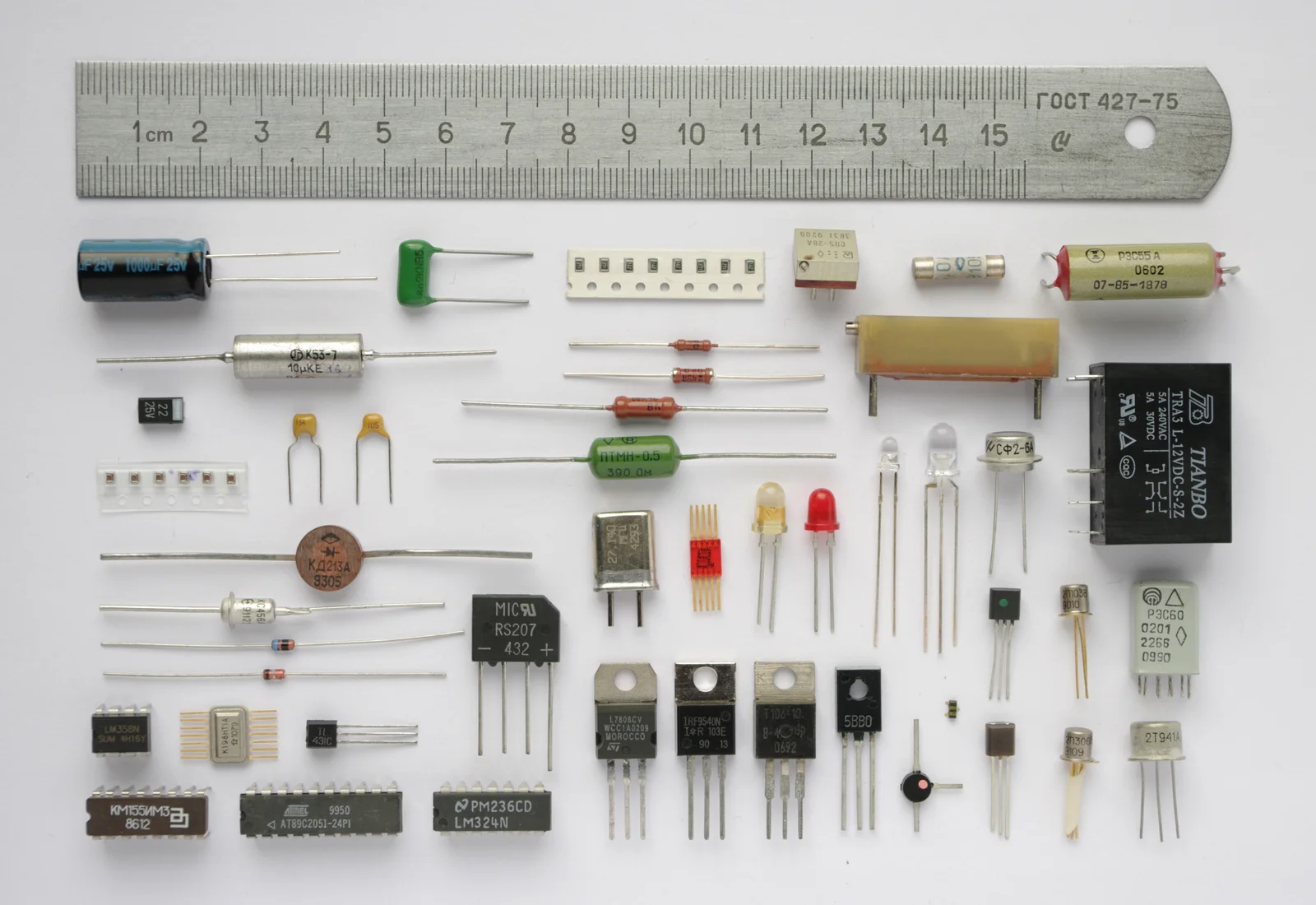
A manufacturer’s end-of-life notice is a product decision, not just a purchasing alert. The team must determine which exact orderable component is affected, where it is used, how long it is needed and whether the best response is to buy remaining supply, qualify an alternate, change the design, retire the product or combine those actions.
Start by assigning a decision owner and working backward from the notice deadlines. Do not release a purchase quantity or change a BOM until the relevant engineering, supply, quality and business owners have reviewed the assumptions.
The output should be a dated response record: a decision for each affected product, supported by verified notice terms, time-phased demand, usable supply, qualification plans, allocation rules and named approvals.
Choose a response path before committing
The following matrix helps frame the decision. More than one path may apply to the same MPN across different products.
| Path | Consider when | Main exposure to resolve | Decision evidence |
|---|---|---|---|
| No further action | All affected demand has ended, including service obligations | Forgotten spares, customer commitments or residual builds | Confirmed retirement and demand closure |
| Last-time buy | Demand will continue and the notice permits orders within a defined window | Forecast error, cash, storage, authenticity and supplier acceptance | Dated demand and supply plan, notice terms and approvals |
| Already approved alternate | A product-specific approval exists and supply is available in time | Approval may cover a different BOM revision, site or customer | Current approved BOM and change-control records |
| Qualify a new alternate | A candidate can meet requirements before the affected supply runs short | Testing, customer approval and schedule may take longer than expected | Qualification plan, milestones and interim supply |
| Redesign | No suitable alternate exists, or the product needs a longer-term solution | Engineering, regulatory, tooling and customer-change impacts | Feasibility assessment, schedule and cost approval |
| Retire the product | Future support or redesign is not justified or feasible | Contractual, service and customer-notification obligations | Approved retirement and support plan |
| Combine paths | A bridge buy is needed while an alternate, redesign or retirement is completed | Overbuying if milestones move; shortages if they slip | Linked quantities, milestones and review triggers |
A last-time buy can be a bridge rather than a lifetime solution. Conversely, a proposed alternate is not a solution until it has been approved for the affected product and is available when needed.
Verify the notice and the exact orderable part
Preserve the manufacturer notice as a controlled record. Capture its issuer, publication date, revision, affected full manufacturer part numbers, stated conditions, last-order date and last-delivery date. Record the dates’ interpretation, including any cutoff time or time zone supplied.
Compare the notice with the BOM’s complete MPN—not just the device family or base number. Package, finish, temperature grade, packing format and order suffix can determine whether a particular orderable item is affected. The BOM procurement checking guide explains MPN matching and lifecycle triage. Check whether the notice lists replacements or exceptions, but treat them as inputs to qualification rather than automatic approvals.
Verify the current status with the manufacturer or an authorized channel. If an ERP tool, distributor listing or web-stock result conflicts with the formal notice, document the discrepancy and resolve it before making the decision. A stock listing does not establish that a new manufacturer order will be accepted, or that the listed material is available for your program.
NRND, LTB and obsolete are not interchangeable
Manufacturers define and use lifecycle terms in their own ways:
- NRND, or not recommended for new designs, generally warns against selecting a part for new work. It does not necessarily mean manufacture has already stopped.
- LTB, or last-time buy, generally identifies a discontinuance process with an opportunity to place final orders under stated terms. The applicable notice controls the dates and conditions.
- Obsolete generally signals that normal manufacture has ended. It does not mean every unit has disappeared from inventory, nor does visible inventory establish an acceptable source.
For example, Texas Instruments’ product life cycle guidance distinguishes NRND, last-time buy and obsolete; TI describes obsolete products as no longer manufactured. That is an example of TI’s definitions, not a substitute for the notice governing another manufacturer’s part.
Check any longevity commitment for the exact participating part, applicable terms, and current status. The end of a stated commitment alone does not establish that a part has been discontinued; check the applicable manufacturer notice.
Out-of-stock is also different from any of these lifecycle labels. It describes a particular availability situation, not necessarily the manufacturer’s production status.
Map the MPN to products and obligations
Search approved records for every use of the exact affected MPN. Include:
- BOM and assembly revisions, production sites and approved manufacturer lists.
- Customers, programs and contractual change-notification requirements.
- Scheduled production, prototypes, field repairs, warranty, service spares and other support obligations.
- Regulatory, safety or qualification baselines that a change may affect.
- Existing approved alternates, including the revisions, customers and sites for which each approval applies.
The same MPN may have different decisions in different assemblies. One product may be near retirement, another may need a service-only buy, and a third may justify a redesign. Keep their demand and approvals separate even if procurement later places a consolidated order.
Establish usable supply, not just ERP balance
Reconcile physical and recorded inventory by owner and location. For each lot, capture quantity, lot and date code, storage and shelf-life conditions, inspection or test status, and traceability to its source. Identify material reserved for other programs and material subject to hold, customer ownership or disposition.
Then separate:
- Usable, unallocated stock that the affected product can actually consume.
- Reserved stock already assigned to this product or another obligation.
- Confirmed applicable inbound supply, with quantity and expected delivery date.
- Unconfirmed orders or inquiries, which should not be treated as available supply.
Avoid counting the same material twice as both stock and inbound. Check that each lot remains acceptable through its planned consumption date. A confirmed inbound order is useful planning evidence, but it is not a guarantee of delivery or acceptance for every product.
For moisture-sensitive devices, include the applicable packaging and exposure history in that assessment. The MSL handling guide covers receiving, storage and floor-life records for those devices.
If the team considers material outside its normal verified channels, evaluate counterfeit, source and traceability risks explicitly; a low apparent price or available quantity is not proof of authenticity.
Build a time-phased demand and supply plan
Choose a documented planning window based on the affected product’s obligations and the earliest credible availability of a qualified replacement, redesign or retirement. There is no universal horizon or safety multiplier.
For each period, estimate production and service demand in component units. State the basis for yield, scrap, repair consumption and uncertainty allowances, and avoid counting the same loss twice. Compare those needs with usable stock and inbound supply by the dates they can actually be consumed.
For the selected period, a planning worksheet can express the signed aggregate net gap as:
Signed aggregate net gap = approved demand + documented loss and uncertainty allowance − verified usable stock − confirmed applicable inbound supply
Each term needs a source and a consistent time window; avoid double counting, including overlap between demand and allowance or between stock and inbound supply. A negative figure represents an aggregate surplus under the stated assumptions; a positive figure is a gap to assess. For the stated demand, allowance, MPN, and plan, assuming no supply beyond listed stock and inbound, max(0, net gap) is the theoretical minimum aggregate number of additional units of that MPN needed to satisfy total need, not necessarily an order quantity or a guarantee of timely supply. A purchase and delivery plan requires demand dates, allocatable and acceptable supply, supplier minimum order quantities, cutoff and delivery terms, and appropriate approvals. Check the detailed build and service schedule for earlier shortages, expiry or stranded stock.
Fictional calculation: a one-year bridge
Assume a notice is received on January 8, 2027, for one exact MPN. For illustration only, its stated last-order date is April 15, 2027, and its last-delivery date is September 30, 2027. The team is planning needs from January 8 through December 31, 2027. No alternate is assumed qualified during that window.
All figures below are component units:
| Planning period | Production | Service | Documented loss/uncertainty allowance | Total need |
|---|---|---|---|---|
| Jan. 8–June 30 | 500 | 80 | 30 | 610 |
| July 1–Dec. 31 | 400 | 120 | 20 | 540 |
| Total | 900 | 200 | 50 | 1,150 |
The team has 240 usable units assigned to this program available initially and 160 applicable inbound units assumed to arrive on May 1. The two quantities do not overlap, and the relevant lots are assumed acceptable through their planned use. No other supply is available in the window.
The aggregate planning gap is:
1,150 − 240 − 160 = 750 units
Add a fictional timing assumption: of the 610 units needed in the first period, 300 are needed before May 1 and the other 310 are needed from May 1 through June 30. These needs include the applicable production, service and allowance quantities already counted above.
| Need period | Total need | Available supply applied | Gap |
|---|---|---|---|
| Jan. 8–April 30 | 300 | 240 initially available | 60 |
| May 1–June 30 | 310 | 160 inbound on May 1 | 150 |
| July 1–Dec. 31 | 540 | None remaining | 540 |
| Total | 1,150 | 400 | 750 |
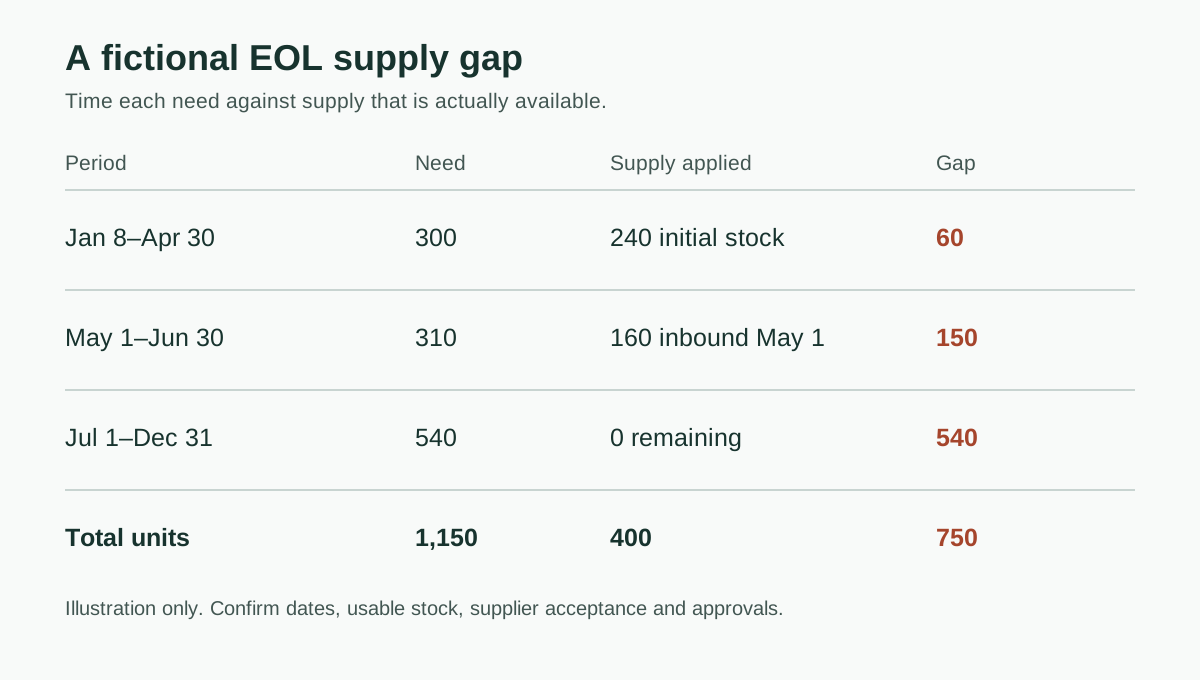
The figures are hypothetical component units, not a purchase recommendation.
The first-period gap is 60 + 150 = 210 units; the second-period gap is 540 units. Without additional supply, those gaps remain shortages.
The actual date of each need and the timing of accepted deliveries still matter. The 60-unit gap arises before May 1, so supply arriving on May 1 cannot cover it in time. The later gaps also need supply by the relevant consumption dates. Any proposed order and delivery schedule must fit the fictional notice terms and be accepted by the supplier; the half-year totals alone do not establish build continuity.
The 50-unit allowance is an example assumption, not a recommended factor. This illustrative calculation is not a real purchase, commitment or authorization. The 750-unit result is not a recommended order for another product or a guarantee of order acceptance, delivery, authenticity, storage life or future demand.
Qualify changes at the product level
For a candidate alternate, compare the full orderable MPN and package against the approved design. Review electrical limits and operating conditions, thermal behavior, footprint and mechanical fit, firmware or configuration effects, manufacturing process, test coverage and reliability as applicable.
Parametric similarity alone does not establish interchangeability. Record the tests, acceptance criteria, samples, responsible owners and approval milestones. Determine whether regulatory review or customer notification and approval are required before release. The component substitution approval guide covers the detailed approval workflow.
A redesign needs similar control, with additional attention to schematic and PCB changes, tooling, verification, documentation, production transition and field support. The engineering change order checklist addresses the approved baseline, effectivity and supplier acknowledgement. Link the redesign schedule to the supply plan: a delay can increase bridge demand, while an early release can leave excess EOL stock.
For retirement, obtain an approved end-of-production and support plan. A product is not demand-free merely because new production stops; service and contractual obligations may remain.
Release a dated decision with named owners
The decision record should identify the chosen path for each affected product and revision, the alternatives rejected and why, quantities and assumptions, notice deadlines, qualification milestones, supply allocations and review dates. Attach the notice, demand and inventory evidence, change records and approval history.
Assign people—not only departments—to approve each part of the response. For example, a fictional project could use the following ownership:
| Named owner | Approval or responsibility |
|---|---|
| Maya Chen, product manager | Product path, customer commitments and retirement or support plan |
| Luis Ortega, design engineering lead | Technical assessment and alternate or redesign qualification |
| Priya Shah, supply planning lead | Demand assumptions, usable-supply reconciliation and allocation plan |
| Ben Carter, procurement lead | Notice terms, supplier communication and any separately authorized order |
| Nora Ellis, quality lead | Traceability, inspection disposition and quality release requirements |
Actual authority depends on the organization and customer agreements. Name the required customer or regulatory approver where applicable; an internal signature does not replace an external approval.
Set allocation rules before shortages occur: identify eligible programs, priority, quantities reserved and who may change the allocation. Maintain lot-to-assembly and lot-to-customer traceability where required. Record how excess, expired, suspect or unused material will be held and dispositioned.
Review the decision when forecasts change, inbound supply slips, a qualification fails, notice terms change or retirement dates move. Each review should update both the quantity and the timing—not merely repeat the original total.
For a PCB assembly project, teams can submit requirements through the quote page and agree on the project scope separately.
Frequently asked questions
Does NRND mean we must immediately stop production?
Not necessarily. NRND is not the same as an established discontinuance, and its meaning is manufacturer-specific. Verify the current notice and assess the affected product’s future demand before deciding whether to buy, change or retire it.
Can we use distributor stock after the manufacturer marks a part obsolete?
Stock may still exist, but availability alone does not establish provenance, condition, allocation or suitability. Apply your source, inspection and traceability requirements before releasing material for use.
Should the last-time buy cover the product’s entire remaining life?
Only if that is the approved decision and the assumptions support it. A shorter bridge buy may be appropriate while an alternate, redesign or retirement is completed. Compare demand uncertainty, storage, cash, service obligations and qualification timing.
Is a manufacturer-suggested replacement automatically approved?
No. It is a candidate. Check the exact MPN and assess product-level electrical, physical, manufacturing, test, regulatory and customer requirements before changing the approved BOM.
Who can approve the final quantity?
The organization must name the people with the relevant authority. Supply planning should support the forecast and inventory basis; product, engineering, quality and procurement owners should approve their respective commitments. Any purchase requires the organization’s separate purchasing authorization.