
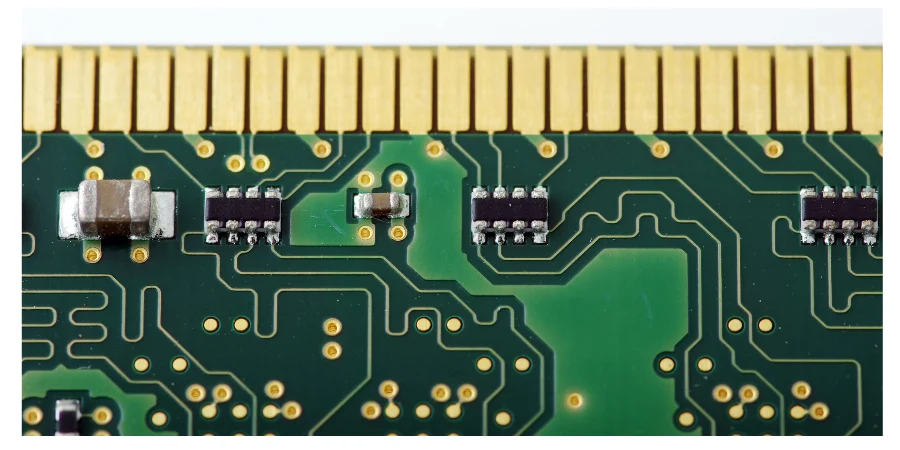
Gold fingers are plated PCB edge contacts that mate with an edge connector. Their performance depends on both contact surfaces, board geometry, plating and the operating environment. Define those requirements together rather than treating gold plating alone as proof of a reliable interconnect.
For a HilPCB review, provide the mating connector drawing, contact pattern, board thickness, plating specification and service conditions. Confirm fabrication scope and acceptance evidence against the actual build. HILPCB provides engineering layout collaboration and specialized gold-finger fabrication, including hard-gold plating, precision milling and connector-specific material options, with prototype-to-volume production support, inspection and access to its in-house Gerber and 3D viewers. The viewer supports visual review only; final plating, wear and fit requirements come from the connector design and qualification plan.
What is a Gold Finger PCB?
A gold-finger PCB has plated edge contacts that mate with an edge connector. Repeated-insertion contacts commonly use electrolytic hard gold over a nickel underplate; ENIG, a solderable surface finish, should not be assumed to offer the same wear life.
Gold finger PCBs are widely used in:
- Modular systems: Where the PCB connects to a larger system or backplane, such as in telecom equipment, memory modules, or GPUs.
- High-speed computing systems: Where signal integrity is crucial, such as in networking cards, memory expansion cards, and graphic cards.
- Consumer electronics: In applications such as gaming consoles, computer peripherals, and high-performance storage devices.
Contact resistance, insertion-cycle durability and RF performance depend on the connector geometry, plating specification, cleanliness and tested interface—not the gold finish alone.
Manufacturing Process for Gold Finger PCBs
Manufacturing Gold Finger PCBs involves a series of precise steps to ensure the correct plating, shape, and finish for the gold-plated pads:
- Design: Define pad dimensions, pitch, contact length, board thickness, keying and insertion datum from the approved connector drawing. Include any staggered contacts and their electrical sequencing requirements.
- Plating: Specify electrolytic hard-gold thickness, nickel underplate, selective plating boundaries and permitted porosity according to the mating connector and application.
- Impedance Control: Use the Impedance Calculator for preliminary transmission-line estimates where appropriate. Validate the actual trace, finger, connector and return-path transitions with suitable models or measurements; a calculator alone does not qualify the channel.
- Edge finish: Define bevel angle, remaining contact length, thickness and burr limits from the connector mechanical drawing; inspect after routing and beveling.
Design-viewer tools can help inspect routing and outline files, but a viewer alone cannot verify plating thickness, contact wear or high-speed channel qualification.

Applications of Gold Finger PCBs
Gold finger PCBs are used in a variety of industries where reliable and high-speed data transmission is required. Common applications, subject to connector and system qualification, include:
- Telecommunications Equipment: Gold finger PCBs are commonly used in telecom systems to connect communication boards to backplanes, with channel performance determined by the complete board/connector interface.
- Graphics Cards and Memory Modules: In computing, Gold Finger PCBs are used in memory expansion cards, GPUs, and other peripherals where fast and reliable signal connections are necessary.
- Automotive Electronics: Selected automotive modules and diagnostic tools may use edge contacts; retention, contamination, vibration and program requirements determine suitability. Not every ECU uses an edge connector.
- Networking: High-speed networking equipment such as switches, routers, and network cards rely on Gold Finger PCBs to connect to backplanes or other system components.
Agree contact-current limits, mating-cycle targets, environmental exposure and RF requirements with the connector/system team; these are not established by the bare board finish alone.
What Should the Fabrication RFQ Include?
- Contact system: Connector part number/revision, pad pattern, board thickness and mechanical tolerances. Include the contact wipe region and bevel geometry.
- Material and finish matching: Select laminate, nickel underplate, hard-gold specification and edge geometry against the connector and environment. Metal-core construction is not a default gold-finger solution.
- Selective plating: Mark plating boundaries and keep solderable areas consistent with the assembly process. Agree any plating bus/tie-bar arrangement and its removal with the fabricator; residual structures can affect routing or high-speed behavior.
- Inspection: Agree nickel/gold thickness measurements, dimensional checks, edge/burr inspection and bare-board electrical coverage. Mating wear and contact resistance need tests of the defined connector interface; routine continuity does not establish cycle life.
- Quantity and schedule: Confirm material, plating and machining feasibility, tooling and the required records before agreeing a prototype or production lead time.
Gold-finger boards should be accepted against the agreed plating, dimensional and electrical-test criteria; no surface finish can guarantee flawless performance in every environment.
Frequently Asked Questions
What are PCB gold fingers?
Pcb gold fingers, gold fingers pcb, golden finger pcb, and pcb gold finger all mean the electroplated gold contacts along a board edge that plug into a mating connector. Edge connectors circuit boards, connector pcb edge, and printed circuit board edge connector describe the same feature. Specify the hard-gold and nickel thickness requirements, bevel geometry and intended mating-cycle target from the connector/application specification. There is no universal gold thickness or cycle rating for all edge interfaces.
What does gold finger pcb manufacturing require?
Gold finger pcb manufacturing includes nickel underplate and hard-gold electroplating on the edge contacts. Bevel/chamfer machining is required only where specified by the mating connector drawing. Inspect plating thickness, the defined edge geometry and burr limits, and record contact spacing and any required bevel in the fabrication drawing. Agree the plating bus/tie-bar process and inspect the finished contact area after machining.