
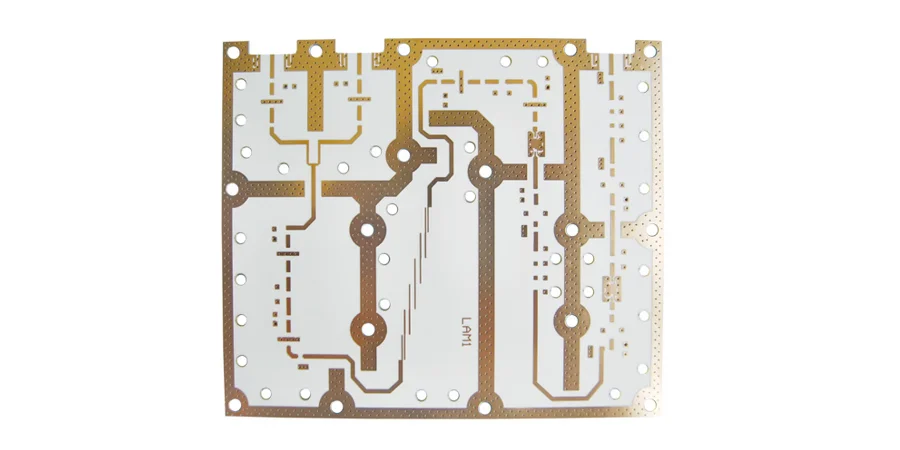
Rogers RO4350B is a hydrocarbon/ceramic-filled, glass-reinforced high-frequency laminate. Rogers specifies process Dk of 3.48 ± 0.05 at 10 GHz and 23°C using clamped stripline, with a separate 3.33 ± 0.05 value for 4 mil material. Its design Dk of 3.66 comes from a differential phase-length method over 8–40 GHz and is intended for circuit modeling. These values are from the Rogers RO4000 data sheet. Confirm material thickness, copper treatment and fabrication capability before specifying the stackup.
RO4350B has a typical dissipation factor of 0.0037 at 10 GHz and useful dimensional stability for many RF circuits. It does not inherently guarantee low insertion loss or mechanical durability for every layout; trace geometry, copper roughness, stackup and environment still govern performance.
The Advantages of Rogers 4350B Material
RO4350B offers useful electrical and processing properties for RF boards:
- Low loss and stability: Typical Df is 0.0037 at 10 GHz, but finished transmission loss depends on frequency, trace geometry, copper roughness and connectors.
- Thermal properties: The published Tg exceeds 280°C by TMA; this is not a continuous operating-temperature rating or an aerospace/automotive qualification. Assess soldering cycles, operating exposure and assembly construction separately.
- Multilayer construction: Glass reinforcement supports dimensional control, but registration, via reliability and any HDI build-up depend on the actual core, bondply, copper balance and qualified fabrication process.
- RF design capability: Its controlled dielectric properties are useful in RF and microwave boards; confirm impedance, insertion loss and qualification using application-specific models and test coupons.
A fabrication drawing should identify the exact laminate grade, thickness, copper construction, impedance targets and acceptance tests so a quotation can address the actual design.
Applications of Rogers 4350B PCBs
Potential applications include the following; laminate selection alone does not qualify the finished product:
- Telecommunications: Rogers 4350B PCBs are used in base stations, RF modules, and communication systems, where high-speed signal transmission is essential.
- Aerospace: Rogers 4350B is used in satellite communication systems, radar applications, and aerospace sensors, where durability and thermal stability are crucial.
- Medical RF electronics: RF acquisition or communication circuits may benefit from controlled dielectric properties. Low-frequency ECG acquisition does not by itself require this laminate, and medical safety or MRI compatibility requires assessment of the complete device.
- Microwave Systems: Lower dielectric loss can help meet an on-board transmission-line loss budget. Radio-link distance also depends on antennas, transmitter power, receiver sensitivity and propagation.
Define the intended frequency band, channel loss and environmental requirements before selecting the board construction.
Specialized Materials for Rogers PCBs
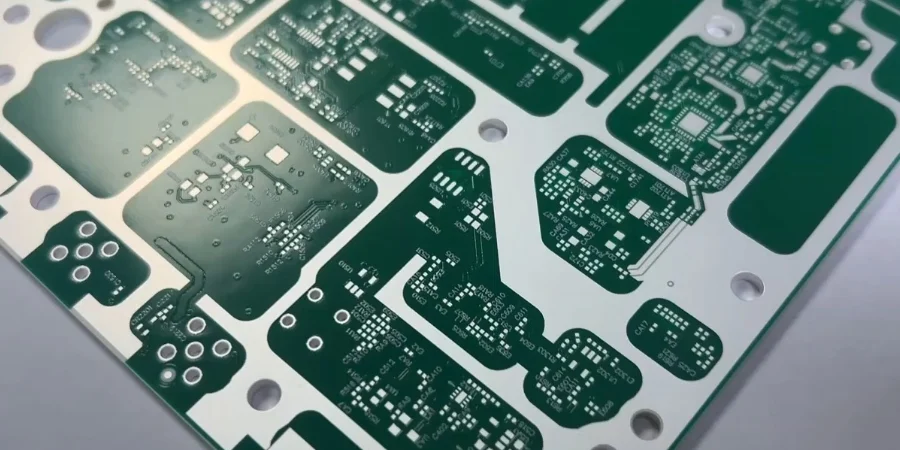
In high-frequency and RF applications, material choice can significantly influence signal integrity, thermal performance, and long-term reliability. Some Rogers grades provide lower dielectric loss or more stable electrical properties than a selected FR-4 grade. Cost, thermal conductivity, processing and mechanical properties still require a grade-specific comparison.
Two of the most widely used high-performance materials in this category are the RO4000 and RO3000 series:
- RO4000 Series Laminates: These materials strike a balance between electrical performance and cost-effectiveness. With a stable dielectric constant across a wide frequency range and low dissipation factor, the RO4000 series is ideal for systems requiring consistent impedance and thermal reliability. Common applications include base stations, automotive radar, RF modules, and aerospace electronics.
- RO3000 Series Laminates: These ceramic-filled PTFE materials offer another set of dielectric and thermal properties for microwave circuits. Select the specific grade using its data sheet; low outgassing or suitability for a space application requires separate evidence.
RO4000 hydrocarbon/ceramic laminates use many FR-4-compatible processes and do not require the PTFE activation used for RO3000 plated-hole preparation. For PTFE constructions, sodium treatment or an appropriate plasma process may be used before metallization. Multilayer lamination follows the selected bonding material, and copper balance and stackup construction affect warpage.
For a mixed-material or multilayer RF board, include the proposed bonding system, finished thickness, registration requirements and test coupons in the fabrication review.
Design Considerations for Rogers PCBs
When designing Rogers PCBs, several critical factors must be considered to ensure that the board performs optimally:
- Signal integrity: Use the design Dk with an appropriate field-solver model rather than treating a process-control Dk as a universal effective permittivity. Typical Df is 0.0037 at 10 GHz and 23°C using the data-sheet clamped-stripline method; copper roughness and line geometry contribute additional loss.
- Thermal Management: RO4350B has a typical thermal conductivity of 0.69 W/(m·K), measured at 80°C by ASTM C518. Design the copper spreading area, thermal vias and enclosure or heatsink path around component dissipation and allowable temperatures.
- Impedance Control: Calculate impedance from the finished dielectric thickness, trace dimensions, copper and reference-plane arrangement. Agree targets, fabrication tolerances and coupon measurement conditions; the laminate brand alone does not establish impedance.
Use the Impedance Calculator for an initial geometry estimate and the Gerber Viewer to inspect exported artwork. These tools do not replace a stackup-aware field solver, fabrication DFM review or measured channel validation.
Why Choose HilPCB PCB Factory for Your Rogers PCB Needs?
HILPCB supports RO4350B fabrication and assembly, custom engineering, and prototype-to-volume builds with tight tolerances when qualified. RO3000 and RO4000-family options, including RO4003C and RO3003, can be processed or sourced subject to grade and availability; RF, microwave and mmWave support includes one-to-one stack-up, DFM and layout engineering. Confirm grade, thickness, copper, bonding system and sourcing before release. Keep process Dk separate from design Dk and use each only with its stated frequency, thickness, method and purpose; PTFE grades and RO4000 processing are distinct. Material availability and project validation govern; no universal performance is claimed.
For a Rogers PCB quotation, provide the fabrication data and acceptance requirements that determine feasibility:
- Material and supply: Specify RO4350B or another exact grade, core thickness, copper foil and approved substitutions. Confirm availability and lead time at quotation.
- Electrical requirements: Identify controlled-impedance structures, target values and tolerances, coupon locations and any insertion-loss measurement requirements.
- Fabrication requirements: State layer count, bonding materials, via structures, surface finish, dimensional tolerances and inspection criteria. Establish which processes and reports are included in the order.
- Engineering review: Resolve proposed stackup changes and DFM exceptions before releasing production data. Agree prototype quantity, delivery dates and the evidence required for production acceptance.
Send these requirements with your design files to request a project-specific quotation from HilPCB.