
Music production keyboards combine comprehensive sound libraries, sophisticated sequencing, and professional connectivity in all-in-one instruments. These complex workstations require multi-board systems with demanding DSP processing, high-quality audio output, and comprehensive connectivity—all manufactured to professional standards.
HILPCB provides professional PCB fabrication and PCBA assembly services for workstation keyboard manufacturers, supporting the complex multi-board systems these instruments demand.
Menu Navigation
- Multi-Timbral Sound Engine Architecture
- Sequencing and Audio Recording Systems
- Professional Connectivity Implementation
- Processing and Memory Architecture
- Box Build and Complete System Assembly
Multi-Timbral Sound Engine Architecture
Production keyboards must deliver studio-quality audio across diverse sound categories with dozens of simultaneous parts. Sound engine PCBs require high-performance DSP systems, large sample memory, and professional audio outputs.
Audio quality depends on both circuit design and manufacturing quality throughout the signal path.
Sound Engine Elements
- Multi-Timbral Processing: 16+ simultaneous parts with 128-256 voice polyphony, requiring DSP systems with adequate processing power and memory bandwidth.
- Audio Quality Standards: 24-bit/48kHz+ sample playback with >100dB dynamic range, <0.01% THD, achieved through proper PCB layout and fabrication.
- Synthesis Engines: Sample playback, virtual analog, FM, wavetable engines running simultaneously on multi-DSP architectures.
- Effects Processing: Per-part insert effects, global reverb/delay, master processing running concurrently without voice stealing.
- Sample Memory: 2-4GB sample RAM with high-bandwidth DDR interface requiring controlled impedance routing and proper termination.
- DSP Interconnect: High-speed buses between multiple DSP chips for distributed processing architectures.
Manufacturing for Audio Quality
Sound engine PCBs require multi-layer construction with proper power/ground plane separation, controlled impedance for high-speed memory and audio interfaces, and audio-grade fabrication practices.
Sequencing and Audio Recording Systems
Built-in sequencing enables complete productions without external equipment. Storage systems must handle large projects reliably, while audio recording interfaces require clean preamps and ADC implementation.
Recording quality depends on proper analog input stage design and noise-free fabrication.
Sequencing System Elements
- MIDI Sequencer Architecture: 32-64 track capacity with high resolution (960-1920 PPQN), pattern and linear modes, requiring reliable timing and adequate storage.
- Audio Recording Integration: 4-16 audio tracks with 24-bit/48kHz recording, clean microphone preamps, and proper ADC implementation.
- Storage System Design: High-speed internal flash for working projects, SD card interface for expansion, USB storage for backup and transfer.
- Audio Interface Circuits: Microphone preamps with optional phantom power, instrument inputs with Hi-Z switching, and proper gain staging.
- Timing Accuracy: Clock generation ensuring sample-accurate playback with minimal jitter affecting sequencer timing.
- Data Protection: Reliable storage interfaces with proper ESD protection and power sequencing for data integrity.
Manufacturing for Recording Quality
Audio input stages require low-noise fabrication with proper grounding, adequate shielding, and clean power supplies.
Professional Connectivity Implementation
Comprehensive connectivity integrates production keyboards into professional studio and stage environments. Reliable connector mounting and proper ESD protection ensure long-term reliability.
Connector quality and assembly robustness determine professional usability.
Connectivity Elements
- Audio Output Architecture: Main L/R (balanced XLR optional), assignable outputs for part routing, dual headphone jacks with independent level control.
- USB-MIDI and Audio: Class-compliant USB-MIDI for universal compatibility, USB Audio streaming for multi-channel computer recording.
- Traditional MIDI: 5-pin DIN In/Out/Thru for hardware integration, external sequencer control, and legacy equipment connection.
- Digital Audio Interfaces: S/PDIF for standard digital connection, optional ADAT for multi-channel studio integration with proper clock handling.
- Expression Controllers: Sustain, expression, and footswitch inputs with polarity detection and configurable assignment.
- Expansion Options: SD card slots, USB host ports for external storage and controllers with proper power management.
Manufacturing for Connector Reliability
Through-hole audio and MIDI connectors require robust soldering for mechanical durability under constant stage and studio use.
Processing and Memory Architecture
Production keyboards require substantial processing power and memory for simultaneous sound generation, sequencing, effects, and user interface. Multi-DSP architectures with high-speed memory interfaces demand advanced PCB fabrication.
Processing board quality directly affects system stability and performance.
Architecture Elements
- Multi-Core Processing: Main DSP for voice generation, separate effects processing, dedicated sequencer core, and display/UI processor.
- Memory System Design: 2-4GB sample RAM with high-bandwidth DDR interface, 512MB-2GB system RAM, 16-64GB flash storage.
- Power Distribution: Separate power domains for DSP, audio, digital logic, and display with proper sequencing and filtering.
- Thermal Management: Heat dissipation planning for sustained DSP operation with thermal via arrays and copper pour.
- Clock System: Multiple clock domains for audio, DSP, and system functions with proper isolation and jitter management.
- Board Partitioning: Main processor, audio output, control panel, and power supply boards separated for manufacturing and thermal management.
High-Performance PCB Requirements
Workstation main boards require 6-8 layer construction with controlled impedance for DDR memory, proper via stitching for EMI containment, and adequate thermal management.
Box Build and Complete System Assembly
Production keyboards represent complete products requiring more than PCB assembly—enclosure integration, cable harnessing, display mounting, and final testing create finished instruments ready for shipping. HILPCB provides box build services for keyboard manufacturers.
Why Choose HILPCB for Production Keyboard Systems
Complete Box Build Capability
Beyond PCB assembly, our box build services integrate all components into finished keyboard products:
- Enclosure mechanical assembly with standoffs, fasteners, and thermal management
- Display and control panel installation with alignment verification
- Internal cable harness fabrication and routing
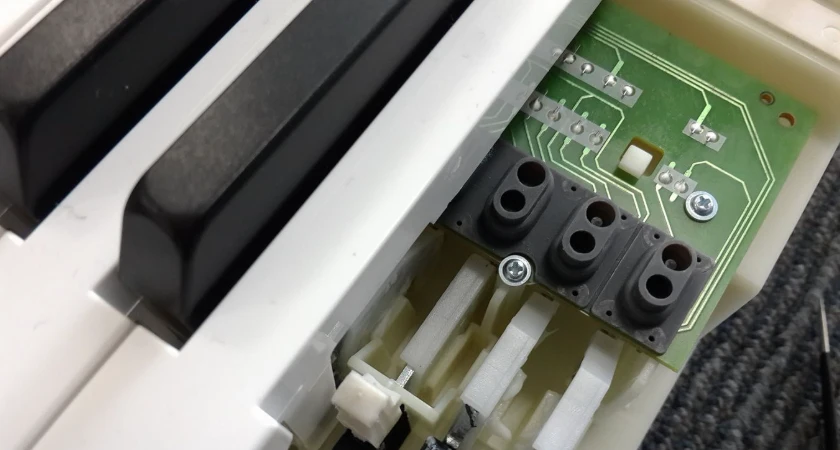
- Keybed integration with main electronics
- Final system testing and quality verification
Multi-Board System Coordination
Workstation keyboards often include 4-6 interconnected PCBs. We manufacture and assemble the complete board set under unified quality control, then integrate into final enclosures with coordinated scheduling.
Stage-Grade Quality Assurance
Professional keyboards face demanding stage environments. Our testing protocols verify:
- System functionality under simulated load
- Thermal performance during sustained operation
- Mechanical integrity of all connections
- Audio quality meeting specifications
Firmware Loading and Calibration
We handle firmware programming, parameter calibration, and factory setup—shipping complete instruments ready for end-user unboxing.
Scalable Manufacturing Model
- Prototype systems with small batch assembly
- Production volumes with large volume assembly
- Complete turnkey assembly including enclosures and accessories
Logistics Simplification
Single-source manufacturing simplifies your supply chain. PCBs, assembly, box build, and fulfillment from one partner reduces coordination overhead and shipping complexity.
Contact us with your complete keyboard system requirements for integrated manufacturing planning.
Common Questions
Why is a music production keyboard often treated as a full system instead of a single PCB job?
Because the product usually combines multiple boards, firmware, mechanical assembly, calibration, and final box build in one deliverable. Manufacturing decisions on only one board rarely reflect the real integration risks of the complete instrument.
Why do firmware loading and system coordination matter before shipment?
A keyboard that is electrically assembled but not programmed, calibrated, or verified as a complete unit still creates avoidable downstream work. Coordinated setup before shipment helps reduce handoff friction, field setup issues, and inconsistencies between builds.
What should be confirmed before scaling a production keyboard program?
Teams should confirm multi-board coordination, connector reliability, thermal behavior, stage-use durability, and factory setup flow before volume launch. Scaling is smoother when the whole keyboard system has been validated as a production process rather than as separate subassemblies.