
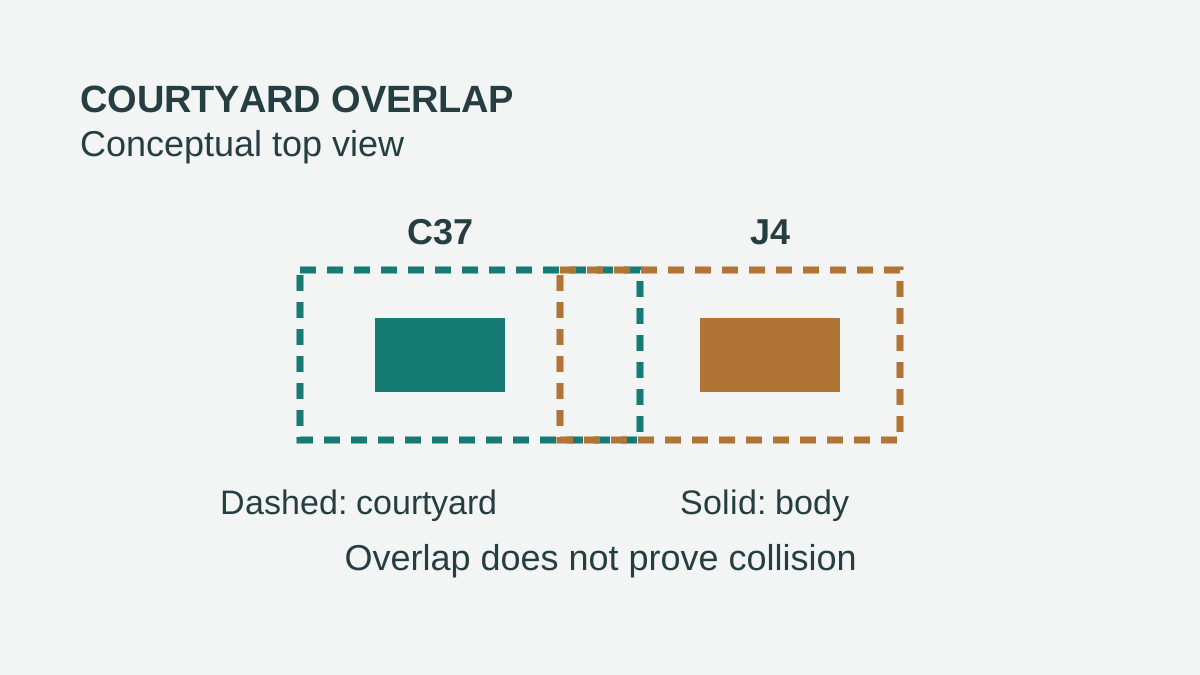
Treat a new assembler's courtyard flag as a change-control question, not a vote on whether the old or new supplier is right. Establish what the previous release assumed, identify the operation the incoming assembler is concerned about, and dispose of that difference against one named design revision.
Neither a courtyard overlap nor a clean CAD check settles the decision. A warning reports a relationship between encoded outlines and active rules. A pass has the same limitation. The supplier still needs enough context to assess the assembly operations included in its review, while the design authority remains responsible for the design disposition.
The workflow below is a recommended project practice. Approval authority and release controls should follow the agreement and change process for the particular job.
Establish the released baseline before discussing the flag
Supplier changes often expose assumptions that were never written down. “The previous assembler built it” does not show which revision was reviewed, whether the overlap was noticed, or whether inspection and rework were included in that review.
Freeze a comparison baseline before changing placement or suppressing a warning:
- Released board and assembly revision, side, coordinates and rotations.
- Exact ordering codes, approved alternates and relevant package-drawing revisions.
- Footprint/library revisions and any board-local edits.
- Courtyard and 3D-model sources, active placement rule, scope, exclusions and existing waivers.
- Manufacturing package and the operations the previous supplier was actually asked to perform.
- Any prior disposition, including who made it and which revision it covered.
An absent record is not evidence that an exception was approved. Mark the previous condition as “history known, rationale unknown” and review it again.
Translate the incoming flag into an operation
Ask the incoming assembler to name the affected references, the release it reviewed and the operation behind the concern. “Courtyards overlap at X/Y” is not yet a disposition request. Useful responses identify whether the concern involves placement, soldering, an inspection view, cleaning, test access, a quoted rework operation or something else.
Keep the response within the supplier's reviewed scope. Acceptance of a local placement operation is not approval of enclosure fit, connector mating, product reliability or all future rework. Conversely, a design waiver is not the assembler's acceptance of its manufacturing operation.
The review should include nearby height, board edges, shields and approach directions, not only the two courtyard outlines. Mating, electrical and thermal restrictions remain separate constraints. A placement courtyard is also not a universal copper or via keepout; routing restrictions require their own applicable rules.
Compare the old assumption with the new request
Use a change table so reviewers can see what is new rather than re-reviewing the entire board from memory.
| Question | Released baseline | Incoming review | Disposition needed |
|---|---|---|---|
| What design was assessed? | Board, assembly, parts and footprint revisions | Same revision or a documented difference | Reconcile before deciding |
| What does CAD report? | Active rule, overlap and existing waiver state | Supplier's imported data and reported flag | Confirm both views use matching inputs |
| What operation matters? | Prior scope or “not recorded” | Named assembly/inspection/rework operation | Decide whether it is required for this job |
| What evidence is missing? | Models, drawings or prior rationale | Supplier assumptions and requested change | Assign an owner and due date |
| Who accepts what? | Design authority and prior supplier scope | Incoming supplier's quoted/reviewed scope | Record separate, bounded dispositions |
This comparison prevents two common errors: treating a previous build as permanent approval, and treating a new supplier's process preference as an automatic design requirement.
A change-specific worked example
The following hypothetical case illustrates a supplier-change review.
Assume control board Rev C was previously released with capacitor C37 beside connector J4. The board files contain a scoped courtyard waiver for the pair, but the waiver says only “accepted.” There is no supplier response, operation, package-drawing revision or approval date attached to it.
The incoming assembler reviews the same Rev C files and asks for a placement change. Its stated concern is not component-body collision: it says C37 obstructs the side-view image it intends to use for one row of J4 solder joints. For this example, assume all of the following have been verified:
- The J4 and C37 ordering codes, package drawings, footprint origins and rotations match Rev C.
- Their modeled bodies do not intersect, and J4's separate mating envelope is clear.
- The courtyard warning is reproducible under the released placement rule.
- The previous supplier's inspection method and reason for the old waiver cannot be recovered.
- The incoming supplier's response applies only to its quoted assembly and inspection flow; rework access is outside that response.
The design team can evaluate a proposed C37 relocation, another validated inspection approach, a component/package change, or a hold while missing evidence is resolved. If it proposes moving C37 by 1.2 mm, that distance is specific to this example, not a universal clearance. The team must check the new neighbor, routing, electrical behavior, board mechanics and all applicable rules; the vanished J4/C37 warning alone is not proof that the revision is ready.
Suppose those checks pass and the incoming assembler confirms that the revised pair addresses the stated inspection concern for its quoted flow. The design authority can release Rev D with the controlled move. That is a design revision, not a retroactive approval of Rev C. If the design cannot change, the alternative is a Rev C exception that names the inspection method and supplier response; it must not be generalized to another supplier or operation.
Check what the CAD result does and does not cover
For the CAD system and configuration actually used, determine how missing or malformed courtyard data is reported, which clearance rule applies, and whether an exception or override affects the result. Read a warning, waiver or clean result together with the active rule and footprint data.
Determine whether the chosen check uses 2D boundaries, 3D bodies or another representation. Ask how missing models, fallback dimensions, excluded components and board-surface clearance are handled. Record the tool version, active settings and any checks that remain outside its scope.
These are tool behaviors, not assembly approvals. Verify model presence, orientation, height, boundary construction, rule scope and exclusions. Compare the board copy with the reviewed library footprint; PCB library management provides the broader revision-control context. Do not weaken a general rule merely to clear one supplier flag. A corrected rule is a controlled design-data change, while a scoped exception is a separate disposition. See the PCB DRC rule template for maintaining the rule baseline.
Choose a bounded disposition
| Review finding | Recommended disposition | Evidence needed before release |
|---|---|---|
| Part, footprint, rule or process information is missing | Hold for review | Current affected-part data, placed footprint revisions, active rule and assembler clarification |
| Physical envelopes conflict, or a required mating or keepout constraint is violated | Revise the design/process or hold release | Updated evidence showing the conflict or requirement has been addressed |
| Geometry appears clear, but required assembly, inspection or rework access is unresolved | Do not approve the exception yet | Incoming assembler’s assessment of the actual operation and surrounding area |
| A footprint or DRC definition is incorrect | Correct the data or rule, then recheck | Reviewed correction, impact assessment and new DRC results; not just a suppressed warning |
| Courtyards overlap, but the specific arrangement and stated operation are accepted | Consider a scoped exception | Named pair and revisions, rationale, evidence, design disposition and supplier response limited to its reviewed scope |
| DRC passes without an overlap | Continue normal release review | Verified inputs and the applicable assembly, mechanical and keepout reviews; a pass alone is not approval |
The matrix does not give an assembler authority to alter design files. If a change is requested, the designated design authority decides and controls it. A designer's CAD waiver is not the assembler's acceptance, and an assembler's local process response is not general design approval.
Record an exception that can be challenged later
A useful exception is narrow enough that a later reviewer can tell when it no longer applies. Record:
- Identity: board and assembly revision, reference designators, part numbers and footprint revisions.
- Condition: the specific DRC finding, rule and geometry involved, with a view or measurement tied to the released design.
- Rationale: why the overlap is acceptable despite the encoded courtyard relationship, including the operations and surrounding features reviewed.
- Evidence: applicable drawings, verified CAD views or models, assembler feedback and the dates or revisions of those inputs.
- Scope: the supplier, assembly process and inspection or rework assumptions covered; list any unresolved limitations.
- Disposition: the design decision, the assembler's bounded response for its reviewed scope and other project-required approvals, with owners and dates.
- Revalidation triggers: changes that invalidate the reasoning or require it to be reviewed again.
A generic note such as “courtyard overlap accepted” is insufficient. It does not identify the pair, the accepted conditions or who accepted them. Keep the exception linked to the DRC report and release package so it remains visible even if the CAD tool suppresses the warning.
RFQ handoff: ask a revision-specific question
The RFQ stage is the time to surface a supplier-specific concern before treating the existing placement as fixed.
- Designer or design owner — identify the baseline. Provide the board and assembly revision, affected references, part numbers and footprint revisions. Identify alternates rather than assuming they share the same geometry.
- Designer — provide the evidence. Include the relevant assembly views, part drawings or drawing revisions, courtyard and DRC information, and known mechanical, mating, electrical and thermal constraints. State which models or dimensions remain unverified.
- Designer — identify the decision requested. Mark the flagged pair and ask which operations within the quoted scope the assembler needs to assess. State separately whether inspection or rework review is being requested.
- Incoming assembler — respond against that baseline. Identify concerns, assumptions, missing inputs and any requested placement change or further review. Avoid treating a general capability statement as approval of the actual pair.
- Design owner and purchasing or project owner — track disposition. Assign an owner and status to each open issue, record the revision reviewed and agree who has authority to approve the final design and assembly scope.
An RFQ response may guide a redesign, but an open question should remain visible until it is resolved against the release revision. For SMT PCB assembly, request a quote with the relevant design context and confirm the inspection and rework scope for the project.
Release handoff: close the loop on the final files
Before release, the parties should verify that their decisions still match what will be built.
- Designer: Confirm the released parts, placements, footprints and any board-local library changes. Review nearby geometry and all applicable mating and keepout constraints.
- Designer: Run the applicable DRC and mechanical checks using the intended rules and data. Review missing, excluded and waived items, not just the total error count.
- Design authority: Approve the placement revision or the specific exception, with its rationale, scope and supporting evidence. Ensure any customer approval required by the project is obtained.
- Incoming assembler: Respond against the actual release revision and only the assembly, inspection or rework operations included in its review. Resolve or list outstanding assumptions rather than silently carrying them forward.
- Release owner: Package the matching board, assembly and manufacturing data, revision identifiers, DRC report and exception record. Verify that the supplier receives the same revision that was approved.
Revalidate the decision after a change to an affected part or package drawing, footprint, courtyard, model, placement, board geometry or DRC rule. Revisit it when the assembler, intended process, inspection approach, rework expectation or relevant mating or keepout requirement changes. New findings during build or inspection should also return the pair to review.
A revised placement is not automatically safe just because the original flag disappears. Check its new neighbors, rerun the applicable rules and obtain the necessary assembler review against the revised release.
FAQ
Does a courtyard overlap always require moving a component?
No. It requires investigation. If the real geometry is verified, the incoming assembler addresses the stated operation within its reviewed scope, and the authorized design decision is documented, a scoped exception may be appropriate. A physical conflict or unresolved required access calls for further review or a design or process change.
Can a clean DRC report be used as assembly approval?
No. It shows the result of the checks as configured against the available data. Missing or incorrect geometry, exclusions, rule scope and process-access needs can leave important questions unanswered.
Who should approve an exception?
The project should identify who can approve the design disposition and who can respond for the incoming assembler on the stated operation within its reviewed scope. Any customer or contractual approval should follow the project's own controls. A CAD waiver by itself is not that approval, and a supplier's local process response is not general design approval.
Are copper traces and vias prohibited inside a courtyard?
Not universally. The courtyard represents a placement envelope; copper and via restrictions come from the applicable electrical, thermal, fabrication and assembly requirements and their configured rules.
When must an accepted pair be reviewed again?
Review it when the affected parts, footprints, placement, rules, surrounding geometry, supplier or relevant process assumptions change. Also revisit it when new evidence calls the original rationale into question, even if the CAD warning remains unchanged.