
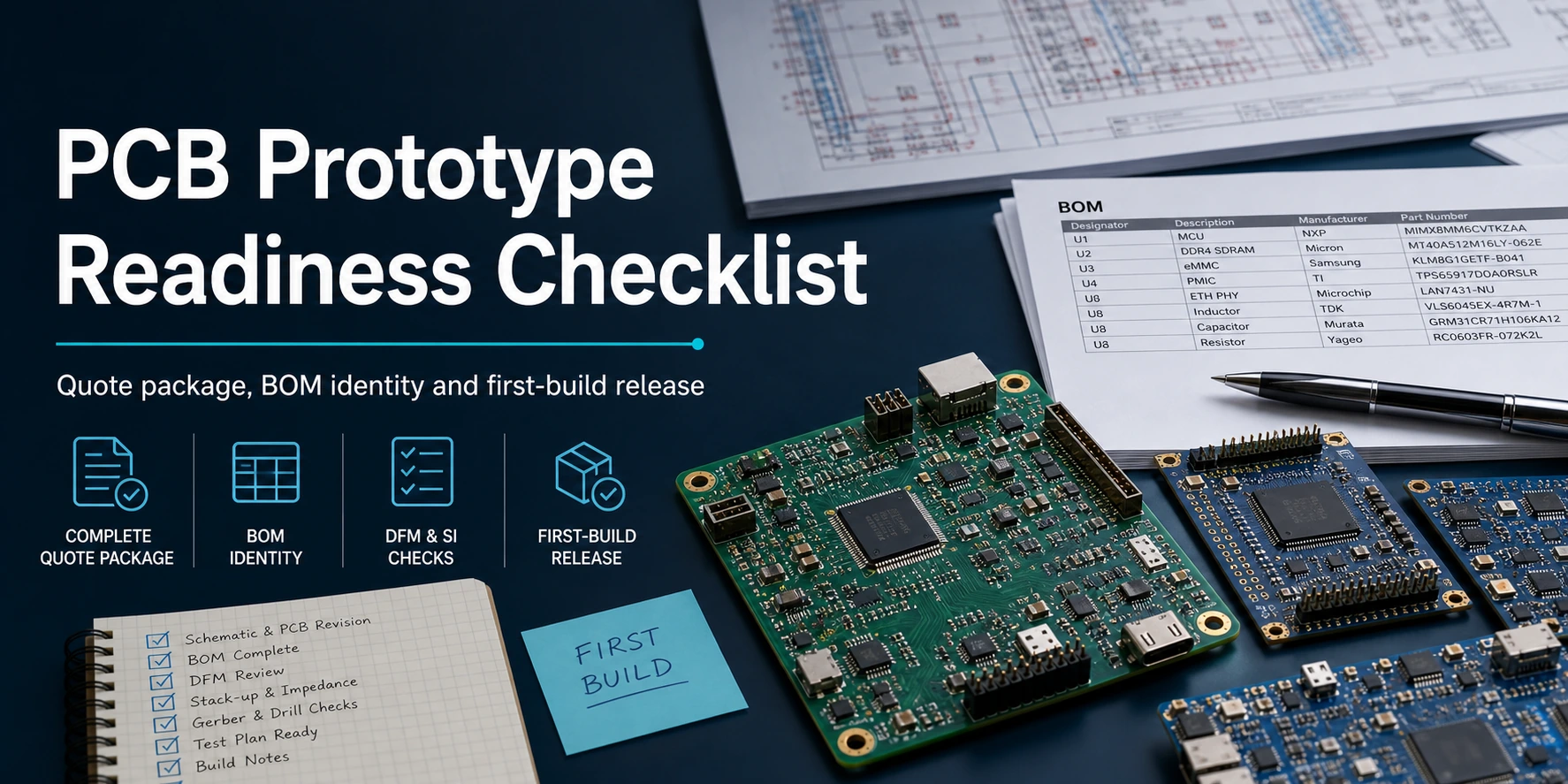
- Prototype readiness is not a commercial promise. It is the point where the package is complete enough for engineering review, quote intake, and a first-build decision.
- Prototype and quick-turn are different routing questions. Prototype describes validation purpose. Quick-turn describes schedule posture after engineering review.
- A file upload by itself does not prove readiness. Fabrication data, revision identity, stackup intent, BOM identity, and test expectations still need to travel together.
- DFM, DFT, and DFA belong before release because manufacturability, test access, and assembly assumptions shape what the first build can actually prove.
- The safest checklist ends with one narrow outcome: a package that is easier to review at PCB Prototype, Quick Turn PCB, or Request a Quote, without turning the article into a commercial-promise page.
This PCB prototype readiness checklist works as a release-discipline guide. The goal is to freeze the package that engineering review actually needs: clear fabrication data, controlled BOM identity, a defined prototype-versus-quick-turn route, and a stated test intent for the first build.
In This Guide
- What prototype readiness means before first-build release
- The early checklist that should be frozen before RFQ
- Prototype versus quick-turn: two different routing questions
- What fabrication-data handoff must include
- Why BOM identity should be explicit before procurement review
- Why DFM, DFT, and DFA belong before the first build
- How to define test-intent readiness for a prototype
- Next steps
- FAQ
- References
What prototype readiness means before first-build release
Prototype readiness is narrower than a later production release. It does not mean every downstream risk is closed, and it does not mean the board should already be treated as a repeatable volume release. The safer meaning is simpler: the package is complete enough for quote intake, engineering review, and a first-build decision without forcing fabrication, assembly, or test teams to guess at design intent.
That matters because prototype articles often drift into the wrong questions. They become commercial-comparison pages, speed-promise pages, or generic procurement pages. The conservative route in this review is different. Before a prototype moves forward, the design owner should be able to show which revision is current, what board construction is intended, what files and notes belong to that revision, which BOM identities are fixed, and what the first build is expected to validate.
This is why readiness is best treated as package completeness plus review discipline:
- package completeness keeps fabrication data, stackup intent, BOM identity, and test expectations from fragmenting across separate channels
- review discipline keeps DFM, DFT, and DFA at the front of the workflow instead of asking the first build to discover everything at once
- routing clarity keeps prototype purpose separate from quick-turn urgency so the team does not mistake schedule pressure for engineering closure
When those elements are frozen together, the project can move to Request a Quote as an intake step rather than as a substitute for technical review.
The early checklist that should be frozen before RFQ
The most useful readiness checklist is short enough to be audited and specific enough to support fabrication and assembly review. It should not pretend that one file export or one form submission is the whole answer.
| Review area | What should be frozen | Why it matters before first build | What to avoid |
|---|---|---|---|
| Revision identity | One active revision, named clearly across files and notes | Prevents the quote and build package from mixing old and new data | Informal filename drift or unlabeled re-exports |
| Routing posture | Decide whether the job is prototype, quick-turn, or both | Keeps validation purpose separate from schedule posture | Treating prototype and quick-turn as synonyms |
| Fabrication package | Files, stackup intent, material/finish expectations, and manufacturing notes | Gives fabrication review one coherent handoff surface | Assuming a file upload alone proves completeness |
| BOM identity | Manufacturer name, manufacturer part number, and controlled alternates posture | Lets procurement review start from part identity, not from loose text strings | Replacing part identity with supplier shorthand only |
| Front-end gates | DFM, DFT, and DFA questions named before release | Aligns manufacturability, test access, and assembly route early | Using the first build as the only review stage |
| Test intent | A written statement of what the prototype should prove | Makes prototype results easier to interpret | Asking one build to prove every downstream outcome |
The checklist is most useful when it travels with the same handoff the team sends for service review. If the package still needs clarification around prototype scope, use PCB Prototype first. If the package is already approved and the schedule posture is the unusual part, the next discussion may belong to Quick Turn PCB. If the package is already coherent enough for intake, use Request a Quote with the frozen revision and supporting files.
Prototype versus quick-turn: two different routing questions
Prototype and quick-turn often appear together, but they should not be written as the same thing. The difference is important because each label answers a different question.
Prototype is a build-purpose decision. It asks whether the first build is being used to validate design intent, manufacturability assumptions, stackup direction, assembly fit, or test planning. It is about learning from the first hardware pass and keeping that learning inside a controlled workflow.
Quick-turn is a schedule-posture decision. It asks whether an already reviewed job needs compressed handling because the program timing is tighter than normal. That does not erase engineering review, and it does not mean every board family should be treated as eligible for the same accelerated path.
The safest routing language is therefore:
- use
prototypewhen the main question is validation, iteration, or first-build learning - use
quick-turnwhen the main question is schedule urgency after engineering review - use
prototype + quick-turnonly when both conditions are true and the copy keeps them separate
This distinction also improves the handoff to HIL routes. A board that is still freezing the release package usually belongs in the PCB Prototype conversation first. A board whose package is already stable but whose schedule is compressed may belong in the Quick Turn PCB conversation. Neither route should be used to imply a universal timing promise.
What fabrication-data handoff must include
Fabrication-data readiness is not only about choosing a file format. Gerber, IPC-2581, and ODB++ can all be discussed safely as handoff identities, but none of them should be treated as proof that the whole package is complete by itself. A first-build handoff still depends on context around the files.
This is where prototype schedules are often lost. A customer can upload clean Gerber data and ask for 24-hour quick-turn, but the package still stalls if the BOM uses ambiguous MPNs or the XY file does not define Pin 1 rotation clearly on dense BGA or QFN parts. No responsible assembly team will guess that orientation on a live build. The result is an Engineering Query (EQ) before the job can even enter placement preparation. Once that question crosses time zones, a nominal one-day prototype can lose 48 to 72 hours just waiting for confirmation of one part rotation or one unresolved line item. That is the practical reason Gerber files alone do not equal prototype readiness. Speed comes from package completeness, not from file upload speed.
For a conservative prototype-release package, the fabrication handoff should keep these items together:
Revision clarity
The active release revision should match the data package, naming, and notes.Fabrication outputs
Provide the board-image and manufacturing-output set the fabricator will review, without assuming the export alone explains every decision.Stackup intent
State the intended board structure, layer logic, and any controlled construction expectations that matter to review.Material and finish direction
Name the intended material family and finish posture when those choices affect the build path.Manufacturing notes and profile context
Keep drill, route, edge, or special handling notes with the same revisioned package instead of scattering them across email threads.
That combined package is what makes Request a Quote useful as an intake route. The form can capture project fields such as layers, dimensions, thickness, material, finish, quantity, urgency, files, and special requirements, but the intake becomes reliable only when those fields point to one controlled release package.
Why BOM identity should be explicit before procurement review
BOM readiness starts with identity, not with market claims. Before procurement review begins, the package should make manufacturer identity explicit, keep manufacturer part number explicit, and treat sourcing-facing links or sourcing notes as a separate downstream layer.
That distinction matters because prototype builds often fail at the handoff boundary, not at the sourcing conversation itself. If the BOM uses loose descriptions, mixed aliases, or uncontrolled alternate substitutions, the review team has to reconstruct what each line item is supposed to mean before it can even evaluate availability, traceability, or assembly fit.
A controlled prototype BOM makes space for:
- manufacturer name
- manufacturer part number
- reference designator alignment
- approved or review-pending alternate posture
- notes on parts that affect programming, orientation, or assembly method
This does not require the article to publish live stock views or source comparisons. The safer point is narrower: procurement review is more stable when part identity is complete before alternates, traceability, and sourcing governance are discussed. If that identity layer is still weak, the prototype package is not ready no matter how clean the fabrication files look.
Why DFM, DFT, and DFA belong before the first build
DFM, DFT, and DFA are not decorative checkboxes. They are front-end gates that help define what the first build is supposed to confirm.
DFM should review whether the board can be fabricated and handed off cleanly with its chosen stackup, profile, notes, and process branch. DFT should ask whether the build will provide enough access and context for the intended test method. DFA should check whether component placement, polarity, package use, and assembly route match the actual build plan.
These gates belong before release for one reason: they reduce ambiguity. A prototype is most useful when the team knows what has already been reviewed and what still remains open. Without that discipline, the first build becomes a bundle of mixed questions:
- Was the layout manufacturable?
- Was assembly access reasonable?
- Did the BOM identity map cleanly to placement and programming needs?
- Was the prototype supposed to prove electrical bring-up, assembly fit, or both?
Keeping DFM, DFT, and DFA in the front-end workflow does not guarantee success, but it creates a much clearer boundary between review inputs and prototype results. That is the right posture before a package moves into PCB Prototype or Request a Quote.
How to define test-intent readiness for a prototype
Test-intent readiness means the prototype package states what the first build should prove and what supporting data the test team will need. It is not enough to say that the board will be tested later. The release package should name the validation posture early enough that test access, programming needs, and assembly assumptions can still influence the handoff.
In practice, that means a prototype package should answer questions such as:
- Is the first build mainly for power-up and bring-up confirmation?
- Does the board need programming, fixture planning, flying-probe thinking, or a functional-test path?
- Are there specific interfaces, connectors, or assembly zones that the first build must verify?
- Is the prototype intended to narrow one validation question or several unrelated ones at once?
The safest outcome is a narrow test statement. For example, the prototype may be intended to confirm that the board powers correctly, that the programmed devices can be loaded and accessed, that critical connectors are assembled in the right orientation, or that a limited functional path can be checked after build. That kind of statement gives the first run a defined purpose without overstating what one build can prove.
This is also where package completeness matters again. Fabrication files alone do not define test intent. The test path may depend on BOM identity, placement context, programming expectations, and design notes that sit outside the bare fabrication export.
Next steps
If you are not sure whether the current package — Gerber, BOM, stackup intent, and test purpose — is complete enough for a clean first-build pilot, do not send it to production and hope the missing pieces will be discovered safely on the line.
Send the full prototype package to [email protected], or upload it through the Quote page. HILPCB's NPI intake team will run a readiness review within 24 hours to check BOM identity quality, stackup ambiguity, and assembly conflicts before the board is released. The goal is simple: remove the gaps that trigger EQ delays before your prototype reaches the factory queue.
FAQ
Does a PCB prototype readiness checklist prove a later production release?
No. A safer checklist only proves that the package is complete enough for quote intake, engineering review, and a first-build decision. Production release, repeatability, and later validation gates are separate questions.
Is prototype the same thing as quick-turn?
No. Prototype is a validation-purpose route. Quick-turn is a schedule route after engineering review. A project can be one, the other, or both, but the labels should not be treated as synonyms.
Do fabrication files alone make a package ready?
No. The handoff still needs revision clarity, stackup intent, material or finish direction when relevant, manufacturing notes, BOM identity, and test expectations. One export format does not replace the rest of the review package.
What should a BOM prove before procurement review starts?
It should prove part identity first: manufacturer name, manufacturer part number, and controlled alternate posture. Supplier-facing sourcing details and traceability governance can follow, but they should not replace identity.
Why should DFM, DFT, and DFA happen before the first build?
Because they define manufacturability, test access, and assembly assumptions while the package can still be corrected. Waiting until the prototype arrives turns the first build into an avoidable discovery exercise.
What does test-intent readiness look like in practice?
It looks like one written prototype objective: what the first build is supposed to validate, what test support it needs, and which assumptions are still open. The narrower that objective is, the easier the prototype result is to interpret.
References
HILPCB: PCB Manufacturing Services
Supports end-to-end custom fabrication, multi-layer rigid boards, and volume scaling from prototype builds.HILPCB: PCB Prototype
Supports prototype-route framing around validation builds and early-stage release review.HILPCB: Quick Turn PCB
Supports quick-turn framing as schedule posture after engineering review rather than as a universal prototype synonym.HILPCB: Request a Quote
Supports quote-intake authority for project fields, file upload, and package-completeness handoff without turning intake into automatic commercial language.Ucamco: Gerber Format Overview
Supports the identity of Gerber as a fabrication-data exchange format rather than as proof of complete manufacturing readiness.IPC-DPMX / IPC-2581 Consortium: About IPC-2581
Supports IPC-2581 as a manufacturing-description exchange family without treating it as a universal replacement for every other handoff artifact.