
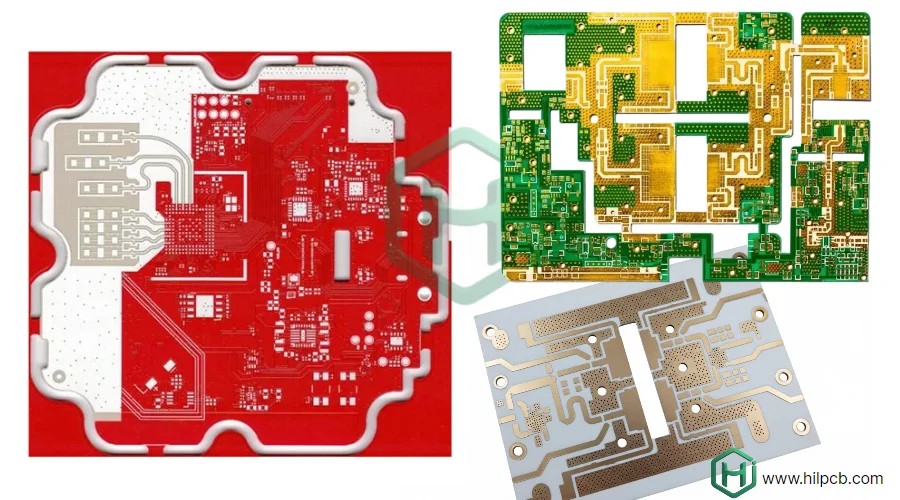
Rogers PCB production is the controlled conversion of a specified Rogers laminate, copper system and stackup into repeatable RF hardware.
Key Takeaways
- Select a material from the loss, impedance, thermal, mechanical, flammability and fabrication requirements; frequency alone is not a sufficient rule.
- Distinguish Rogers process Dk from Design Dk and record the value, thickness, foil and model used for impedance calculations.
- RO4000 hydrocarbon-ceramic laminates generally use FR-4-like processing; PTFE-based RT/duroid materials need different handling, drilling and hole activation.
- Freeze stackup, artwork compensation, coupon evidence, traceability and change rules before pilot production.
Table of Contents
- Which Rogers material should production use?
- What must be frozen before the prototype?
- How does fabrication change by material family?
- How do prototypes become volume production?
- What should inspection and test prove?
- Rogers PCB production RFQ checklist
- Frequently asked questions
Which Rogers Material Should Production Use?
Do not convert a frequency band into an automatic laminate choice or assume every Rogers grade has the same process.
| Material family | Production advantage | Main release question |
|---|---|---|
| RO4003C / RO4350B | rigid hydrocarbon-ceramic; FR-4-compatible imaging, etching and plating | Is UL 94 V-0 required? RO4350B is intended for that need; RO4003C is not V-0. |
| RT/duroid 5870 / 5880 | very low-loss PTFE composite | Can the fabricator control soft-core handling, smear and PTFE activation? |
| RT/duroid 6002 family | ceramic-filled PTFE with different Dk and mechanics | Are grade, thickness, bond system and qualification evidence frozen? |
| TMM series | ceramic-filled thermoset with several Dk values | Do size, expansion and machining needs justify it? |
| Rogers/FR-4 hybrid | low-loss material only on required RF layers | Is the mixed-dielectric bond and registration stack qualified? |
Rogers lists process Dk / Design Dk as 3.38 ±0.05 / 3.55 for RO4003C and 3.48 ±0.05 / 3.66 for RO4350B. These come from different methods and conditions, so the stackup must identify the value used by the field solver.
What Must Be Frozen Before the Prototype?
Release one package containing the exact laminate grade, core thickness, foil type/profile, bonding material, finished copper, mask, finish and approved substitutions. Include the impedance table, stackup, Gerber/ODB++, drill, netlist and revision identifiers.
Use Design Dk with the intended thickness and foil model, then solve the proposed pressed construction. Define who may adjust width or spacing for etch compensation. A substitute material cannot qualify the production stack.
How Does Fabrication Change by Material Family?
Rogers' RO4000 guidance permits standard photoresist, develop/etch/strip, copper plating and common finishes, but advises against aggressive etchback. Desmear may be unnecessary for a double-sided RO4000 board yet required by multilayer bonding materials.
RT/duroid 5870/5880 needs supported handling, conservative drilling and smear prevention. Drilled PTFE requires activation before metallization; Rogers prefers sodium treatment for these grades, while specified plasma processes may accompany direct metallization. One generic “plasma-clean” recipe is incorrect.
Choose ENIG, ENEPIG, immersion silver, OSP, HASL or selective hard gold from assembly, wire-bond, connector and RF-interface needs—not from the laminate name.
How Do Prototypes Become Volume Production?
This release matrix is the core decision asset for procurement and engineering:
| Gate | Freeze or measure | Approval evidence |
|---|---|---|
| engineering prototype | material/foil, stackup, model and hole-preparation route | label trace, DFM record, coupon plan and netlist result |
| pilot build | production panel, compensation and process window | microsection, finished geometry, impedance report and defect disposition |
| volume release | approved material configurations, sampling and substitutions | delta review, control plan and retained lot records |
| later lot/change | material lot, press panel, process revision and deviations | lot reports and requalification when a controlled input changes |
What Should Inspection and Test Prove?
AOI and netlist-based flying-probe or fixture testing find image and connectivity defects; they do not prove RF loss. Microsections verify geometry, plating and hole condition. A representative TDR coupon verifies impedance. Loss, return-loss or phase requirements need a calibrated VNA coupon or product test with acceptance limits.
Do not promise a universal ±5% impedance tolerance. Derive it from the circuit budget and demonstrated construction, then define coupon representation, sampling and disposition. Incoming control normally verifies identity, grade, thickness, foil, condition and traceability; claim routine Dk/Df measurement only when an agreed method is actually used.
Rogers PCB Production RFQ Checklist
- Rogers grade, thickness, foil/profile, bonding system and approved alternatives;
- stackup, controlled structures, Design Dk source, loss model and tolerance;
- Gerber/ODB++, drill/netlist, drawing, revision and quantities;
- vias, cavities, routing, edge plating, backdrill and RF launches;
- finish, mask, assembly and environmental requirements;
- coupon, microsection, TDR/VNA, electrical test, sampling and reports;
- material/press-panel traceability, first article and change rules.
Cost follows material utilization, PTFE processing, hybrid lamination, via complexity, panel yield and evidence requirements. HILPCB can review a released high-frequency PCB package for stackup risk and quotation. Confirm all commitments for the exact build.
Reference Standards and Specifications
- IPC-4103 — IPC
- IPC-6012 — IPC
- IPC-6018 — IPC
- IPC-TM-650 — IPC
- UL 94 — UL Solutions
Frequently Asked Questions
Can the prototype use a different Rogers grade from production?
It may test mechanics, but it does not qualify RF behavior or production. Changes in Dk, Df, thickness, foil, bonding or hole preparation need a delta review.
Does every Rogers PCB require plasma treatment?
No. RO4000 generally needs no special pre-metallization treatment. PTFE requires activation; the sodium or plasma route depends on material and metallization.
Is a passing impedance coupon enough for volume release?
No. Volume release also needs material identity, finished geometry, hole/plating evidence, electrical test, sampling, traceability and change control.
Can a Rogers material substitution be approved from Dk alone?
No. Compare the exact grade and construction, Dk and Df test context, thickness, copper profile, bonding system, processing route, availability, and the effect on the released RF or high-speed channel. Define who approves the change and what coupon or product evidence must be repeated.
Release the Process, Not Just the Artwork
Repeatable production needs a frozen material-and-process definition with evidence at every gate. Send HILPCB the stackup, RF requirements, test plan and volume profile for aligned quotation and DFM.