
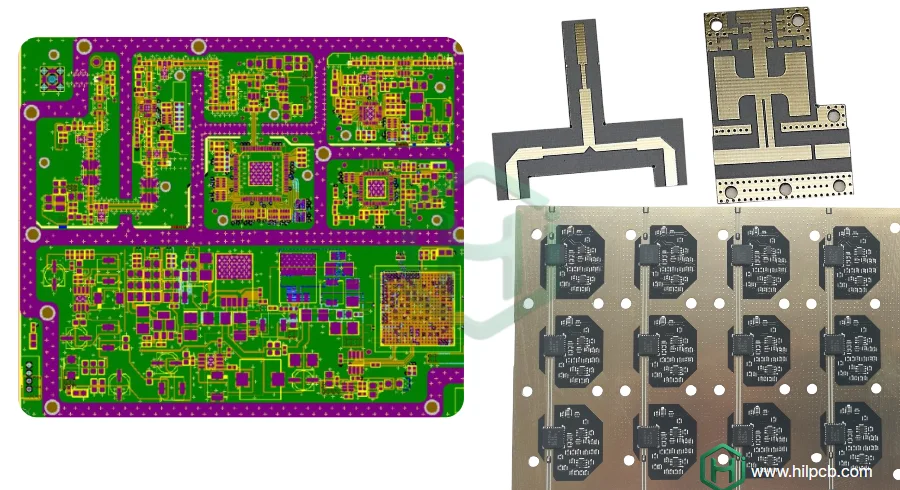
A Rogers PCB supplier is a fabricator or manufacturing partner that can source the specified Rogers laminate, preserve lot and material identity, convert the released RF stack-up into controlled geometry, and provide the inspection and test evidence required by the design. Stock availability alone does not prove RF process capability.
Key Takeaways
- Select the laminate from frequency, loss, circuit size, thermal, mechanical, flame-rating, processing, and cost requirements together.
- Use the current grade-specific design Dk and copper option for impedance work; do not substitute a family name or nominal Dk.
- Require material identity, lot traceability, pressed stack-up, impedance evidence, and change control in writing.
- Confirm that the fabricator has a validated process for the exact PTFE, hydrocarbon-ceramic, or hybrid construction.
- Send RF, mechanical, thermal, test, and documentation requirements with the RFQ.
How Should a Rogers Laminate Be Selected?
Start with the worst-case electrical and environmental requirement, then relax toward cost and process simplicity. Higher Dk can shrink resonators and antennas but changes line geometry and tolerance sensitivity. Lower dissipation factor reduces dielectric loss, yet conductor roughness, copper profile, surface finish, launch design, connectors, radiation, and fabrication variation still contribute to the channel.
Hydrocarbon-ceramic RO4000 materials process closer to FR-4 than PTFE-based families and are common in multilayer and hybrid boards. PTFE composites can provide very low loss or high-Dk options but need material-specific preparation, bonding, drilling, plating, registration, and handling. TMM thermoset materials offer another balance of Dk, mechanical stability, and processing.
The values below are representative published data near 10 GHz, not universal acceptance limits. Confirm the current Rogers datasheet, test method, thickness, copper type, tolerance, design Dk, and intended frequency before release.
| Grade | Representative Dk / Df | Useful selection reason | Main manufacturing question |
|---|---|---|---|
| RO3003 | Dk about 3.00; Df about 0.0010 | Low-loss RF, filters, feeds, phased-array structures | Can the supplier control the selected PTFE construction and copper? |
| RO3010 | Dk about 10.2; Df about 0.0022 | Circuit miniaturization at high Dk | How will geometry, thickness and registration tolerances affect tuning? |
| RO4003C | Process Dk about 3.38; Df about 0.0027 | Broadband RF with FR-4-like multilayer processing | Which design Dk and copper option are used in the field solver? |
| RO4350B | Process Dk about 3.48; Df about 0.0037 | Multilayer RF where UL 94 V-0 may be required | Are flame rating, prepreg, hybrid bonding and CAF requirements defined? |
| RT/duroid 5880 | Dk about 2.20; Df about 0.0009 | Very low-loss radar, SATCOM and microwave structures | How are soft PTFE handling, plating and dimensional stability controlled? |
| TMM family | Dk options from roughly 3 to 10 | Thermoset processing and Dk/CTE choices | Is the exact grade compatible with the multilayer and thermal design? |
RO4003C, RO4350B, and RT/duroid 5880 are not drop-in substitutes. A change in Dk, thickness, copper, resin system, loss, thermal expansion, or flame rating changes line width, resonator dimensions, processing, and often qualification evidence.
What RF and Fabrication Failures Should Be Prevented?
| Failure mode | Likely cause | Prevention or evidence |
|---|---|---|
| Impedance or phase drift | Wrong Dk, thickness, copper, etch or lot assumptions | Released stack-up, grade and copper identity, coupons, TDR or RF measurement plan |
| Excess insertion loss | Dielectric, rough copper, long route, finish, launch or connector loss | Channel budget using representative material and manufactured geometry |
| Delamination or weak plating | Incompatible surface preparation, bonding or thermal process | Grade-specific process controls, coupons, microsection and reliability evidence |
| Via or pad cracking | CTE mismatch, geometry, lamination or thermal cycling | Hybrid-stack review, via design, material pairing and product-specific qualification |
| Filter or antenna detuning | Geometry and Dk variation, solder mask, enclosure or assembly change | Tolerance analysis, RF coupons or test structures, installed-state tuning |
| Mixed or unapproved material | Weak receiving, storage, replenishment or change control | Purchase documents, CoC, lot identity, traveler records and substitution approval |
RF performance is a system result. PCB impedance evidence does not by itself prove antenna efficiency, filter response, EVM, output power, receiver sensitivity, radar range, or protocol compliance.
What Evidence Should a Rogers PCB Supplier Provide?
Ask for evidence that matches your risk rather than a generic certificate bundle:
- Exact laminate, prepreg or bond-ply, dielectric thickness, copper type and weight, lot or date identity, and material certificates
- Proposed pressed stack-up, impedance calculation assumptions, design Dk, etch compensation, and coupon design
- Confirmation of material-specific drilling, desmear or activation, plating, lamination, handling, storage, and bake controls
- Fabrication capability for the required registration, line and space, via type, backdrill, cavity, finish, outline, thickness, and warpage
- Electrical test, AOI, microsection, TDR, dimensional, cleanliness, solderability, thermal or RF test evidence as contracted
- Nonconformance, rework, traceability, record-retention, change-notification, and requalification procedures
Quality-management certificates apply only to the entity, site, scope, and validity shown on the certificate. They do not certify a laminate lot, PCB construction, RF result, or final product.
How Can Hybrid Rogers and FR-4 Stack-Ups Reduce Cost?
A hybrid stack can place low-loss material only on RF layers while using compatible FR-4-family materials for digital, control, or power layers. This can reduce recurring material cost, but it adds bonding, resin-flow, thickness, CTE, registration, skew, and reliability questions. The stack must be developed with the fabricator before layout, then validated as the released construction.
Avoid an unnecessary full-board premium laminate when only a short RF region needs it. Also avoid a hybrid solely for cost if it creates an unqualified via, lamination, or thermal-cycling risk.
Rogers PCB RFQ Checklist
Material and construction
- Exact Rogers grade or performance requirement, thickness, copper type and weight, bond-ply or prepreg, layer count, and full stack-up
- Hybrid-material boundaries, via structures, backdrill or cavity details, finish, solder mask, final thickness, outline and tolerances
- Approved material source, certificates, lot traceability, storage, substitutions, and change-control requirements
RF, thermal and mechanical
- Frequency range, topology, target impedance and tolerance, insertion-loss or phase limits, reference models, and coupon or de-embedding method
- Power, heat flux, temperature range, thermal interfaces, copper temperature rise, environmental stress and reliability requirements
- Connector, antenna, enclosure, launch, keepout, mounting and mechanical interface data
Inspection, test and program
- Electrical test, AOI, microsection, TDR, VNA or application-specific RF tests with methods, sample plans, limits and reports
- PCB assembly scope, BOM, solder alloy, inspection, X-ray, cleaning, programming and functional-test requirements
- Prototype and production quantities, forecast, target dates, panel assumptions, packaging, retained records and requalification triggers
Reference Standards and Responsibility Scope
- IPC-4103 — IPC
- IPC-6018 — IPC
- IPC-6012 — IPC
- IPC-A-600 — IPC
- IPC-2141 — IPC
- IPC-TM-650 — IPC
- Current Rogers grade-specific datasheet and processing guidance
The purchase specification should state revision, applicability, sampling, acceptance, and precedence. HILPCB can support contracted material review, stack-up development, fabrication, assembly, inspection, traceability, and test reporting. The customer retains ownership of circuit simulation, RF architecture, antenna or module performance, thermal design, environmental qualification, regulatory approval, and final system acceptance unless explicitly assigned.
Why Ask HILPCB to Review a Rogers-Laminate PCB Build?
HILPCB can review suitable high-frequency PCB projects for laminate choice, hybrid stack-up, manufacturability, controlled impedance, fabrication, assembly, inspection, and test planning. Confirm stock, source, exact capability, certificates, lead time, and evidence for the released construction in the RFQ. The strongest supplier response makes assumptions and exclusions visible before purchase.
Frequently Asked Questions
How do I choose between RO4003C and RO4350B?
Compare the current datasheets, design Dk, loss, flame rating, thickness and copper options, multilayer construction, environment, and cost. Their different electrical properties require line geometry to be recalculated.
When is RT/duroid 5880 justified?
It is considered when its very low loss and Dk fit the circuit budget and the program can support PTFE-specific fabrication. Use channel or circuit analysis rather than frequency alone.
Does a Rogers certificate prove the finished PCB's RF performance?
No. It supports material identity or supplied properties. Finished performance also depends on stack-up, geometry, copper, plating, solder mask, launches, assembly, enclosure, and system tuning.
Should every Rogers PCB receive TDR testing?
Not necessarily. TDR is useful for specified transmission-line impedance, but resonators, filters, antennas, couplers, and mmWave structures may need different coupons or RF measurements. Define the test from the acceptance risk.
What is the most important supplier audit question?
Ask the supplier to trace a sample finished panel back to the exact material lot, released stack-up, process route, coupon or test result, nonconformance history, and shipment record.
Select the Process With the Material
The best Rogers grade cannot compensate for an uncontrolled stack-up or unsuitable fabrication route. Release the material, geometry, processing assumptions, and acceptance evidence together, then ask HILPCB to quote that complete construction.