
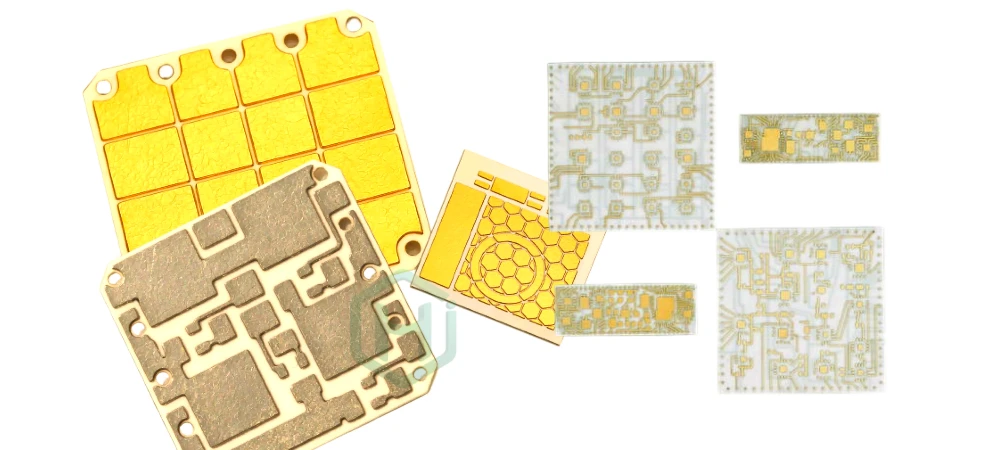
As a full-spectrum PCB manufacturing and assembly provider, we build everything from standard FR4 and HDI to rigid-flex, MCPCB, high-frequency, and ceramic technologies.
Within this capability set, the Al2O3 ceramic circuit board is one of our key options when customers need high dielectric strength, stable thermal behavior, and long service life in harsh environments.
Compared with AlN, an Al2O3 ceramic circuit board offers lower thermal conductivity but excellent electrical isolation, mechanical strength, and a far more attractive cost level for medium-power and high-reliability designs in medical, industrial, and high-voltage applications.
Why Choose an Al2O3 ceramic circuit board?
An Al2O3 ceramic circuit board is not meant to replace every PCB in your system. It is usually reserved for high-stress zones where FR4, standard MCPCB, or basic high-thermal laminates are no longer sufficient.
Key Advantages of Al2O3 ceramic circuit board Solutions
High dielectric strength
Well suited for high-voltage power supplies, isolation barriers, medical equipment, and safety-critical interfaces.Balanced thermal performance and cost
With thermal conductivity around 20–30 W/m·K, an Al2O3 ceramic circuit board sits between organic boards and AlN, making it a cost-effective choice for medium-power designs that still need solid heat dissipation.Chemical and environmental stability
Al2O3 substrates are resistant to moisture, chemicals, and aggressive cleaning processes, making them ideal for industrial and medical environments.Dimensional stability and flatness
Tight flatness and low CTE support precise sensors, implantable devices, high-frequency communication modules, and tight-tolerance assemblies.
In many projects, we combine Al2O3 ceramic circuit board sub-modules with standard FR4 PCB, Multilayer PCB or other ceramic PCB technologies to balance performance, complexity, and cost at the system level.
Metallization and PCB Processing on Al2O3
We are not a raw ceramic material manufacturer. Instead, we work with qualified Al2O3 substrate suppliers and focus on converting those substrates into manufacturable, testable Al2O3 ceramic circuit boards.
Core Process Options on Al2O3
Thick-film metallization
Screen-printed and fired conductors, resistors, and dielectrics on Al2O3 for hybrid ICs, precision resistor networks, and sensor electronics that require long-term stability.Copper-based power structures
Copper patterns and pads on Al2O3 ceramic circuit boards for LED drivers, power stages, and high-voltage interfaces that need better heat flow and current capacity than standard FR4.Precision laser drilling and contouring
High-precision laser drilling and cutting for holes, slots, and complex outlines on dense Al2O3, with controlled edge quality and minimal chipping to protect reliability during assembly and operation.Solderable surface finishes
Application of suitable finishes (for example, Ni/Au or Ag) to ensure robust solderability and long-term contact stability for both power and signal pins.
Our role is to turn your Al2O3 ceramic circuit board design into real production panels that can be assembled, inspected, and shipped consistently.
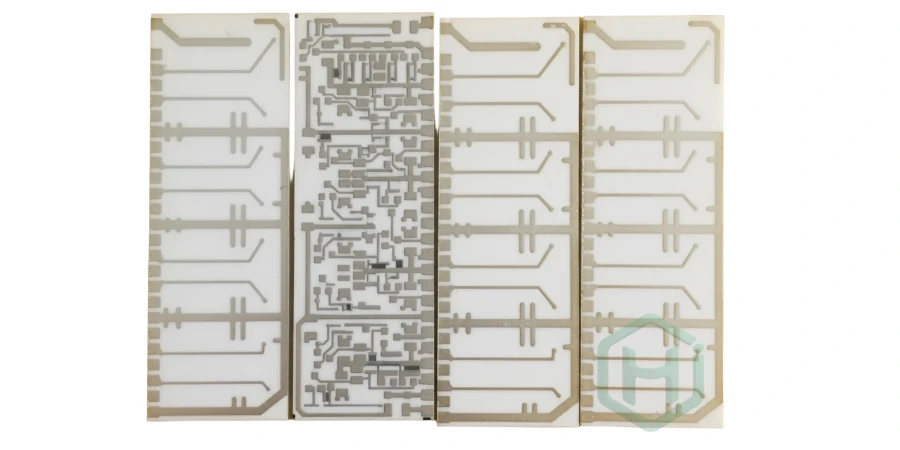
Turnkey Assembly and System Integration on Al2O3
Most Al2O3 ceramic circuit boards function as critical sub-modules inside a larger system—such as high-voltage, high-temperature, or high-accuracy measurement sections. Because we are both a PCB and assembly factory, we can manage the ceramic sub-board and the surrounding electronics in one integrated project.
What Our Al2O3 Turnkey Service Can Include
Bare-die and package attach
Solder, epoxy, or sintered die attach for sensors, power devices, or analog ICs directly on the Al2O3 ceramic circuit board when the design calls for it.Wire bonding and high-reliability interconnects
Gold or aluminum wire bonding for sensor inputs, RF paths, and high-voltage nodes, with bonding strategies tuned to your reliability and cost requirements.SMT and mixed-technology assembly
Surface-mount components, connectors, and passives assembled on the Al2O3 board, and on companion FR4 or rigid-flex PCB boards, to create compact, system-level modules.Sub-module to main PCB integration
Mechanical and soldered integration of the Al2O3 ceramic circuit board onto a main control board using reflow, press-fit, or fixture-based approaches, ensuring robust mechanical support and repeatable electrical performance.Final test options
Optional functional tests, insulation and hipot testing, and environmental stress screens to align with your qualification plan for medical, industrial, automotive, or communication equipment.
This means you do not have to coordinate separate ceramic vendors, board fabs, and assembly houses—one team can handle the full Al2O3 ceramic circuit board sub-system from bare substrate to tested module.
DFM, Quality, and Application Coverage for Al₂O₃ ceramic circuit board Projects
Al₂O₃ ceramic circuit board designs typically carry higher reliability expectations, longer lifetimes, and tighter safety margins. We treat them as platform technologies that must stay stable from first prototype through long-term mass production, across multiple industries.
How We Support DFM and Quality
Early DFM and technology selection
We review your schematics, power levels, voltage classes, and mechanical constraints to determine where an Al₂O₃ ceramic circuit board is genuinely required and where FR4, MCPCB, or other materials are more appropriate. This avoids over-engineering and keeps the overall BOM under control.Panel utilization and cost optimization
By optimizing panel layout, board sizes, and variant combinations, we increase panel utilization and reduce scrap, lowering effective cost per Al₂O₃ board without compromising quality or test coverage.Process control and traceability
We maintain lot-level traceability from incoming Al₂O₃ substrates through metallization, drilling, profiling, and assembly steps. Process capability and inspection data are tracked so that volume builds behave like proven prototypes, not “new experiments.”Reliability and environmental testing options
For high-reliability projects, we can support thermal cycling, temperature-humidity, and other stress tests to confirm metallization adhesion, solder joint integrity, and long-term stability under real operating conditions.
Typical Application Domains We Support
Because we also manufacture FR4, HDI, rigid-flex, MCPCB, and other PCB types, an Al₂O₃ ceramic circuit board can be integrated into a very wide range of products:
- Medical electronics – Imaging front-ends, RF coils, high-voltage generators, implantable or surgical tools that require stable isolation and biocompatible materials.
- Industrial and high-voltage systems – Motor drives, high-voltage power supplies, measurement and protection circuits that must operate reliably in harsh environments.
- Communications and RF – Stable, low-loss support for RF front-ends, microwave links, and precision reference circuits where temperature drift and mechanical movement are unacceptable.
- Automotive and transportation – High-temperature, vibration-exposed sub-modules in charging, power conversion, and high-voltage sensing.
- Aerospace and defense – Rugged electronics exposed to wide temperature swings, vacuum, or aggressive cleaning and maintenance regimes.
In each of these areas, our job is to help you decide:
- Where an Al₂O₃ ceramic circuit board is the right tool for reliability, safety, or precision;
- Where more conventional PCB technologies are sufficient and more economical;
- And how to combine them in a single, manufacturable, testable design that scales from prototypes to stable series production.