
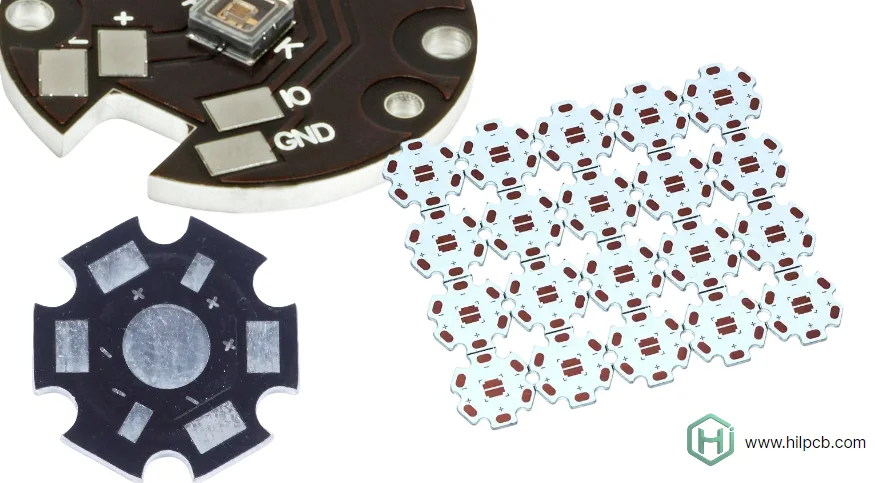
An aluminum PCB supplier manufactures an insulated metal substrate (IMS) in which copper circuitry is electrically isolated from an aluminum base by a thermally conductive dielectric. Selecting one requires proof that the quoted construction, process, and evidence will meet the product's thermal, electrical, mechanical, assembly, and traceability requirements—not just a low price or a high thermal-conductivity headline.
Key Takeaways
- Freeze the dielectric, copper, aluminum base, finish, outline method, and acceptance evidence before comparing quotes.
- Compare thermal resistance, isolation, and test method at the construction level; dielectric thermal conductivity alone does not predict component temperature.
- Treat management certificates, UL recognition, material declarations, and product qualification as separate evidence.
- Qualify the supplier in stages: document review, DFM, first article, assembled thermal correlation, then pilot-lot and change-control approval.
- Require production changes to be documented and requalified where they affect prior evidence.
- Make suppliers list assumptions, substitutions, tooling, tests, and recurring data in a normalized RFQ.
Table of Contents
- What must an aluminum PCB supplier control?
- Why thermal conductivity is not enough
- Supplier evidence gates
- How to compare certifications correctly
- Five-stage supplier qualification
- How to normalize aluminum PCB quotes
- Common sourcing failures
- Aluminum PCB supplier RFQ checklist
- Reference standards and responsibility boundaries
- What can HILPCB support?
- Frequently asked questions
What Must an Aluminum PCB Supplier Control?
A single-sided IMS board contains copper, an electrically insulating thermal dielectric, and an aluminum plate. Added circuit layers, plated holes, isolation clearances, or two-sided assembly change fabrication risk and the thermal path.
Ask a supplier to identify the exact construction it is quoting, not merely “aluminum PCB.” The controlled package should cover:
| Construction item | Why it matters | Evidence to request |
|---|---|---|
| Dielectric product and thickness | Drive thermal resistance and electrical isolation | Datasheet, declared construction, tolerance and alternate rule |
| Dielectric thermal data | Values depend on test method, specimen, temperature, and reporting convention | Thermal conductivity or thermal impedance with method and conditions |
| Aluminum base | Alloy, temper, thickness and flatness affect machining and heat spreading | Material designation, tolerance and traceability requirements |
| Copper and geometry | Affect current, heat spreading, etching and soldering | Finished copper, design rules and first-article measurements |
| Holes and metal isolation | An unintended connection to the metal base can create a short or insulation failure | Hole construction drawing, section evidence and electrical test plan |
| Profile and panelization | Routing, punching and V-scoring create different edge and yield risks | Panel drawing, profile method, tolerance report and edge acceptance |
| Finish and solder mask | Affect solderability, optics, storage and assembly | Exact finish/mask, required coverage and shelf-life controls |
Capability tables screen suppliers; only written confirmation against released files commits a construction.
Why Thermal Conductivity Is Not Enough
Competitor pages often rank substrates by a single W/m·K value. That number is incomplete. For a uniform layer, thermal resistance scales approximately with thickness divided by conductivity and area:
Rθ ≈ t / (k × A)
A thin moderate-conductivity dielectric can have lower resistance than a thicker high-conductivity one, but may reduce isolation margin or robustness. Junction-to-ambient performance also includes component attachment, copper/aluminum spreading, interface material, heatsink, enclosure and airflow.
Request dielectric identity and thickness, thermal-data method, isolation test, design voltage/transients, copper area, mounting interface, ambient and cooling conditions together. Datasheet breakdown voltage is not automatically an allowable working voltage; creepage, clearance, pollution, aging and end-product safety still apply.
“High thermal conductivity” without construction and method is not comparable evidence.
Supplier Evidence Gates
Use gates instead of a subjective supplier score; a missing safety or construction gate stops release.
| Gate | Pass evidence | Red flag |
|---|---|---|
| Construction control | Exact stack, controlled materials, tolerances and substitution procedure | Quote names only “1.5 W/m·K aluminum” |
| DFM ownership | Marked-up isolation, spacing, hole, profile and assembly risks | Generic “files checked” response |
| Measurement capability | Method, equipment, sample plan, limits and data format for each required test | Lists AOI or electrical test without saying what it proves |
| First-article traceability | Lot-linked material, dimensional, section and electrical records | Undated unrelated sample report |
| Production change control | Written notification/reapproval triggers for material, site, stack, tooling and process | “Equivalent material may be used” with no approval route |
| Assembly correlation | Reflow plan and thermal-test interface when PCBA is included | Reuses an FR-4 profile without validation |
AOI, electrical test, microsection and thermal testing answer different questions; none substitutes for the others.
How to Compare Certifications Correctly
Ask for documents and scope rather than logos.
- Verify a management certificate's issuer, legal entity, site, scope, validity and coverage of the quoted production site.
- IATF 16949 does not by itself approve an automotive part, control plan, PPAP, or customer-specific requirements.
- UL recognition should be checked against the supplier file and the exact material/construction parameters. UL 796 covers printed wiring boards as components and explicitly does not make an end product acceptable without further investigation.
- RoHS or REACH declarations do not prove thermal, insulation, workmanship or reliability performance.
- State IPC criteria, edition/addenda and exceptions in the purchase documentation; “IPC compliant” is insufficient.
Five-Stage Supplier Qualification
- Desktop audit: review capability, certificates, materials, sample records, traceability, nonconformance flow and change control.
- DFM and quote freeze: resolve the stack, material/test methods, tolerances, isolation, profiling, panelization and assembly assumptions. Record every deviation.
- First article: verify dimensions, specified flatness, copper/features, hole isolation, electrical test, finish, workmanship and lot-linked materials.
- Assembled correlation: run the actual reflow profile and validate temperatures using defined power, sensors, interface material, mounting force, heatsink, ambient and airflow. Compare results with the thermal model and acceptance limits.
- Pilot and release: check repeatability, yield/failure disposition, packaging and recurring reports; freeze change and requalification triggers.
Prototype success does not qualify an altered production construction; repeat evidence affected by a change.
How to Normalize Aluminum PCB Quotes
Two prices are comparable only when their assumptions match. Put the following columns into one bid sheet:
| Quote field | Supplier must state |
|---|---|
| Construction | Material family/product, dielectric thickness and data method, aluminum alloy/temper/thickness, finished copper and total thickness |
| Fabrication | Minimum rules actually used, hole/isolation method, outline method, panel utilization, finish, solder mask and accepted tolerances |
| Evidence | Electrical test, inspection, microsection, thermal/isolation/dimensional data, sample size and recurring versus one-time reports |
| Commercial | Quantity breaks, tooling/NRE, material minimums, yield assumptions, standard and expedited schedule, packaging and shipping basis |
| Exceptions | Every substitution, drawing conflict, unavailable requirement and proposed alternative |
| Change control | Notification period, approval route and requalification responsibility |
Cost drivers include dielectric, metal/copper thickness, panel utilization, profiling, unusual cutouts, tight dimensions, mask, test data, assembly profiling and material minimums. Avoid unjustified tolerances or premium materials.
Common Sourcing Failures
| Failure | Why it happens | Prevention |
|---|---|---|
| Prototype runs cool; production runs hot | Material/thickness changed or test setup varied | Freeze construction and correlation conditions |
| Hi-pot/isolation failure | Working-voltage assumptions, edge spacing, hole isolation or contamination were missed | Release electrical-isolation requirements and inspect the actual construction |
| Board rocks on the heatsink | Flatness, burrs or mounting stack was unspecified | Define interface/edge acceptance and inspect fit |
| Solder defects after switching from FR-4 | Higher thermal mass changed the reflow response | Develop and record a profile on the real panel and component mix |
| Lowest quote becomes most expensive | Testing, tooling, material minimums or deviations were excluded | Normalize inclusions and price exceptions before award |
| Certificate does not apply | Wrong site, scope or recognized construction | Verify the document/file and production route |
Aluminum PCB Supplier RFQ Checklist
Design and construction
- Gerber X2 or ODB++/IPC-2581 as accepted, NC drill, netlist, profile and revision readme;
- stack drawing with copper, dielectric, aluminum base, finished thickness and tolerances;
- material performance requirements with test methods, not conductivity alone;
- voltage, isolation, creepage/clearance and any metal-base keep-out requirements;
- board dimensions, datums, holes/slots, flatness/interface and profile-edge criteria.
Product and assembly conditions
- component power, temperature limits, duty cycle, ambient and cooling;
- thermal-interface material, heatsink/cold plate, mounting pattern and torque;
- BOM, placement, solder paste, reflow limits and required thermal-profile data if assembled;
- operating/storage environment and product-life targets.
Quality and supplier response
- applicable standards, certificate/site scope and customer-specific requirements;
- first-article and recurring electrical, dimensional, section, material and thermal/isolation evidence;
- quantities, pilot/production stages, serialization, packaging and traceability;
- proposed construction, DFM findings, exceptions, alternates, tooling, lead-time assumptions and change-control triggers.
Reference Standards and Responsibility Boundaries
Applicable references may include:
- IPC-2221 and IPC-2222, generic and rigid-board design requirements
- IPC-4101, base materials for rigid and multilayer printed boards
- IPC-6012 and IPC-A-600, rigid-board qualification/performance and acceptability
- IPC-TM-650, test methods selected by the purchase specification
- J-STD-001 and IPC-A-610 when assembly is included
- UL 796, printed wiring boards
- UL 94, flammability of plastic materials, where applicable
- IATF 16949 and customer-specific automotive requirements when contractually applicable
Use the exact edition, test method, class, construction and acceptance limit. The PCB supplier owns only the contracted fabrication/assembly process and evidence. The product owner retains responsibility for thermal design, working voltage, safety, EMC, environmental qualification, integration and end-product release.
What Can HILPCB Support?
Use HILPCB's metal-core PCB and high-thermal PCB routes to start a construction review. If assembly is required, define the profile and thermal-test boundary through turnkey assembly. The Gerber Viewer can support file review before submission.
Send the normalized RFQ and ask HILPCB to confirm the exact material, construction, tolerances, testing, records, exceptions and production-change controls in writing. Submit the released package through the quote page; capability is committed only by the reviewed quotation and order documentation.
Frequently Asked Questions
What should be checked first when choosing an aluminum PCB supplier?
Check whether it can control the exact dielectric, aluminum base, copper, profiling method and evidence. Generic capability claims do not pass this gate.
Is higher dielectric thermal conductivity always better?
No. Resistance also depends on thickness and area, while isolation imposes competing constraints. Validate the complete assembled thermal path.
Does UL recognition mean the finished product is UL approved?
No. Verify that the recognized construction covers the quote. UL 796 treats the board as a component; the end product still needs applicable investigation.
Should the same supplier build the PCB and assemble it?
Not necessarily. Integrated supply can simplify DFM and profiling, but a separate assembler is acceptable when interfaces, evidence and change control are explicit.
What should trigger requalification?
Assess changes to materials, thickness, stack, site, hole isolation, tooling, finish, assembly or thermal interface. Repeat every affected qualification step.
Conclusion
The right aluminum PCB supplier is the one that can hold a defined construction, show evidence that answers each risk, and control changes from prototype through production. Normalize the RFQ, gate the evidence, correlate the assembled thermal path, and award business only after assumptions and responsibilities are explicit.