

Digital pianos bridge acoustic piano tradition with modern electronics, delivering authentic playing experiences through sophisticated sampling and weighted key action. The Electronic Piano PCB determines every aspect of performance—from capturing subtle dynamics across 88 weighted keys to reproducing concert grand samples with studio-quality fidelity.
HILPCB provides professional PCB fabrication and PCBA assembly services for piano manufacturers, delivering the audio-grade manufacturing quality that discerning pianists expect.
Menu Navigation
- Weighted Key Action and Velocity Sensing
- Hi-Fi Audio System Architecture
- Piano-Specific Feature Implementation
- Multi-Board System Integration
- Audio-Quality Testing for Piano PCBs
Weighted Key Action and Velocity Sensing
Authentic piano feel requires sophisticated key sensing that captures every nuance of the player's touch across the full 88-key range. Consistent PCB quality ensures uniform velocity response across all keys—manufacturing variations that cause key-to-key inconsistency destroy the playing experience.
88-key scanner boards require tight tolerances for consistent velocity sensing performance.
Key Sensing Elements
- Dual-Contact Timing Systems: Two switch contacts measuring hammer velocity through time-difference calculation with ≤10µs timer resolution achieving smooth 127-step velocity curves.
- Triple-Sensor Integration: Three contact points enabling velocity plus key position data for half-pedaling simulation, let-off modeling, and escapement feel reproduction.
- Optical Sensing Options: Contactless IR LED/phototransistor pairs providing continuous key position with excellent longevity for premium and hybrid key actions.
- 88-Key Scanner Architecture: 8×11 or 9×10 matrices with high-speed multiplexing and anti-ghosting diodes, 2kHz+ scan rates capturing fastest repeated notes.
- Calibration Data Storage: Non-volatile memory for per-key velocity curve adjustment compensating for mechanical variations across the keybed.
- Aftertouch Options: Channel aftertouch (single FSR strip) or polyphonic aftertouch (per-key sensing) implementations.
Manufacturing for 88-Key Consistency
88-key scanner PCBs require consistent copper weight for stable reference voltages across the entire scanning matrix, reliable via connections for all 88+ sensor positions, and uniform solder quality on every multiplexer and ADC connection.
Hi-Fi Audio System Architecture
Digital pianos must deliver audio quality matching acoustic piano recordings. Audio PCB fabrication quality directly affects achievable specifications—noise, distortion, and frequency response depend on ground plane integrity, power supply filtering, and manufacturing cleanliness.
Professional piano audio demands audio-grade fabrication and assembly practices.
Audio System Elements
- High-Resolution DAC Selection: Professional converters (PCM1794A, AK4490, ES9038PRO) with 24-bit/96kHz+ capability, achieving >110dB dynamic range and <0.005% THD.
- Low-Jitter Clock Design: Ultra-low-jitter crystal oscillators (<1ps RMS) with clean distribution networks ensuring bit-perfect audio conversion.
- Output Stage Architecture: Premium op-amps (OPA1612, AD797) in I-V conversion and output buffering with balanced XLR options for professional installations.
- Headphone Amplifier Integration: Dedicated headphone stages providing 50mW+ into 32Ω with <1Ω output impedance for critical monitoring.
- Noise Floor Management: Ground plane strategy with analog/digital separation achieving >100dB SNR, comprehensive shielding, and power supply filtering.
- Multi-Channel Outputs: Stereo main, assignable outputs, and dual headphone jacks with independent level control and routing.
Audio-Grade PCB Fabrication
Audio applications require multi-layer construction (4-6 layers) with dedicated power and ground planes, consistent copper weight for stable power distribution, and clean surface finishes (ENIG recommended) for reliable audio component soldering.
Piano-Specific Feature Implementation
Digital pianos include specialized features designed for piano playing and practice. Proper pedal sensing, resonance modeling connections, and recording interfaces require reliable PCB implementation and robust connector mounting.
Feature reliability depends on manufacturing quality throughout the product lifetime.
Piano Feature Elements
- Sophisticated Pedal Systems: Continuous half-pedaling for sustain, sostenuto with note tracking, soft pedal with tonal change, all with proper signal conditioning and debouncing.
- Resonance Modeling Integration: DSP connections for string resonance, damper resonance, and soundboard simulation processing.
- Recording Capability: Internal MIDI recording with song storage, USB audio streaming for computer recording, with proper file system support.
- Practice Features: Metronome with configurable time signatures, split/layer modes for duet practice, and recording playback.
- Professional Connectivity: Main L/R outputs (balanced XLR optional), dual headphone jacks, USB-MIDI, and traditional 5-pin MIDI.
- Audio Input Integration: Aux input for backing tracks with proper level matching and mixing into outputs.
Manufacturing for Feature Reliability
Piano PCBs combine delicate audio circuits with robust connector mounting for years of use. Mixed-technology assembly handles both SMT electronics and through-hole jacks, pedal connectors, and MIDI DIN connections.
Multi-Board System Integration
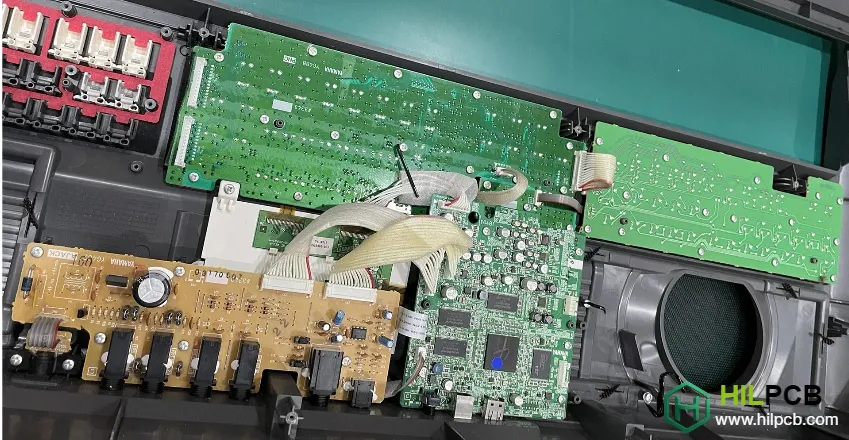
Full-size digital pianos typically distribute functions across multiple PCBs. Consistent manufacturing quality across all boards ensures reliable system operation, while proper connector selection and assembly provides dependable inter-board communication.
Complete piano systems require unified quality control across all PCBs.
System Integration Elements
- Board Function Allocation: Main processor, 88-key scanner, audio output, control panel, and power supply boards partitioned for manufacturing and thermal management.
- High-Speed Keybed Interface: Parallel bus or high-speed SPI (10MHz+) between keybed scanner and main board with controlled impedance routing.
- Audio Bus Implementation: I2S routing between main processor and audio board with low-jitter master clock distribution and proper ground referencing.
- Power Distribution: Centralized or distributed power architecture with proper cable sizing, connector selection, and protection.
- Thermal Management: DSP and power components positioned for adequate cooling across board set.
- Dimensional Coordination: Matching board dimensions ensuring proper fit in piano chassis.
Multi-Board Manufacturing
Piano systems benefit from manufacturing all boards under consistent quality control. Unified assembly processes ensure matching quality throughout the board set.
Audio-Quality Testing for Piano PCBs
Digital pianos require audio performance testing beyond standard electrical verification. HILPCB provides audio-specific testing protocols validating that your piano PCBs meet the sonic specifications discerning pianists expect.
Why Choose HILPCB for Piano PCB
Audio Performance Measurement
Beyond basic functional testing, we validate audio specifications including THD+N, noise floor, frequency response, and channel separation. Testing catches audio issues before boards ship—preventing field failures that damage brand reputation.
88-Key Uniformity Verification
For keybed scanner boards, we verify consistent ADC performance across all 88 key positions. Automated testing identifies any keys with marginal response before system integration.
Clean Assembly Environment
Audio circuits demand assembly cleanliness. Our processes include thorough flux residue removal and inspection under UV light—eliminating contamination sources that cause hiss and intermittent noise in the field.
Long-Board Fabrication
88-key scanner boards are often 400mm+ in length. Our FR4 PCB fabrication maintains dimensional accuracy and flatness across long boards, ensuring consistent fitment in keyboard chassis.
Multi-Layer Audio Boards
Piano audio boards require 4-6 layer construction with dedicated power/ground planes. Multilayer PCB production maintains the plane isolation your audio engineer designed for lowest noise.
Stage-Durability Testing
Stage pianos face demanding environments. We can perform thermal cycling and vibration screening validating durability for professional touring use.
- Small batch assembly for prototype piano systems with audio testing
- Large volume assembly with SPC monitoring for consistent quality
- Turnkey assembly sourcing audio-grade components through authorized channels
Request audio testing capabilities in your quote for piano-specific quality assurance.
Common Questions
What makes an electronic piano PCB project different from a basic MIDI input design?
Electronic piano systems usually combine long key-scanning boards, audio circuitry, control logic, and mechanical integration in one product. That means the design has to balance signal quality, dimensional stability, and consistent key response instead of focusing only on simple digital input.
Why are long-board accuracy and clean assembly so important for electronic pianos?
Scanner boards for 88-key systems are often physically long, so flatness and dimensional control directly affect fit and key consistency. Clean assembly also matters because flux residue and contamination can degrade low-noise audio performance and create intermittent field issues.
What should be verified before an electronic piano PCB moves into production?
Teams should verify audio metrics, key-to-key uniformity, multilayer stackup behavior, and environmental durability before release. Production is safer when both musical performance and stage-use reliability have been validated together.