
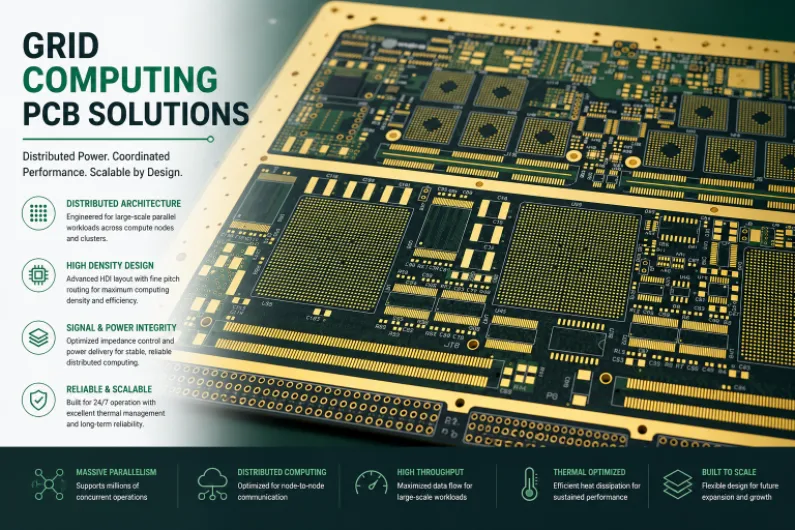
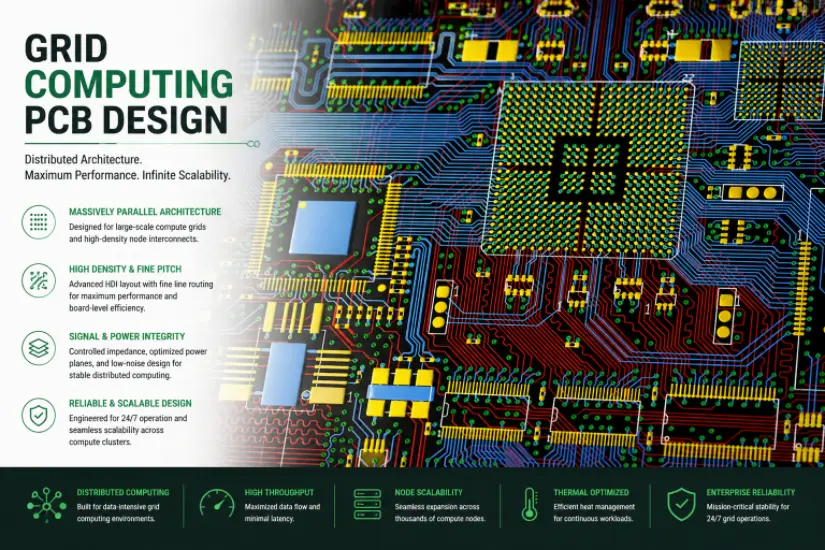
The Worldwide LHC Computing Grid (WLCG) alone comprises over 170 computing centers across 42 countries, processing 200 petabytes of collision data annually from the Large Hadron Collider. Grid computing — powering scientific programs at CERN (Switzerland), Fermilab (United States), DESY (Germany), KEK (Japan), and INFN (Italy) — connects geographically dispersed computing resources into a unified processing fabric that enables organizations to tackle computational problems too large for any single institution's hardware. From particle physics event reconstruction at CERN to pharmaceutical molecular dynamics simulation and pan-European climate modeling across national weather services, grid computing harnesses thousands of autonomous nodes coordinated by middleware (gLite, HTCondor, DIRAC) that schedules jobs, manages data movement, and monitors resource availability.
What distinguishes a grid computing PCB from a standard server board is the operational context: these nodes operate autonomously at remote sites, communicate through wide-area networks with variable latency and bandwidth, must function independently during connectivity outages, and are serviced by local staff who may not have PCB-level diagnostic expertise. The Grid Computing PCB must deliver sustained computational throughput across 7–10 years of continuous operation, interface reliably with heterogeneous network infrastructure, and maintain consistent performance across large populations deployed at sites with vastly different environmental conditions.
HILPCB supports multi-site grid deployments with phased production lots shipped directly to each installation — serving research institutions, national laboratories, and enterprise organizations building computational grids worldwide.
Menu Navigation
- Grid Node Architecture: Autonomous Operation by Design
- WAN-Optimized Network Interface Engineering
- Reliability Engineering for Always-On Scientific Workloads
- High-Throughput Storage for Petabyte-Scale Datasets
- Remote Diagnostics and Unmanned Site Operations
- Multi-Site Production Coordination
Grid Node Architecture: Autonomous Operation by Design
Grid nodes differ from cluster nodes in a fundamental architectural way — they must operate as fully autonomous computing systems that continue useful work when network connectivity degrades or disappears entirely. A grid node at a university computing center in São Paulo must cache incoming datasets locally, execute computation jobs to completion even during a 6-hour WAN outage, store results for later upload, and rejoin the grid seamlessly when connectivity restores — all without human intervention.This autonomy requirement drives PCB design decisions that have no parallel in cluster or cloud computing: integrated high-capacity local storage alongside compute resources, watchdog timers and hardware-level auto-recovery circuits, multiple network interfaces for redundant connectivity, and power management that handles the unclean shutdowns common at remote sites with imperfect UPS protection.
Grid-Specific Board Architecture
- Autonomous Compute + Storage Integration: Dual-socket server-class CPU layout (Intel Xeon or AMD EPYC) with integrated NVMe storage interfaces (4× PCIe Gen 4 x4 lanes routed directly to CPU root ports without switch overhead) alongside SATA III ports for bulk data staging — providing both high-IOPS checkpoint storage and high-capacity dataset caching on a single multilayer board.
- Heterogeneous WAN Networking: Dual 25GbE primary data interfaces (SFP28) with independent 1GbE management ports, each PHY on isolated routing domains with dedicated reference clocks — supporting both dedicated dark fiber connections at major laboratories and shared internet links at smaller university sites.
- Standard Rack Form Factors: 1U/2U form factors with EATX or proprietary board dimensions fitting standard 19" rack infrastructure at distributed sites — from purpose-built national laboratory computing halls to repurposed university server rooms with limited cooling capacity and older power distribution.
- Hardware Watchdog and Recovery: BMC-controlled hardware watchdog with automatic power cycling and POST monitoring — recovering from firmware hangs and OS kernel panics without requiring remote KVM access or on-site staff intervention.
WAN-Optimized Network Interface Engineering
Grid computing networks span buildings, campuses, continents, and oceans — connecting through infrastructure ranging from dedicated 100G dark fiber (between Tier-1 centers) to shared university internet connections operating at a fraction of available bandwidth. The PCB network interface must handle this variability while maintaining data integrity and security across untrusted network paths where packet loss rates of 0.01–0.1% are normal (versus <0.0001% within a datacenter).Network Interface Design
- Multi-Speed Ethernet with Quality-of-Service: 25GbE primary data interfaces with SFP28 connector-to-PHY routing following IEEE 802.3by guidelines — trace lengths under 100 mm for 25G and under 200 mm for 10G fallback on high-speed PCB layers. Hardware QoS classification engines enabling priority scheduling of control traffic over bulk data transfer.
- TCP/UDP Hardware Offload: Full-featured NIC with TCP segmentation offload (TSO), large receive offload (LRO), and RSS (receive-side scaling) — offloading protocol processing from CPU cores to dedicated silicon, freeing 5–15% of CPU cycles for grid workloads rather than network stack processing.
- Hardware Encryption Acceleration: Dedicated AES-NI instruction support augmented by hardware IPsec offload on the NIC — enabling line-rate WAN encryption without measurable CPU impact, essential for grid nodes communicating institutional research data over shared internet infrastructure between countries.
- Dedicated BMC Management Interface: Isolated 1GbE management port with IPMI 2.0/Redfish support on separate routing domain with independent power (powered even when main board is off) — enabling remote power control, console access, and sensor monitoring for nodes deployed at unstaffed remote sites.
Reliability Engineering for Always-On Scientific Workloads
Grid nodes run batch computational workloads that execute for hours, days, or weeks. A Monte Carlo particle physics simulation might run for 72 hours before producing results — a board failure at hour 71 doesn't just lose the node, it discards 71 hours of computation that must be restarted from the last checkpoint (typically every 4–8 hours). Board-level reliability directly determines computational efficiency at the grid scale — a fleet of 500 nodes with 99.9% individual availability still averages one node failure every 20 days, each potentially discarding hours of completed work.Reliability Design for Sustained Scientific Computing
- Component Derating for Decade-Long Service: Electrolytic capacitors derated 30% in voltage and temperature (not the standard 20%), ceramic capacitors specified as X7R or C0G for temperature stability, MOSFETs selected with thermal Rdson at worst-case junction temperature maintaining 25% margin above maximum steady-state current.
- Thermal Design for Sustained Load: Processor heat extraction through filled thermal via arrays (0.3 mm vias at 0.8 mm pitch, copper-filled) connecting to bottom-side heatsink mounting pads. Heavy copper inner planes (2–3 oz) providing lateral heat spreading from concentrated die footprints — maintaining junction temperatures 15°C below rated maximum under sustained 95% CPU utilization.
- Extended Solder Joint Qualification: SAC305 joints validated through 3,000+ thermal cycles per IPC-9701 at the application's actual operating range (0–85°C for indoor grid nodes, -20 to +70°C for nodes in semi-conditioned spaces) — exceeding standard 1,000-cycle qualification by 3× for infrastructure intended to operate continuously for a decade.
- Material Stability for Long Service: High-Tg FR-4 (Tg ≥ 175°C, Td ≥ 350°C, T260 > 60 min) preventing long-term dielectric degradation at sustained operating temperatures — validated through 10,000-hour accelerated aging at 125°C confirming <5% change in dielectric properties.
High-Throughput Storage for Petabyte-Scale Datasets
Grid computing workloads process and generate large datasets — terabytes per job for climate simulation, hundreds of gigabytes per run for genomics analysis, and petabytes annually for particle physics reconstruction. The PCB storage subsystem must support high-throughput sequential I/O (reading multi-terabyte input datasets from grid storage), high-IOPS random access (checkpoint/restart operations every 4–8 hours), and sufficient local capacity to cache datasets when WAN transfer rates limit real-time streaming.Storage Integration Design
- NVMe Direct-Attach for Performance Storage: PCIe Gen 4 x4 lanes routed directly from CPU root complex to M.2 or U.2 connectors with 85Ω controlled impedance, ±1 mil intra-pair skew, and insertion loss below 4 dB at 8 GHz — achieving full NVMe bandwidth (7 GB/s per drive) without PCIe switch overhead or added latency.
- High-Capacity SATA for Bulk Data: 6–8 SATA III ports with AHCI controller integration and properly terminated signal routing for reliable 6 Gbps operation — providing cost-effective bulk storage for dataset caching and result staging.
- Checkpoint Storage with Power-Loss Protection: Dedicated high-endurance NVMe partition (DWPD > 3) with supercapacitor-backed power-loss protection circuit — preserving computation state during unexpected power events at remote grid sites where UPS systems may be undersized or unmaintained.
- DMA-Optimized Data Paths: PCIe topology designed for direct NIC-to-NVMe transfers (P2P DMA) minimizing CPU involvement during dataset staging — the board routes network and storage PCIe lanes through common root complex enabling RDMA-to-storage operations at wire rate.
Remote Diagnostics and Unmanned Site Operations
Grid nodes deploy at distributed sites with varying levels of technical support — from full-time staff at Tier-1 national laboratories to part-time system administrators at university departments. The PCB must support comprehensive remote diagnosis, firmware updates, and predictive maintenance without physical access to individual boards.Remote Operations Design
- Comprehensive BMC Sensor Array: Baseboard management controller monitoring 20+ sensor channels — CPU die temperatures (via PECI), DIMM temperatures (via SPD thermal sensor), VRM phase currents (via PMBus), inlet/outlet air temperatures, fan RPM, and power consumption per rail — all accessible through IPMI/Redfish API for integration with grid monitoring frameworks (Ganglia, Nagios, Prometheus).
- Diagnostic LED and Debug Access: POST status LEDs and 7-segment error code display visible during on-site visits. UART console and JTAG debug interfaces accessible through front-panel micro-USB connector — enabling field diagnostics by local staff following remote-guided troubleshooting procedures.
- Hot-Swap Components for Minimal Downtime: Field-replaceable power supplies and storage drives with hot-swap electrical design (inrush current limiting, presence detection, orderly handoff) — reducing mean time to repair from hours to minutes for the two most common failure modes (PSU and storage drive).
- Firmware Remote Update: BMC-managed BIOS and firmware update capability with rollback protection — enabling coordinated fleet-wide updates deployed from the central grid operations center without site visits.
Multi-Site Production Coordination
Grid deployments scale across multiple sites on different continents — the WLCG operates at 170+ sites, a national weather service grid might deploy 200 nodes at 15 locations, and an enterprise grid serves 8 regional datacenters. Each site requires identical hardware with site-specific network configuration, delivered on schedules coordinated with local installation teams.Deployment-Aligned Production
- Prototype Validation: 10–50 boards for hardware validation and pilot testing at representative sites — verifying compatibility with site-specific rack infrastructure, cooling capacity, and power distribution before production commitment.
- Phase-Synchronized Manufacturing: Production lots scheduled to site deployment timelines — boards fabricated, assembled, tested, serialized with site-specific asset tags, and packaged for direct shipment to each installation location with site-specific network configuration pre-loaded on BMC.
- Turnkey Procurement and Assembly: Complete component procurement with long-lead buffer stock, SMT assembly, ICT and functional testing, conformal coating where required by site environmental conditions, and palletized packaging for international shipment — eliminating multi-vendor coordination overhead across geographically distributed deployments.
- 7–10 Year Lifecycle Manufacturing Support: Fabrication tooling, approved material specifications, and assembly programs maintained for the entire grid program lifetime — enabling spare board production, fleet expansion at new sites, and component-level repair support years after initial deployment.
Grid Computing PCB FAQ
Why do grid computing PCBs require hardware-level autonomy?
Grid nodes are distributed globally and must function independently during wide-area network outages. Their PCBs integrate hardware watchdogs, auto-recovery circuits, and high-capacity local storage (like direct-attach NVMe) so they can continue computing and caching data without human intervention or cloud connectivity.
How does board design impact long-term reliability in scientific computing?
Grid nodes often run batch simulations for weeks continuously. Boards are designed for a 7-10 year lifespan using high-Tg materials, heavily derated capacitors, and thermal via arrays under processors to prevent material degradation and solder joint fatigue under constant thermal stress.
What network PCB optimizations are used for grid computing?
To handle high-latency, variable-bandwidth WAN connections, grid node PCBs utilize hardware offloading (TCP/UDP, IPSec encryption) on multi-speed Ethernet interfaces (like 25GbE). The layout prioritizes these interfaces with short, low-loss traces directly to the CPU to minimize latency.
Plan your multi-site grid deployment with our production team →