
Proceed only when the project’s first-power evidence meets an approved, board-specific contract. If the contract or evidence is incomplete, hold. If an approved stop or failure condition occurs, record a failed gate and leave diagnosis to a separate process.
This decision sits between preparing a prototype and attempting firmware or functional work. The PCB prototype readiness checklist addresses earlier project preparation; the oscilloscope test and measurement guide covers adjacent measurement planning. Neither replaces an executed first-power decision for an identified assembly.
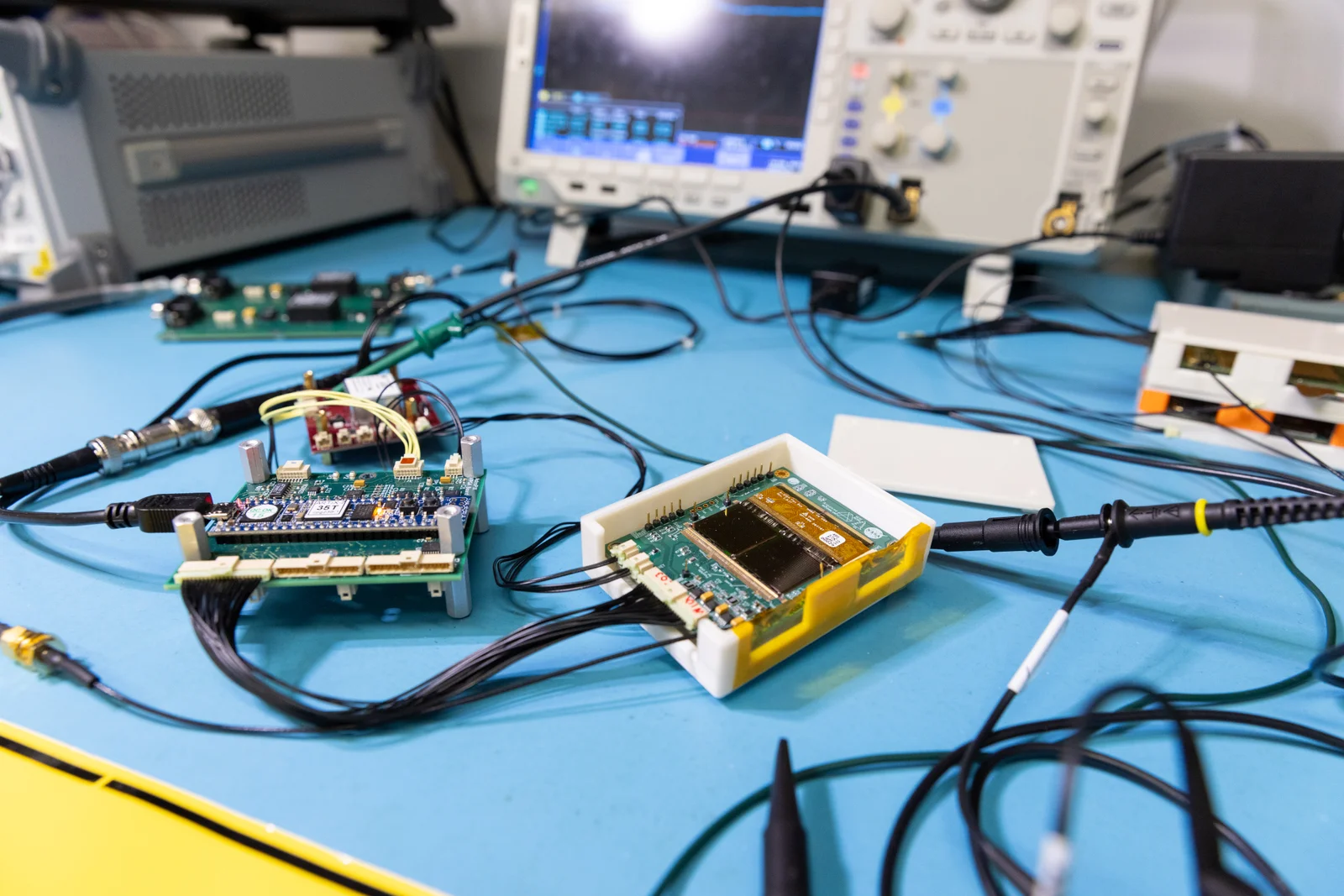
The photograph shows a laboratory measurement setup; it is not a first-power procedure or a connection diagram for the example in this article.
What this gate does—and does not do
The gate asks whether a newly assembled board, in a specified configuration, has shown the hardware behavior needed to enter the next approved stage. It is not a general MCU programming guide, a troubleshooting flowchart, a production first-article inspection, or a full validation plan.
A pass is deliberately narrow: this particular assembly is ready for the specified subsequent firmware or functional work under the recorded conditions. It does not establish that the product functions correctly, is reliable, complies with requirements, is ready for production, or is qualified.
This article is limited to low-voltage prototypes for which the project has an appropriate approved procedure. Here, “low-voltage” is descriptive, not a universal safety classification: the project hazard assessment and approved procedure determine whether this approach is appropriate. It does not provide procedures for mains, high-energy, battery, charging, motor-drive, large-capacitor, or safety-critical systems. Those require their own approved procedures and qualified personnel.
Declare the contract before making the connection
The gate contract is the agreed basis for deciding what may be energized, what will be observed, and what outcomes mean. It should be approved before the board is connected to the supply—not assembled retrospectively from whatever happened.
Identify the item and its state:
- The unique board identifier and exact PCB revision.
- The BOM and assembly variant, including approved substitutions, fitted options, and known deviations.
- Jumper, switch, strap, connector, and other configuration states.
- Any existing firmware, configuration image, or programmable-device state, including what may start automatically.
- The approved supply entry and return path, plus any sense connections.
- The attached load, or an explicit statement that the approved configuration has no external load.
- The required instruments, their setup, measurement points, and safe reference scheme.
The technical owner should link the contract to the actual schematic, power tree, assembly records, component documentation, instrument manuals, and approved project procedure. These sources establish the applicable operating limits and the expected startup behavior for that configuration.
Confirm that approved substitutions apply to the exact board revision and assembly variant. The component substitution approval process describes the evidence and authorization to retain when a part changes.
For each planned observation, declare an expected result and an acceptance basis. Depending on the board, these may include the input behavior, supply mode, rail behavior, enables, reset, clock, configuration straps, and debug-interface prerequisites. Specify any applicable sequence, ramp behavior, settling or observation requirements, and load conditions from the project documents. Do not substitute a generic order or limit for the board’s actual requirements.
Finally, list stop conditions and the authorized response. These may include a project-defined out-of-bounds observation, an unexpected supply mode, visible distress, odor, or other unsafe behavior. State which outcomes mean failure and which leave the gate on hold. If expectations, stop conditions, or the safe connection scheme cannot be approved, the disposition is hold, not “power it and see.”
The Texas Instruments TPS6213x Buck Converter Evaluation Module User's Guide, SLVU437B illustrates why a setup must be tied to the device and board being used: its connections and operating conditions apply to that documented module, not to every prototype.
Record unpowered observations first
With the board in the project-defined unpowered state, compare the assembly and configuration with the approved records. Document discrepancies, missing identification, unexpected fitted options, orientation concerns, and anything that prevents a reliable comparison.
An existing PCB assembly inspection report can supply useful identity, inspection, and exception records, but it does not replace the first-power contract.
Perform only the targeted unpowered checks authorized by the contract. Record the points and method as well as the observation. A resistance reading or continuity indication can be useful evidence, but neither alone diagnoses a short. Components and circuit paths can affect the indication; interpretation requires the actual design and further analysis.
An unresolved discrepancy is not permission to improvise a powered test. The authorized reviewer decides whether it is an approved deviation, a hold, or a failed unpowered criterion. Update the record before considering first power.
Authorize first power as a controlled event
Before enabling the supply, the operator checks that the identified assembly, configuration, load, connections, and instrument settings match the approved contract. The supply output remains disabled while the authorized connection setup is established. Any planned ramp, sequencing, remote-sense arrangement, or other supply behavior must follow the actual board and instrument documentation.
Current limiting is a control, not a guarantee of protection. A supply’s constant-current indication can mean that it has reduced its output voltage to regulate current; it does not by itself prove a board short. Nor does a current setting establish that every component is safe. The Rohde & Schwarz supply fundamentals distinguish current limiting from output-disabling overcurrent protection, whose behavior depends on the instrument.
Measurement connections also need an approved reference plan. Select probes and instruments for the board, measurement, and instrument ratings. On an ordinary earth-grounded oscilloscope, a conventional grounded probe's reference lead is connected through the instrument to protective earth. Isolated, differential and purpose-designed floating instruments have their own ratings and connection requirements. Follow the relevant instrument and probe manuals; do not defeat protective earth to make a measurement. The Tektronix ABCs of Probes Primer explains both reference considerations and connection effects on waveform fidelity.
Only the authorized operator initiates power, and only under the declared procedure. Observe the items the contract requires, including applicable supply behavior and signs of unexpected heating. If a stop condition or unsafe behavior occurs, stop using the approved shutdown action and record what happened. Do not repeatedly reapply power merely to obtain a more complete ledger.
Use a matrix to connect evidence to the decision
The matrix below is a template, not a set of universal tests. The project must replace each basis with its own approved documents, criteria, and conditions.
| Observation | Expected basis | Evidence to retain | Disposition rule |
|---|---|---|---|
| Board identity and configuration | Released revision, BOM, assembly record, approved options and firmware state | Board ID, version references, observed configuration, deviations | Mismatch or unknown state: hold or fail as the contract specifies |
| Unpowered assembly review | Project inspection requirements and approved assembly documentation | Findings, locations, images or records where required | Unresolved discrepancy: no authorization to energize |
| Targeted unpowered measurement, if required | Schematic and approved check with its interpretation limits | Points, method, instrument, result, conditions | Evaluate against the declared criterion; a reading alone is not a short diagnosis |
| Supply and measurement setup | Approved path, load, instrument manuals, reference plan, and settings | Connection record, setup, instrument identification, authorization | Incomplete or mismatched setup: hold before output enable |
| First-power behavior | Board-specific startup, supply, and stop criteria | Supply indications, relevant observations, timestamps, captured records, anomalies | Stop condition: shut down as authorized and record the failed or held state |
| Hardware readiness observations | Approved prerequisites for the named next stage | Results for applicable rails, enables, reset, clock, straps, or debug availability | Proceed only if every required prerequisite meets its approved criterion |
A row marked “not applicable” needs an approved reason, not an empty cell. A failed observation should remain visible in the ledger even if a later correction produces a passing result.
Make the observation ledger auditable
The contract says what should happen; the ledger says what was actually observed. Keep them linked by board identifier and contract version.
For each required entry, record the operator and timestamp, instrument model and relevant setup, measurement or observation point, configuration and load, expected basis, observed result or waveform reference, and disposition. Record anomalies even when they do not breach a declared criterion. If evidence is captured elsewhere, include a retrievable reference rather than an unsupported “OK.”
The ledger should also show interruptions, shutdowns, approved deviations, rework, and retest status. Preserve the original observation and its conditions; add the later record rather than overwriting history. After any change, the technical owner determines which observations are invalidated and which gate activities must be repeated. A result from the earlier configuration cannot silently stand in for evidence on the changed one.
Choose the disposition explicitly
Proceed means all required, applicable observations are complete and satisfy the approved criteria, no unresolved stop condition remains, and the authorized reviewer has named the next permitted activity. It is not permission to skip later gates.
Hold means a decision cannot yet be made or authorization is missing. Examples include an incomplete expected basis, uncertain assembly identity, missing evidence, or an unresolved deviation. A hold is not a pass.
Failed gate — diagnosis pending means an approved failure criterion or stop condition occurred. Preserve the conditions and evidence, then route the board to the project’s separate diagnosis and corrective-action process. Failure identifies an unmet gate condition; it does not establish a root cause.
After correction, a new or amended contract may be needed. The reviewer should explicitly decide the scope of retest and document the resulting disposition.
Assign ownership before the event
The project technical owner defines the board-specific expectations, document basis, and stop conditions. The authorizing reviewer accepts the contract and later signs the disposition. The operator verifies the setup, performs the authorized event, and stops when required. A recorder, if separate from the operator, maintains the ledger and evidence references.
The owner of later firmware or functional work should agree on the hardware prerequisites before first power. Roles may be combined where the project permits, but the record should identify who acted and who approved. This avoids treating an operator’s observation as an unstated project acceptance.
For subsequent testing, the PCBA test coverage matrix helps connect later test methods to the requirements and fault coverage they actually address.
A hypothetical evidence check
Suppose a contract requires 12 ledger entries, and a review finds that 9 have all required documentation fields completed.
The reviewer identifies 12 - 9 = 3 entries with incomplete documentation and records the missing fields for resolution.
The count describes missing documentation only. It says nothing about whether any electrical observation passed, whether the board is safe, or whether the gate should proceed. The missing entries must be resolved according to the contract; even a completely filled ledger could contain failures.
For a separate commercial discussion, the project can use the quote page. A quotation request is not a first-power authorization or an acceptance record.
FAQ
Can a board proceed if it powers up but the ledger is incomplete?
No. If required evidence is missing, the reviewer cannot demonstrate that the contract was met. Hold until the missing information is resolved or an authorized contract change is documented.
Does constant-current mode prove there is a short?
No. It is a supply observation that must be interpreted against the approved setup and expected behavior. It may be a stop condition, but it is not a root-cause diagnosis.
Is a continuity check enough to clear an unpowered board?
No. Continuity or resistance is only one observation, and circuit paths can affect the result. The project must define the check and its interpretation; the broader unpowered criteria still apply.
Does a first-power pass authorize programming?
Only if the disposition explicitly names programming as the next permitted activity and its prerequisites have been met. Existing firmware state is part of the first-power configuration; new programming or functional tests belong to later authorized work.
What happens after rework?
Record the change, preserve the earlier evidence, and have the technical owner determine the required retest. A prior pass applies to its recorded configuration and does not automatically transfer to a modified assembly.