
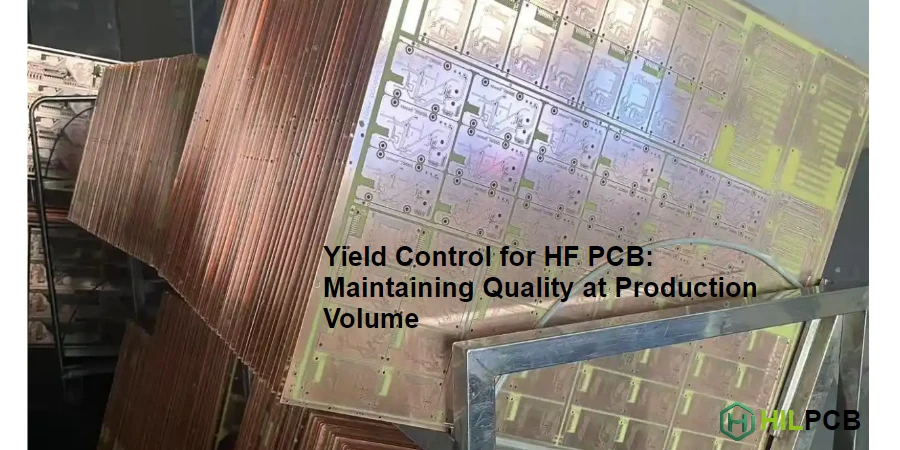
Yield—the percentage of boards passing all quality requirements—determines manufacturing efficiency and cost-effectiveness. High frequency PCBs present unique yield challenges because their tighter tolerances and specialized materials leave less margin for variation. A process that achieves acceptable yield with standard boards may fail economically with demanding HF specifications. Systematic yield control ensures consistent quality while maintaining manufacturing efficiency.
This guide provides comprehensive strategies for yield control in high frequency PCB manufacturing, supporting the practical achievement of quality requirements outlined in HF PCB fabrication challenges.
HILPCB maintains precision RF circuit board manufacturing with yield management systems that deliver consistent quality across production volumes while controlling cost.
In this article:
- Understanding HF PCB Yield Challenges
- Defect Prevention Strategies
- Process Monitoring and Control
- Quality Metrics and Targets
- Continuous Improvement
- Cost of Quality Considerations
Understanding HF PCB Yield Challenges
High frequency PCBs face yield challenges beyond those of standard boards. Understanding these challenges guides effective yield management.
At HILPCB, our controlled PCB manufacturing processes address the specific yield challenges of high frequency production.
Tighter Tolerance Impact
Standard tolerances that yield well become yield limiters when tightened for HF requirements. Trace width tolerance of ±15% yields well; ±10% is harder; ±7% may significantly reduce yield without process improvement. Every tolerance tightening increases yield risk.
The accumulation of multiple tight tolerances compounds the challenge. When trace width, dielectric thickness, impedance, and registration all have reduced tolerance, achieving all simultaneously requires exceptional process control.
Material Sensitivity
High frequency materials often behave differently than FR-4, creating yield challenges. PTFE requires special handling and surface treatment—improper treatment causes adhesion failures. Ceramic-filled materials may have different drilling and routing behavior. Hybrid stackups require compatible processing across different materials. Learning curves with new materials initially reduce yield.
Inspection Challenges
Some HF defects are harder to detect than standard defects. Impedance variation requires TDR testing rather than simple continuity. Material property changes may not be visible. Adhesion problems may not appear until thermal stress. Comprehensive testing increases inspection cost per board.
Lower Volume Impact
Many HF applications have lower volumes than consumer electronics. Lower volume means less opportunity to optimize processes through repetition. Setup and qualification costs are amortized over fewer boards. Prototype and small production runs may have inherently lower yield.
Defect Prevention Strategies
Preventing defects is more effective than detecting and rejecting them. Systematic defect prevention improves yield while reducing inspection burden.
Process Qualification
Thoroughly qualify processes before production. Build test vehicles to verify capability. Establish process windows with demonstrated margin. Document parameters for consistent reproduction. Requalify when materials or equipment change.
Process qualification applies to all steps including imaging, etching, lamination, and drilling. For specialized steps like PTFE treatment, qualification is particularly important. HILPCB maintains qualified processes for PTFE circuit board fabrication.
HF PCB Yield Factors
Incoming Material Control
Verify material quality before use. Check material certifications and test results. Verify key properties match specification. Segregate material lots for traceability. Reject non-conforming material before it enters production.
Material quality is particularly important for HF applications where electrical properties must be consistent. Lot-to-lot variation in Dk or Df affects impedance and loss.
Environmental Control
Control manufacturing environment conditions. Temperature and humidity affect many processes. Cleanroom or controlled environment for critical steps. Material conditioning before processing. Proper storage prevents degradation.
Operator Training
Skilled operators prevent defects through proper technique. Train on HF-specific requirements and sensitivities. Qualify operators for specialized processes. Maintain training currency with refresher education. Empower operators to stop for quality concerns.
Process Monitoring and Control
Continuous monitoring catches problems before they cause significant yield loss.
Statistical Process Control
SPC monitors critical parameters continuously. Control charts detect process drift and abnormal variation. Reaction to out-of-control conditions prevents defects. Process capability (Cpk) quantifies ability to meet specifications.
Key parameters for HF SPC include trace width, impedance on test coupons, dielectric thickness (via cross-section sampling), registration measurements, and surface treatment verification. Monitoring these parameters supports requirements for etching precision in HF PCB and other critical processes.
In-Process Inspection
Inspect at key process stages rather than only at final. AOI (Automated Optical Inspection) after imaging and etching catches defects before further processing adds value. Early detection allows process correction before additional panels are affected.
Equipment Maintenance
Preventive maintenance prevents equipment-caused defects. Follow manufacturer maintenance schedules. Track equipment performance over time. Replace wear items before they cause problems. Calibrate measurement equipment regularly.
Trend Analysis
Analyze yield data over time to identify trends. Gradual yield decline may indicate process drift. Sudden yield drops suggest specific events or changes. Correlation analysis connects yield to process variables.
Quality Metrics and Targets
Define and track metrics that measure yield performance.
First-Pass Yield
First-pass yield measures boards passing without rework. This is the primary yield metric because rework adds cost and may not restore full quality. Target first-pass yield depends on product complexity and specifications.
Final Yield
Final yield includes boards passing after any acceptable rework. Some defects (minor cosmetic issues, repairable opens) may be correctable. Final yield minus first-pass yield indicates rework extent.
Yield by Defect Type
Track yield loss by defect category. Identify which defect types cause most loss. Focus improvement on dominant defect types. Track improvement as changes are implemented. This analysis integrates with copper roughness control for HF PCB and other material-related factors.
Process Capability Index
Cpk measures process capability relative to specification. Cpk = 1.0 means process is just capable of meeting specification. Cpk = 1.33 provides reasonable margin. Cpk = 1.67 or higher indicates robust capability.
For demanding HF specifications, target Cpk > 1.33 for critical parameters. Lower Cpk indicates yield risk that should be addressed. These metrics apply to all critical parameters including lamination accuracy for high frequency PCB and registration tolerance for HF PCB.
Continuous Improvement
Systematic improvement increases yield over time.
Root Cause Analysis
When defects occur, determine root cause. Use structured analysis methods (5-Why, fishbone diagram). Distinguish between special and common causes. Address root cause, not just symptoms.
Corrective Action
Implement corrective actions that prevent recurrence. Verify effectiveness of corrective actions. Document changes for knowledge retention. Share learnings across similar processes.
Process Improvement Projects
Prioritize improvement efforts on highest-impact opportunities. Use data to guide project selection. Apply improvement methodologies (PDCA, Six Sigma). Measure improvement results.
Design for Manufacturability
Work with designers to improve manufacturability. Early DFM review prevents designs that will yield poorly. Design rules that match manufacturing capability. Feedback from manufacturing to design improves future products.
Cost of Quality Considerations
Understand the economics of yield and quality.
Cost of Poor Quality
Yield loss has direct cost impact including scrapped material and processing cost, rework labor and materials, inspection and testing to find defects, and customer impact if defects escape.
Investment in Quality
Prevention costs less than correction. Process improvement investment pays back through better yield. Better equipment and materials may cost more but yield better. Training investment improves operator performance.
Yield-Cost Optimization
Balance quality investment against yield improvement. Diminishing returns at very high yield levels. Find economic optimum for your product. Consider total cost including quality risk.
HILPCB balances yield optimization with cost-effectiveness for Rogers laminate fabrication and other HF materials.
HILPCB Yield Control Services
HILPCB delivers consistent yield for high frequency applications:
Process Discipline: Statistical process control, qualified processes, and continuous monitoring for yield stability.
Defect Prevention: Root cause analysis, corrective action, and continuous improvement for yield enhancement.
Quality Metrics: Comprehensive tracking and reporting of yield and quality performance.
Design Support: DFM review helps ensure designs are manufacturable with good yield.
From RF prototypes through volume production, HILPCB provides yield-optimized high frequency PCB manufacturing.
Contact HILPCB for yield consultation and manufacturing quotation.