

As electronics continue to shrink in size while growing in complexity, HDI PCB assembly has become a defining capability for next-generation products. High Density Interconnect (HDI) boards integrate microvias, blind and buried vias, and often sequential lamination during board fabrication; assembled boards then need package-specific SMT processes to achieve reliable solder joints and perfect alignment for fine-pitch components.
At HILPCB, we specialize in HDI PCB assembly services that combine engineering precision, automated surface mount technology (SMT), and rigorous quality control. Whether for AI computing, automotive electronics, 5G infrastructure, or medical devices, our HDI assembly lines deliver unmatched accuracy, repeatability, and reliability.
What Is HDI PCB Assembly and Why It Matters
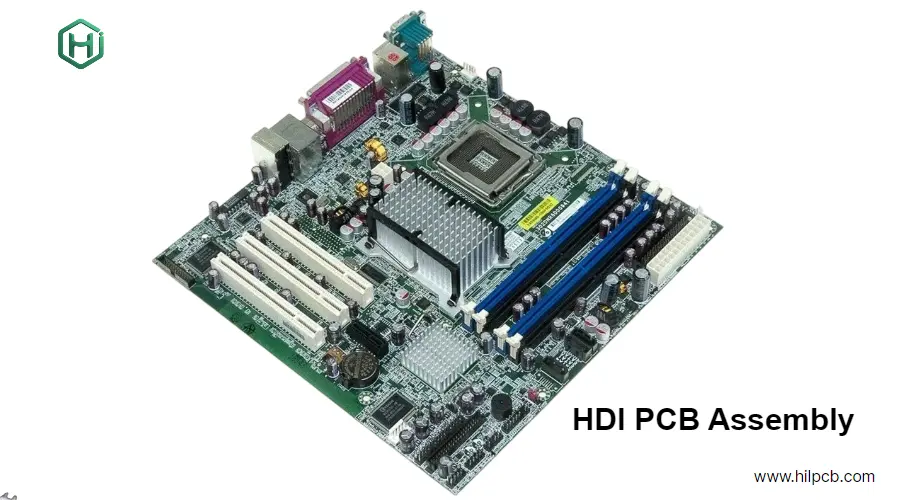
HDI PCB assembly is the process of mounting and soldering components onto multilayer circuit boards designed with high interconnect density. Unlike standard multilayer boards, advanced HDI circuit boards feature microvias, sequential build-up layers, and fine-pitch BGA packages that demand specialized placement and soldering precision. As a factory-direct HDI PCB manufacturer, HILPCB coordinates precision bare-board fabrication and turnkey SMT assembly under one roof to eliminate interface defects.
Core Characteristics
- Microvias <100 μm enabling compact interconnections
- Via-in-pad designs for BGA and CSP packages
- 8–40+ layer stack-ups with controlled impedance
- Laser-drilled interconnects for high-speed data lines
- Thin dielectric spacing improving signal integrity
Successful HDI assembly depends on precise temperature profiling, minimal warpage, and controlled component placement and solder-joint quality — all achieved through automated process control at HILPCB.
Core Processes in HDI PCB Assembly
1. Engineering Review and DFM Optimization
Every project begins with a full Design for Manufacturability (DFM) and Design for Assembly (DFA) analysis.
We evaluate:
- Pad-to-via distances, stencil apertures, and copper balance
- Thermal distribution during reflow
- Solder mask alignment and solderability
- Component spacing and pick-and-place orientation
Our engineering feedback prevents production defects such as tombstoning, bridging, and insufficient solder fill — ensuring stable yields across complex HDI layouts.
2. High-Precision SMT Assembly
HDI PCBs require exceptional SMT placement accuracy.
Our automated lines include:
- 01005 and 0201 passive component placement
- Fine-pitch BGA and QFN handling (≤0.3 mm)
- Placement tolerances should be confirmed for the equipment, package and inspection method; AOI checks visible placement and solder features
- Nitrogen reflow ovens with dynamic temperature profiling
We use micro-stencils, laser-cut apertures, and optimized solder paste formulations to ensure uniform wetting and solder joint consistency.
3. Reflow, Inspection, and X-Ray Verification
After placement, HDI boards undergo a qualified reflow process, using nitrogen where required by the assembly specification with precise ramp-soak-peak control to avoid solder voids and component shift.
Post-reflow validation includes:
- 3D AOI (Automated Optical Inspection) detecting solder height and alignment
- X-ray inspection for BGAs and via-in-pad joints
- Thermal profile logging for every production batch
Each stage is digitally recorded for full traceability, ensuring assembly integrity for fine-pitch and stacked via designs.
4. Through-Hole and Mixed-Technology Integration
Many HDI assemblies combine high-speed logic with mechanical or power components.
Our hybrid process integrates:
- Through-hole assembly for connectors and high-power devices
- Selective wave soldering and pin-in-paste methods
- Thermal relief patterns minimizing stress during soldering
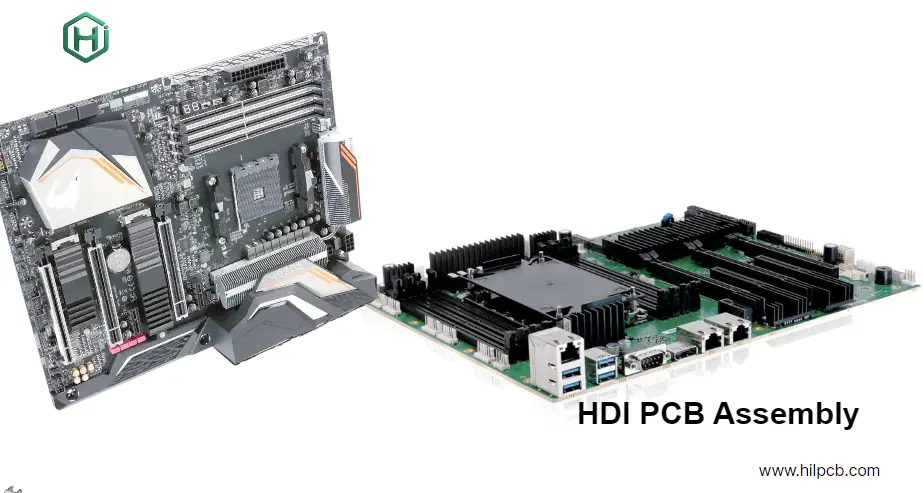
This combination supports complex systems like server motherboards, automotive control units, and industrial drives.
5. Functional Testing and Quality Validation
Verification and reliability sampling should be defined in the order-specific inspection and test plan:
- In-Circuit Testing (ICT) for electrical continuity
- Functional testing (FCT) simulating real-world operation
- Thermal cycling and vibration testing for durability
- Conformal coating when environmental protection is required
Our quality management uses project-specified IPC-A-610 acceptance classes and documented quality procedures; any IATF 16949/ISO 9001 certification claims require current certificates and site scope.
Applications Across Industries
HDI PCB assembly is critical to performance-driven electronics across multiple sectors:
- Automotive and EV systems: ECU, ADAS radar, and BMS modules requiring vibration and heat tolerance
- AI servers and data centers: multi-processor motherboards and accelerator cards demanding tight impedance control
- 5G communication: base stations, RF front-ends, and antenna modules using Rogers PCB laminates
- Aerospace and defense: ruggedized electronics with polyimide cores and conformal coatings
- Industrial and medical equipment: controllers, imaging devices, and robotic interfaces requiring compact, reliable interconnects
HILPCB’s flexible assembly capabilities adapt seamlessly across these diverse markets, ensuring consistent quality and on-time delivery.
Why Choose HILPCB for HDI PCB Assembly
Reliable HDI PCB assembly requires precision engineering, process control, and integration between fabrication and assembly. At HILPCB, we provide a complete one-stop electronic manufacturing service that combines HDI PCB manufacturing, SMT assembly, component sourcing, and functional testing — ensuring seamless coordination and consistent quality from prototype to mass production.
Key elements of our HDI assembly and manufacturing capability include:
- In-house HDI PCB fabrication with microvia drilling, blind/buried via lamination, and controlled impedance for multilayer structures
- High-precision SMT assembly for 01005 passives, 0.3 mm BGA, and fine-pitch QFN packages
- Turnkey material sourcing with BOM verification, authorized component procurement, and lifecycle management
- Automated inspection and testing, including AOI, X-ray, ICT, and FCT for high-reliability builds
- Scalable production lines supporting prototypes, pilot runs, and large-volume manufacturing
- Engineering and DFM collaboration to optimize manufacturability, cost, and performance before production
- End-to-end quality control, aligned with the agreed inspection class and the applicable, verified QMS scope
By integrating HDI PCB manufacturing and advanced assembly under one roof, HILPCB shortens lead times, improves yield, and ensures high reliability across automotive, computing, 5G, industrial, and medical applications—making us a trusted global partner for high-density interconnect production. HILPCB offers a qualified ±20 μm placement option, multi-zone reflow with nitrogen availability, and ICT/FCT, thermal-cycle, vibration, and conformal-coating services under an order-specific plan. Agreed IPC-A-610 Class 3 acceptance and applicable automotive or IATF-program quality-system support can be scoped to the project; the plan defines which screening applies to each assembly.