

Harsh environments expose keyboards to water, dust, and contaminants that quickly destroy unprotected electronics. IP67 Keyboard PCB for Harsh Environments delivers complete protection through sealed construction rated for dust-tight operation and temporary water immersion.
HILPCB provides professional PCB fabrication and PCBA assembly services for IP-rated keyboard manufacturers, including sealing verification testing that confirms protection levels before shipment.
Menu Navigation
- IP67 Rating Explained: What Waterproof Really Means
- Gasket and Enclosure Sealing for IP67 Keyboards
- Waterproof Key and Switch Design Solutions
- Sealed Cable Entry and Connector Options
- IP67 Testing, Verification, and Manufacturing Services
IP67 Rating Explained: What Waterproof Really Means
IP (Ingress Protection) ratings define measurable protection levels against environmental hazards. IP67 represents high-level protection suitable for demanding outdoor, washdown, and marine applications where water and dust exposure is unavoidable.
Understanding rating definitions helps you specify the right protection level for each deployment environment.
IP Rating Fundamentals
- IP67 Rating Definition: First digit (6) indicates dust-tight—complete protection against dust ingress; second digit (7) indicates protection against temporary immersion to 1 meter depth for 30 minutes.
- Testing Standards: IEC 60529 defines test procedures, conditions, and acceptance criteria for IP rating verification; compliance requires testing per specified methods.
- Comparison with IP65/IP66: IP65 protects against water jets; IP66 against powerful water jets; IP67 adds immersion protection critical for flooded or submerged scenarios.
- IP68 for Continuous Submersion: IP68 extends to continuous immersion at manufacturer-specified depth; appropriate for permanently submerged or deep immersion applications.
- IP69K for High-Pressure Washdown: Specialized rating for high-pressure, high-temperature jet cleaning common in food processing; requires specific test per ISO 20653.
- Application Mapping: Food processing often requires IP65-IP69K; outdoor installations need IP65+; marine applications typically specify IP67+; laboratory and cleanroom may require specific IP levels.
Environment-Specific Requirements
Beyond the IP rating itself, specific environments impose additional requirements—chemical resistance, UV stability, temperature range, and material compatibility for cleaning agents all factor into successful deployments.
Gasket and Enclosure Sealing for IP67 Keyboards
Achieving IP67 requires comprehensive sealing throughout the keyboard design—enclosure joints, key interfaces, cable entries, and mounting interfaces all need appropriate sealing solutions working together.
Gasket design, material selection, and compression control collectively determine whether your sealing actually works in the field.
Sealing System Design
- Enclosure Gasket Design: Compression gaskets at enclosure joints; proper groove design ensuring consistent compression; continuous gasket path around entire perimeter without joints or gaps.
- Gasket Material Selection: Closed-cell foam for applications tolerating compression variation; solid silicone or EPDM for demanding sealing; material compatibility with operating environment chemicals and temperature.
- Compression Ratio Control: 15-25% compression typical for reliable sealing; fastener torque specification ensuring consistent compression; visual indicators confirming proper assembly.
- Surface Finish Requirements: Sealing surface flatness within 0.1mm/100mm; surface roughness Ra 1.6μm or better; burr-free edges preventing gasket damage during assembly.
- Corner Continuity: Molded gaskets with continuous corners; corner radius appropriate for gasket material flexibility; no joints or splices in high-stress corner areas.
- Redundant Sealing Option: Dual seal barriers for critical applications; primary seal prevents ingress, secondary provides backup; drainage between barriers indicates outer seal failure.
Environmental Aging
Seal materials age differently across environments—UV exposure, ozone, chemical exposure, and temperature cycling all affect long-term seal integrity and must be factored into material selection.
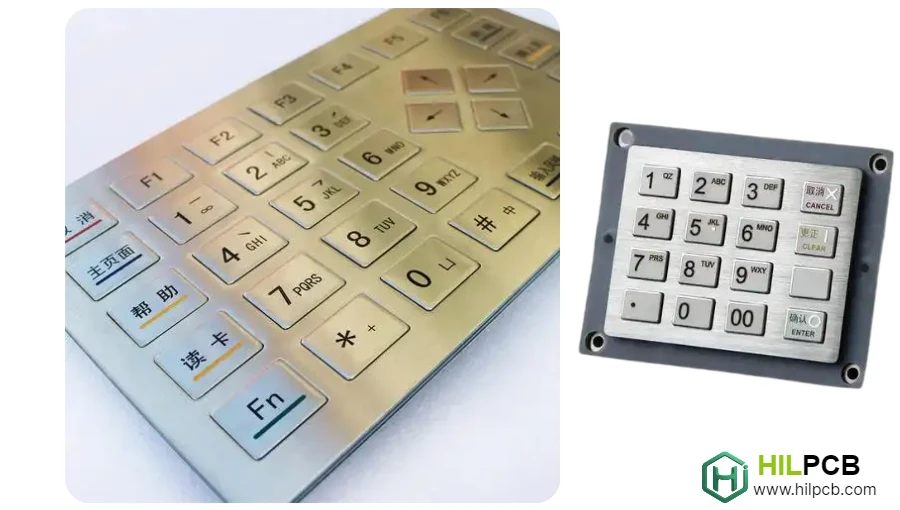
Waterproof Key and Switch Design Solutions
Each key represents a potential ingress point requiring sealed design solutions. Switch technology selection determines which sealing approaches are available to you.
Balancing key feel with sealing effectiveness requires selecting the right technology for each application's priorities.
Key Sealing Technologies
- Silicone Rubber Keypads: One-piece molded silicone provides inherent sealing; key shapes molded for tactile feel; conductive pills or carbon contacts actuate underlying switch; integrated sealing lip to enclosure frame.
- Sealed Membrane Construction: Polyester membrane layers with sealed perimeter; tactile feedback through embossed keys or metal domes; LED backlighting through translucent graphics; flat cleanable surface.
- Glass or Solid Surface Touch: Capacitive touch through solid glass or polymer surface; no moving parts means inherent sealing; works with gloved or wet hands depending on design; scratch resistance for public applications.
- Sealed Mechanical Switches: Individual switch sealing with silicone boots; maintains mechanical switch feel with IP protection; higher cost but preferred by users who demand that tactile response.
- Hybrid Approaches: Sealed membrane overlay with optional mechanical click elements; combines sealing with improved tactile feedback.
- Key Feel Optimization: Silicone durometer selection affecting force and travel; dome geometry providing click feedback; actuation force balanced for gloved operation in wet conditions.
Backlight Sealing
LED backlighting requires light transmission without compromising the seal—light pipes, translucent silicone, or edge-lit designs maintain illumination through sealed construction.
Sealed Cable Entry and Connector Options
Cable entry points require sealing attention equal to the main enclosure, with connector selection and installation quality determining interface protection.
Connector choice depends on required IP rating, mating cycle requirements, and system interface standards.
Cable Interface Options
- Sealed Circular Connectors: M12 and 7/8" industrial connectors provide robust sealing when mated; IP67+ rated when properly assembled; standard industrial form factors.
- Sealed USB Connectors: IP-rated USB receptacles available in various configurations; protective caps maintain rating when unmated; panel-mount and cable-mount options.
- Cable Gland Implementation: Cable glands seal around cable jacket; size selection matched to cable diameter; proper tightening ensures seal without cable damage; gland IP rating must match or exceed keyboard requirement.
- Captive Cable Design: Permanently attached cable eliminates connector sealing challenge; cable sealed at entry point with potting or gland; trade-off: cable damage requires keyboard replacement.
- Wireless Elimination: Bluetooth connectivity eliminates cable entry entirely; battery compartment must maintain IP rating; wireless charging avoids charging connector sealing.
- Connector Position: Connector placement affects cable routing and stress; downward-facing connectors shed water naturally; protected recesses shield connectors from direct spray.
Installation Requirements
Sealed connector effectiveness depends entirely on proper installation—torque specifications, mating verification, and cable strain relief all affect installed IP rating.
IP67 Testing, Verification, and Manufacturing Services
IP67 keyboards require verified sealing—manufacturing processes must ensure consistent seal quality, with testing confirming protection before shipment. HILPCB provides IP-rated keyboard manufacturing with sealing verification capabilities.
Why Choose HILPCB for IP67 Keyboard PCB
Sealing Verification Testing
We verify IP ratings before shipment using appropriate test methods:
- Pressure decay testing detecting seal leaks
- Bubble testing for visual leak identification
- Post-test functional verification
- Documentation for your quality records
Precision Gasket Assembly
Consistent sealing requires controlled assembly. Our processes include:
- Gasket positioning verification before enclosure closure
- Torque-controlled fastening ensuring proper compression
- Visual inspection confirming gasket placement
- Assembly work instructions for repeatability
Conformal Coating for Secondary Protection
Beyond mechanical sealing, PCB protection provides defense-in-depth. SMT assembly includes:
- Conformal coating application (acrylic, urethane, or silicone)
- Proper masking of connectors and test points
- Cure verification and thickness inspection
- UV inspection confirming complete coverage
Clean PCB Fabrication
FR4 PCB for sealed keyboards provides:
- Clean surfaces supporting gasket adhesion
- Precise dimensions for enclosure fit
- Consistent board flatness for gasket contact
- Surface finish compatible with sealing requirements
Complete Keyboard Assembly
We assemble complete IP67 keyboards including:
- PCB assembly with conformal coating
- Enclosure assembly with gasket installation
- Cable or connector integration
- Sealing verification before shipment
IP Testing Documentation
Quality records supporting your IP claims:
- Test procedure and conditions
- Test results with pass/fail criteria
- Sample retention for reference
- Batch traceability
Production Capability
- Small batch assembly for IP-rated prototypes and low-volume products
- Large volume assembly with in-line sealing verification
- Turnkey assembly sourcing sealed connectors and gasket materials
Contact us with your IP67 keyboard requirements for sealing verification manufacturing assessment.
Common Questions
What does achieving IP67 mean for a keyboard PCB program?
It means the product must be designed as a sealed system, not just a PCB with a rating attached to it. The enclosure, gasket stack, connector strategy, coating approach, and verification method all have to work together if the keyboard is expected to maintain protection in harsh environments.
Why is sealing verification as important as normal functional testing?
Because a keyboard can pass electrical tests and still fail in the field if its sealing stack is inconsistent. Pressure, immersion, or other sealing checks provide direct evidence that the assembled product can resist ingress the way the specification claims.
What should teams lock down early for an IP67 keyboard design?
Teams should define the sealing concept, material compatibility, interface strategy, and verification method early, before mechanical and PCB details drift apart. Early alignment reduces redesign risk and helps ensure that the finished build is manufacturable as a true IP67 product.