
A proposed PCB material substitution is not approved simply because both laminates meet the same IPC-4101 slash sheet. First check the released drawing and change agreement: if the product or construction is locked, hold the change for the designated approval. If alternatives are permitted, compare the actual core, prepreg, foil and finished stackup against the electrical, thermal and compliance requirements of that particular board.
Before purchasing commits, obtain the proposed grade and construction, identify the approver and agree which evidence is needed before release. An impedance calculation, a material certificate and a finished-board qualification answer different questions; none automatically replaces the others.
For selecting and specifying the base material itself, see our copper-clad laminate guide. This article focuses on the subsequent decision to accept or reject a proposed change. For matching test conditions, see our material data sheet guide; for background, see the IPC-4101 guide.
Start With the Release Decision
| Situation | Decision before placing the order | Evidence to request |
|---|---|---|
| Drawing names one product or prohibits substitution | Hold until the named authority approves a deviation or revises the requirement | Exact original and proposed construction, reason for change, written disposition |
| Drawing permits a defined alternative | Check that this specific proposal meets every condition of that permission | Material identity, construction, applicable conformance and traceability records |
| Controlled impedance or loss-sensitive channel | Hold for design review of the revised stackup and any trace-width or gap changes | Calculation inputs, impedance targets and tolerance, proposed coupon and loss evidence where required |
| Customer-qualified or safety-marked construction | Check the qualification and applicable listing before release | Qualification scope, applicable board manufacturer's listing and customer disposition |
| Information is missing or requirements conflict | Do not treat silence as approval | An owner, a due date and a documented resolution for each open item |
The governing contract, drawing and customer quality agreement determine approval authority even for a different lot or manufacturing site of the same product. Procurement can request the evidence and manage the order; it should not infer engineering acceptance from a supplier's label.
1. What Changes When a Laminate Changes
| Property | What it affects | Sensitive designs |
|---|---|---|
| Dk at the operating frequency | Impedance, propagation delay, coupling | Controlled impedance, timing-matched buses, RF |
| Df (loss) | Insertion loss | Long high-speed channels, RF |
| Pressed dielectric thickness (prepreg resin content and flow, available core thicknesses) | Impedance, board thickness, capacitance | Controlled impedance, thickness-toleranced boards, buried capacitance |
| Glass style | Local Dk variation (fiber weave effect), CAF resistance, drilling | Differential pairs at high data rates, dense via fields |
| Copper foil type and roughness | Conductor loss, peel strength | High-speed channels, fine lines |
| Tg, Td, CTE-z, time to delamination | Plated-hole reliability, reflow survival | Thick boards, many reflows, lead-free assembly |
| Resin system and filler | Drilling, desmear, lamination parameters | All; affects fabrication route and yield |
| Flammability rating and UL recognition | Product safety listing | UL-listed products |
| CTI | Creepage requirements | High-voltage designs |
Two laminates with similar nominal Dk can still produce different finished dielectric thicknesses because of the construction and lamination process. Conversely, matching thickness alone does not prove that loss, reliability or the fabrication process is acceptable. Compare the characteristics relevant to the actual design, not just the headline grade.
2. Worked Example: A Stackup Proposal and Its Approval Boundary
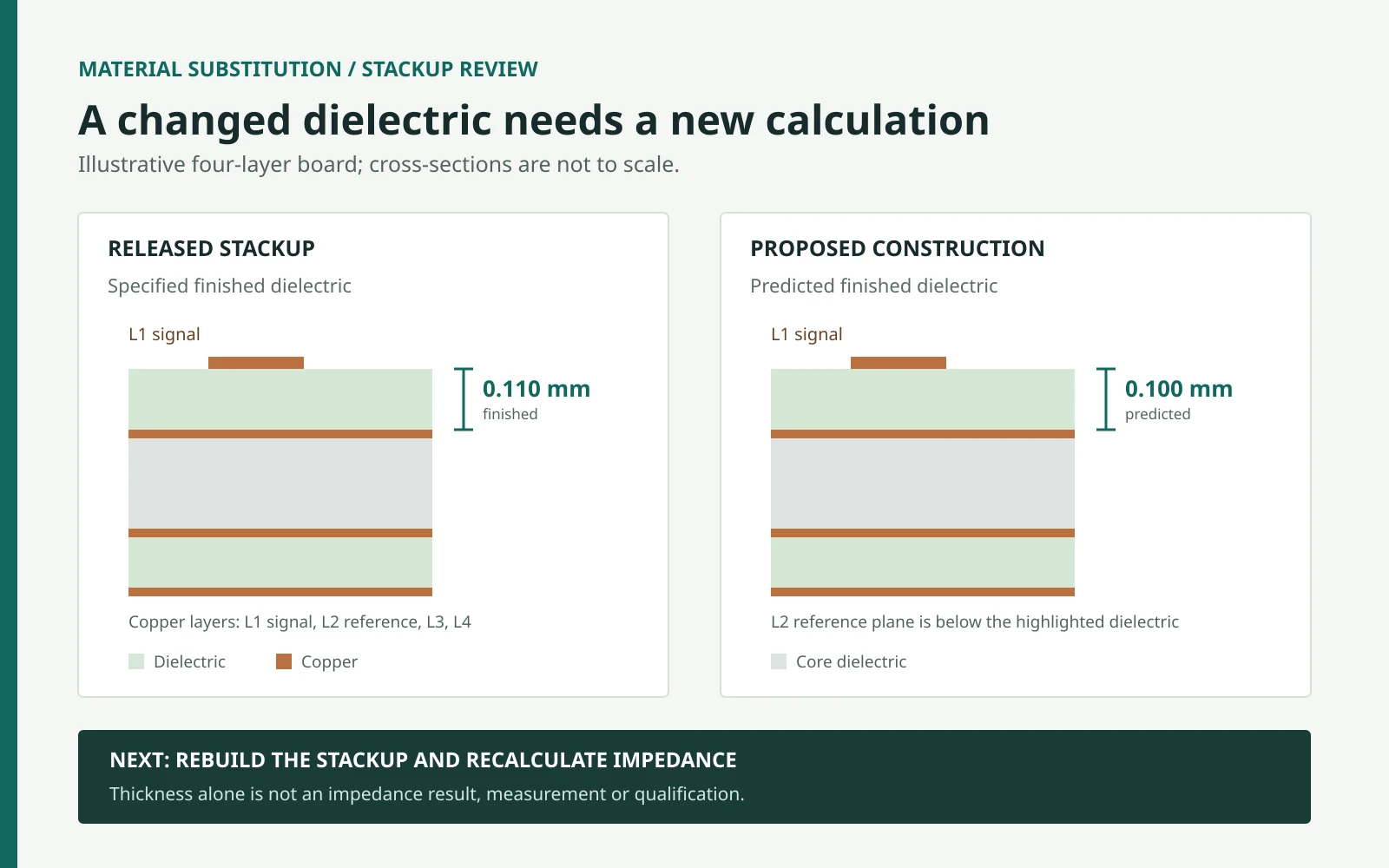
Conceptual schematic, not to scale: the proposed dielectric thickness is a prediction, not a measurement.
Assume a four-layer board has an outer-layer 50 Ω single-ended target with an agreed ±10% tolerance. Its released stackup calls for a finished 0.110 mm dielectric between the signal and its reference plane. The fabricator proposes a different prepreg construction with a predicted finished thickness of 0.100 mm. These are hypothetical inputs, not a measured board or a material recommendation.
| Check | Illustrative result | What it means |
|---|---|---|
| Finished dielectric | 0.100 − 0.110 = −0.010 mm, or approximately −9.1% | A meaningful model input changed; it does not imply a 9.1% impedance change |
| Contractual impedance range | 50 Ω × 0.90 to 50 Ω × 1.10 = 45–55 Ω | These are the assumed project limits, not a universal tolerance |
| Recalculated geometry | Not yet supplied | The designer cannot determine acceptance from thickness or Dk alone |
| Coupon result | Not yet built or tested | No production measurement or qualification exists at this stage |
Ask the fabricator for a revised stackup and calculation using the proposed finished dielectric, relevant Dk basis, copper geometry and solder-mask assumptions. The designer decides whether the predicted result and any width or spacing changes are acceptable. Agree on coupon geometry, test method, sampling, acceptance and reporting before building. A passing impedance coupon is evidence for the agreed structure and measurement; it does not by itself prove channel loss, assembly survival or product qualification.
3. What an IPC-4101 Slash Sheet Does and Does Not Control
An IPC-4101 specification sheet is a starting point for defining a base-material requirement, not a blanket finished-board equivalence certificate. The IPC-4101E public scope and classification identify laminate and prepreg and show that callouts may also specify thickness, cladding, reinforcement and prepreg parameters. Requirements and optional tests vary with the sheet and contract.
| Check in the applicable specification and purchase callout | Still needs project-specific agreement |
|---|---|
| Material class, reinforcement, resin system and applicable requirements | Actual product, core and prepreg construction and availability |
| Required properties, tests, methods and conditions for the specified edition and sheet | Dk and Df appropriate to the channel, frequency and model |
| Any additional laminate and prepreg callout parameters | Finished dielectric thickness, copper profile, impedance and loss |
| Supplier evidence of conformance as required by the order | Fabricator process and finished-board qualification or listing scope |
Use the edition, amendment and sheet invoked by the contract; a newer publication does not automatically replace an explicitly specified earlier edition or change a supplier's conformance claim. If the callout is undated, resolve the applicable revision before ordering, using the contract and the applicable controlled standard. Assess any proposed edition change through the agreed approval process.
Specify additional properties, tolerances, construction and approval conditions where needed. A supplier's typical data is useful for comparison but is not automatically a guaranteed acceptance limit. Obtain the controlled specification and the applicable supplier documents before writing a purchase requirement; the public scope alone does not establish every sheet's limits.
For example, the Isola 370HR data sheet, revision C, lists typical Dk of 4.17 at 1 GHz using IPC-TM-650 2.5.5.9 and 4.04 at 2 GHz using a stripline method. Both frequency and method differ, so the figures are not a controlled comparison of frequency alone or guaranteed values for a proposed board. Confirm the current grade, construction and test conditions with the supplier.
4. Approval and Requalification Matrix
| Change | Example | Typical approval | Typical evidence |
|---|---|---|---|
| Same product, different lot or plant | Same grade from a different site | Follow the agreed notification and approval rules; site changes may be controlled | Traceability, relevant conformance and site-change evidence |
| Different product, same sheet, no impedance requirement | Alternative FR-4 within the stated material class | Use only within the drawing's explicit permission; otherwise seek the designated approval | Grade and construction comparison against the drawing, with supporting material records |
| Different product, controlled impedance | Different core or prepreg in a controlled stackup | Design authority reviews the proposed construction and any geometry changes | Revised stackup and calculation; coupon plan or results as agreed |
| Different resin, glass style or foil | New resin or reinforcement in a critical layer | Engineering and quality review the relevant failure risks and qualification scope | Applicable electrical, thermal and process evidence; tests as agreed |
| Customer-qualified or safety-marked construction | A board construction covered by a customer qualification or listing | Follow customer change control and review the actual board manufacturer's listing | Customer disposition, listing review and qualification evidence as required |
These are review paths, not automatic rights to substitute or mandatory test plans. The design authority approves design changes; the fabricator assesses its process and proposed build; customer quality or the product owner determines applicable qualification. Record approval as an authorized deviation or revision with the affected part, stackup, site, lots, duration and conditions. An order-specific deviation should not silently become approval for every future build.
5. Evaluating a Proposed Substitute
- Get the full identity: manufacturer, product, slash sheet, glass styles and resin content of the prepregs proposed, and copper foil type.
- Compare like with like: Dk and Df at the same frequency and test method; Tg, Td, CTE-z by the same method (our data sheet guide explains why test conditions matter).
- Rebuild the stackup with the proposed core thicknesses and predicted finished prepreg dielectric thicknesses, and recalculate impedance and trace widths.
- Review board and assembly risks: reflow and rework exposure, hole construction, material interfaces and the applicable acceptance requirements. Set a test plan where necessary instead of treating a datasheet value as a reliability result.
- Check listings and qualification: identify the board manufacturer's relevant UL file and recognized construction, as well as any customer-qualified material list. The laminate supplier's recognition alone does not establish the finished board's status.
- Agree evidence and timing: identify what is needed before release versus what will be measured on the build. Define coupon geometry, method and sampling, or thermal-stress and microsection criteria where applicable.
- Record the disposition: approve, reject or hold; identify the approver and the exact scope, affected revisions and expiration or lot boundaries.
Match the evidence to the decision
| Evidence | What to check | What it does not establish on its own |
|---|---|---|
| Material data sheet | Grade, revision, test method and conditions; typical versus specified values | Conformance of the delivered lot or the finished board |
| Material certificate or certificate of conformance | Issuer, material identity, applicable specification and edition, lot or other scope, and what is actually attested | That every property was measured on the supplied lot |
| Qualification or process history | Tested material and construction, test conditions, acceptance criteria and whether the proposed build is covered | Automatic approval of a different site, stackup or application |
| Build-specific test report | Board or coupon identity, method, sampling, results and agreed limits | Performance outside the measured characteristics or approval for future changes |
Before release, agree which documents and results are required, who reviews each, and which checks may occur on the production build. If a required report is only available after fabrication, a conditional authorization to build is not the same as acceptance to ship; define the hold point and disposition if results fail. Where the records do not establish lot-specific testing, ask for the agreed evidence rather than inferring it from a certificate title.
Compare the actual purchasing decision
Assume an alternate saves $2 per board on an order of 1,000 boards, but an agreed qualification costs $3,000 once. The material saving is $2,000; for that order the net change is $1,000 more, before any schedule, inventory or other costs. At the same assumed per-board saving, 1,500 boards would offset the $3,000 qualification cost. These are illustrative figures, not a quote or a forecast. Procurement should compare the same quantity, delivery date, qualification and documentation scope for both offers, and confirm whether the qualification can be reused on later orders.
6. Drawing and RFQ Wording
- Alternates allowed within defined limits: "Base material per IPC-4101 [edition]/[sheet] and attached material and construction requirements. Alternate grades within these requirements are permitted subject to [notification, records and scope]."
- Impedance board, alternates allowed with approval: "Base material [product] or approved alternate per IPC-4101 [edition]/[sheet]. Submit proposed construction, revised stackup and impedance calculation for [design authority] approval before build."
- Locked material: "Base material [product] only. No substitution without written buyer approval."
Add the impedance targets, finished dielectric thickness requirements and test evidence separately; the material callout alone does not carry them.
HILPCB's FR-4 PCB offering includes standard, high-Tg, halogen-free and lower-loss constructions; material, stackup, geometry and test plan are confirmed for the project. A material certificate or certificate of conformance is available when quoted. Send the drawing, released stackup and change restrictions with your quote request, and identify the calculation, coupon and qualification evidence you need agreed before release.
Frequently Asked Questions
Are two laminates on the same IPC-4101 slash sheet interchangeable?
Not automatically. The applicable sheet defines material requirements, but the complete drawing, construction, intended performance and change-control agreement govern whether a particular substitute is acceptable.
How much does a material change affect impedance?
It depends on the geometry, dielectric properties, copper and other construction details. Recalculate with the proposed finished stackup and compare the result with the project's target and tolerance; a percentage thickness change is not the same percentage change in impedance.
What should a drawing say about alternate materials?
State the slash sheet or product, the key property limits, whether alternates are allowed, and who approves them. For impedance boards, require the fabricator to submit a revised stackup and impedance calculation before using an alternate.
When does a material change need requalification?
The customer, product owner and applicable quality agreement determine the qualification scope. Changes to resin, glass, foil, manufacturing site or a customer-qualified construction can trigger review or requalification; even a same-product site change must follow the agreed notification rules.
Does a material substitution affect UL recognition?
It can. UL recognition often applies to a specific combination of laminate, solder mask and construction. Check that the substitute is covered for the finished board construction before shipping a UL-marked product.