
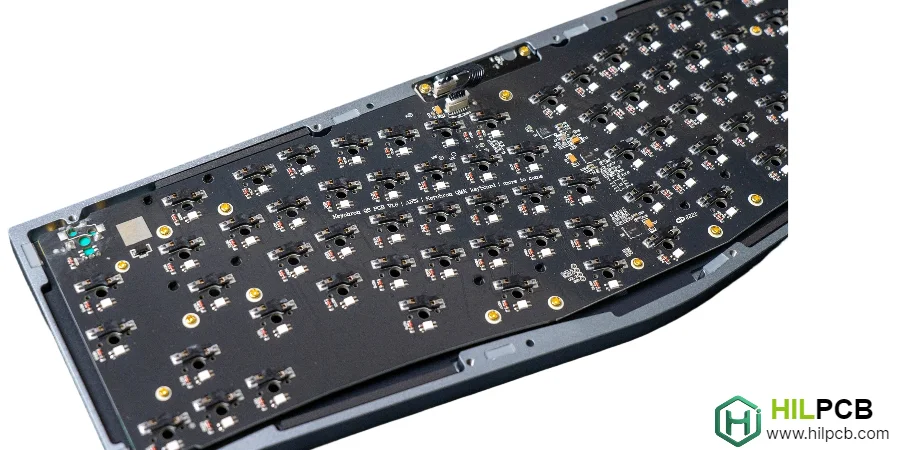
Some applications demand keyboards capable of withstanding punishment that would destroy standard industrial equipment within hours. Rugged Keyboard PCB for Industrial Use addresses the most extreme operating conditions—from military field operations to offshore oil platforms, mining equipment to outdoor public terminals.
HILPCB provides professional PCB fabrication and PCBA assembly services for rugged keyboard manufacturers, including IPC Class 3 assembly and environmental qualification support.
Menu Navigation
- Military, Marine, Mining: Understanding Extreme Environment Categories
- Potting, Reinforcement, and Shock-Resistant PCB Construction
- IP68 Sealing, Corrosion Protection, and Thermal Management
- Application-Specific Rugged Keyboard Design Requirements
- IPC Class 3 Assembly for Mission-Critical Rugged Keyboards
Military, Marine, Mining: Understanding Extreme Environment Categories
Understanding the range of extreme environments helps specify appropriate ruggedness levels for each application, matching design investment to actual deployment conditions.
Different environments stress keyboards in different ways—temperature extremes, mechanical shock, contamination, or chemical exposure each requiring specific design countermeasures.
Environment Categories
- Military and Defense: MIL-STD-810 defines comprehensive environmental testing—temperature cycling -40°C to +71°C, humidity to 95% RH, salt fog exposure, sand and dust penetration, shock and vibration per platform profiles.
- Offshore and Marine: Salt spray exposure accelerating corrosion; humidity causing condensation in sealed enclosures; platform vibration from machinery and wave action; UV degradation from sun exposure.
- Mining and Heavy Industry: Abrasive dust penetration; impact from flying debris; vibration from heavy equipment; extreme temperatures in underground or smelting operations; explosive atmosphere requirements in some areas.
- Outdoor Public Terminals: Weather exposure including rain, snow, and temperature extremes; vandalism resistance; UV degradation of materials; condensation from day/night temperature cycling.
- Vehicle-Mounted Applications: Platform-specific vibration spectra; shock from road conditions; temperature extremes in unoccupied vehicles; electromagnetic interference from vehicle electrical systems.
- Arctic and Desert Extremes: Extended temperature ranges (-55°C to +85°C); rapid temperature transitions; UV exposure at altitude; blowing sand and ice crystal erosion.
Ruggedness Specification
Environmental specifications quantify protection requirements—temperature range, IP rating, shock levels, vibration profiles, and chemical exposure guide design decisions.
Potting, Reinforcement, and Shock-Resistant PCB Construction
Surviving extreme conditions requires construction techniques beyond standard industrial approaches, with robust materials and assemblies maintaining function under abuse.
Every design decision affects durability—PCB construction, component selection, mechanical structure, and sealing systems collectively determine survival.
Construction Elements
- Reinforced PCB Construction: 2.0mm+ board thickness resisting mechanical flexing; high-Tg laminate (Tg 170°C+) preventing delamination; 2oz copper improving thermal distribution and mechanical robustness.
- Potting and Encapsulation: Complete encapsulation with epoxy or polyurethane potting compound protecting against shock, vibration, and contamination; thermal management considerations for heat dissipation.
- Component Selection: Industrial or military temperature ratings; robust packages (no tall, fragile components); shock-resistant mounting for heavy components; proven reliability history.
- Mechanical Reinforcement: Internal support structures preventing PCB flexing; energy-absorbing enclosure construction; reinforced mounting points; protected cable entry.
- Vibration Resistance: Vibration-rated connectors with locking features; component placement avoiding resonance; PCB mounting isolating high-frequency vibration; solder joint reliability under sustained vibration.
- Impact Protection: Recessed keys or protective bezels; reinforced corners and edges; energy-absorbing materials in impact zones; adequate enclosure wall thickness.
Material Selection
Material choices affect durability—stainless steel hardware resisting corrosion; UV-stable plastics for outdoor exposure; chemical-resistant enclosure materials for industrial environments.
IP68 Sealing, Corrosion Protection, and Thermal Management
Multi-layer environmental protection ensures reliable operation across temperature extremes, moisture exposure, and contamination ingress.
Sealing systems, thermal management, and corrosion protection work together providing comprehensive environmental defense.
Protection System Elements
- Advanced Sealing Technology: IP68/IP69K ratings for submersion and high-pressure washdown; redundant seal barriers for critical applications; seal materials selected for specific environmental exposure.
- Temperature Management: Extended-temperature components maintaining function across operating range; thermal design preventing overheating at high ambient; cold-start capability from extreme low temperatures.
- Corrosion Protection: Stainless steel hardware eliminating rust; protective plating on metal components; conformal coating preventing PCB corrosion; sealed connectors blocking contact contamination.
- Chemical Resistance: Enclosure materials resisting specific chemical exposure; seal compatibility with cleaning agents and process chemicals; conformal coating rated for chemical environment.
- UV Stability: UV-resistant materials for outdoor exposure; UV-blocking coatings on transparent elements; color-stable materials maintaining appearance.
- Pressure Compensation: Breather vents equalizing pressure during temperature changes while maintaining IP rating; prevents enclosure stress from altitude or temperature-induced pressure differential.
Environmental Qualification
Environmental testing per applicable standards validates design—MIL-STD-810, IEC 60529, and industry-specific requirements depending on target application.
Application-Specific Rugged Keyboard Design Requirements
Different rugged applications have specific requirements beyond general environmental protection, addressing unique operational demands.
Application-specific design addresses not just survival but optimal function in each deployment scenario.
Application-Specific Designs
- Mining and Heavy Equipment: Explosion-proof construction for hazardous atmospheres (ATEX, IECEx); resistance to coal dust and abrasive particles; extreme vibration tolerance; impact resistance for equipment-mounted installation.
- Marine and Offshore: Extended salt fog resistance (1000+ hours); UV stability for deck installation; submersion survival during deck washing; Coast Guard and maritime classification society approval.
- Outdoor Public Terminals: Vandal-resistant construction preventing damage from intentional abuse; weather sealing for rain, snow, and temperature exposure; tamper-proof mounting and enclosure.
- Vehicle and Mobile Equipment: Platform-specific vibration qualification; shock resistance for off-road operation; temperature cycling for unoccupied vehicle exposure; secure mounting under acceleration loads.
- Emergency and First Responder: Drop resistance for handheld equipment; gloved operation capability; visibility in varied lighting; rapid decontamination capability.
- Field Military Systems: Full MIL-STD-810 qualification; NVIS compatibility where required; EMI/EMC per MIL-STD-461; COTS insertion programs with ruggedized COTS requirements.
Certification Requirements
Many rugged applications require third-party certification—military qualification, explosive atmosphere approval, maritime classification, or industry-specific certification.

IPC Class 3 Assembly for Mission-Critical Rugged Keyboards
Rugged keyboards demand the highest manufacturing quality—IPC Class 3 workmanship ensures solder joints and assemblies survive extreme environmental exposure. HILPCB provides Class 3 manufacturing for demanding rugged applications.
Why Choose HILPCB for Rugged Keyboard PCB
IPC Class 3 Assembly
High-reliability applications demand IPC-A-610 Class 3 workmanship. Our SMT assembly provides:
- Trained and certified operators to Class 3 standards
- Process controls ensuring Class 3 solder joint quality
- Inspection protocols verifying Class 3 compliance
- Documentation supporting your quality requirements
High-Reliability PCB Fabrication
FR4 PCB for rugged applications includes:
- High-Tg laminates (Tg 170°C+) for thermal reliability
- 2oz copper standard; heavier weights available
- ENIG or hard gold finish for connector reliability
- IPC-6012 Class 3 fabrication quality
Conformal Coating
Environmental protection through professional conformal coating:
- Acrylic, urethane, or silicone coating options
- Proper masking of connectors and test points
- UV inspection verifying complete coverage
- IPC-CC-830 qualification compliance
Environmental Screening
Pre-shipment environmental screening validates rugged keyboards:
- Temperature cycling per your specification
- Functional testing at temperature extremes
- Burn-in for infant mortality screening
- Documentation for qualification records
Component Traceability
Rugged applications often require full traceability:
- Lot-level component traceability
- Date code and source documentation
- Certificate of Conformance for each lot
- Records retention per your requirements
Production Capability
- Small batch assembly for qualification units and low-volume applications
- Large volume assembly with consistent Class 3 quality
- Turnkey assembly sourcing military and industrial-grade components
Contact us with your rugged keyboard requirements for Class 3 manufacturing assessment.
Common Questions
What does “rugged” really mean for an industrial keyboard PCB?
It means the keyboard is designed to keep working through environmental stress, not just survive a marketing checklist. Temperature extremes, vibration, contamination, traceability, and controlled manufacturing quality all matter if the product is expected to perform reliably in demanding field conditions.
Why are traceability and Class 3 quality often emphasized in rugged keyboard programs?
Because rugged applications usually tolerate fewer unknowns in both build quality and supply history. Strong traceability and disciplined Class 3-style controls help teams diagnose failures, support qualification records, and reduce the risk that hidden assembly variation will appear only after deployment.
What should be screened or validated before shipment on a rugged keyboard?
The most useful pre-shipment checks are environmental screening, functional confirmation under expected conditions, and documentation that ties results back to specific lots and components. Those checks provide stronger evidence of field readiness than a basic room-temperature functional pass alone.