
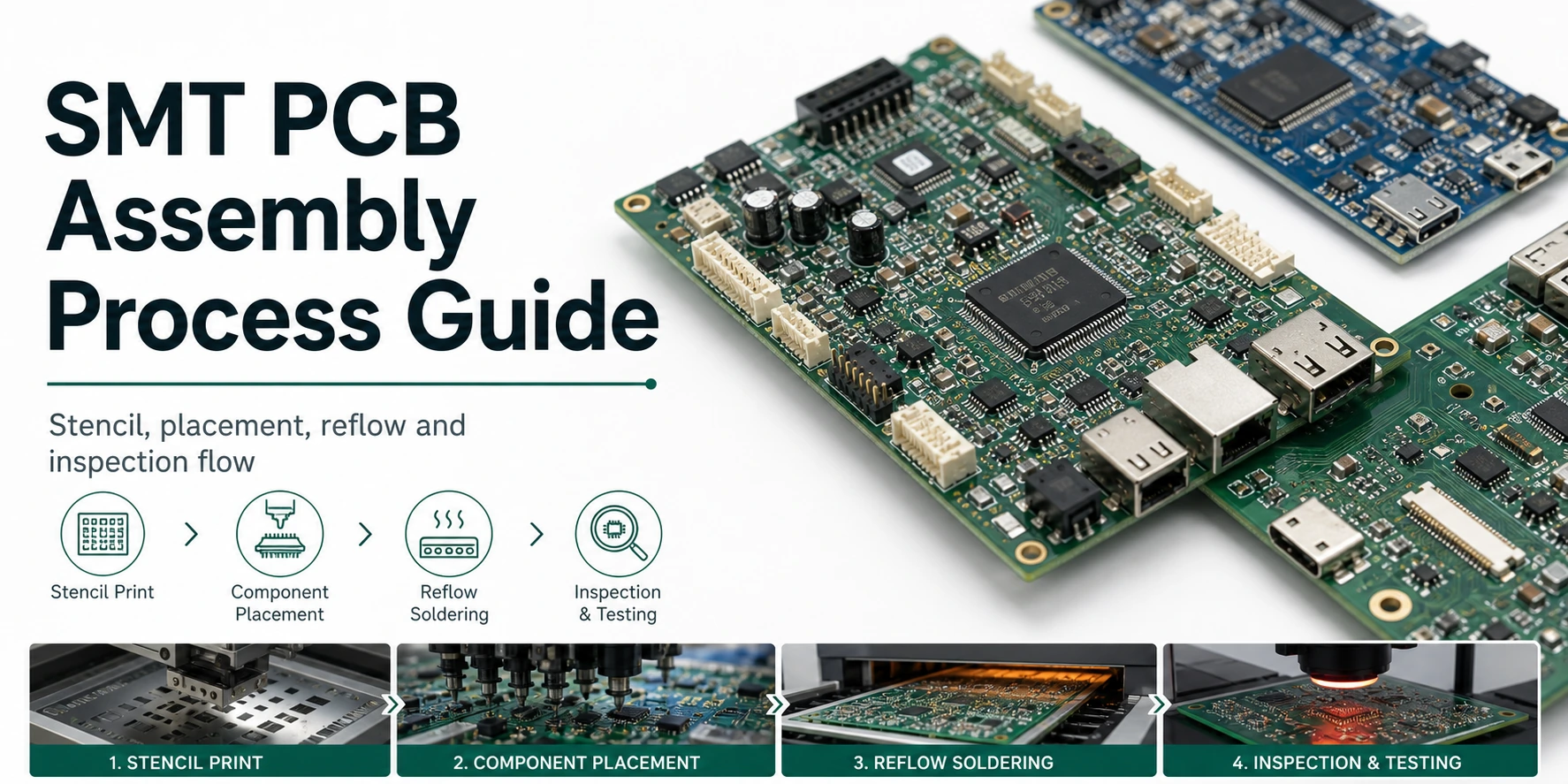
- Treat SMT assembly as a release-package problem first. A board is not ready for assembly because Gerbers exist; it is ready when BOM identity, placement intent, revision control, route choice, and test intent are visible enough to support the next build.
- Keep SMT, THT, selective solder, dense-package handling, inspection, and electrical test inside one coordinated assembly flow instead of scattering them across isolated service terms.
- Use layered inspection language carefully.
SPI,AOI,X-ray, electrical test, functional test, first-article confirmation, and final inspection answer different questions and should not be collapsed into one generic quality promise. - State test intent before the board reaches launch. The assembly route is stronger when the package already shows whether the next build mainly needs fixture-free electrical checks, fixture-based access, functional behavior confirmation, or a narrower validation handoff.
- Keep
turnkey,flex,rigid-flex,HDI, and application-suffix vocabulary subordinate to package clarity. Those terms help only after the release package already knows what kind of build it is asking the assembly flow to support.
An SMT PCB assembly process guide is most useful when it behaves like a release-readiness document. It should show what the package still needs, how the assembly route is chosen, why inspection must stay layered, what test intent should already be visible, and what evidence must travel into later validation.
In This Guide
- What this process guide is actually deciding
- What the assembly release package must include before build
- How SMT, THT, selective solder, and inspection stay in one flow
- How electrical-test intent and validation handoff should work
- FAQ
- Next steps
- Sources
What this process guide is actually deciding
This SMT PCB assembly guide does not open like a capability brochure. It opens like a release review. Search demand around this topic mixes electronics assembly, pcb assembly solutions, SMT assembly guide, flex PCB assembly, rigid-flex PCB assembly, HDI PCB assembly, HDMI assembly, and application-specific SMT assembly terms as if they all ask for the same answer. They do not. Some describe package complexity. Some describe form factor. Some describe board population. Some describe downstream route options. The useful job here is to turn that noisy demand into one board-level question: what must the release package expose before the board can enter assembly cleanly?
That question matters because a board can look assembly-ready too early. Gerbers, a rough BOM, placement data, or a quick test note can create false confidence. The board is not ready for a clean assembly route if revision intent, package completeness, mixed-technology burden, inspection layering, and test intent are still vague. A strong guide uses those gaps to define the next release decision clearly.
The first thing it should decide is what kind of assembly route the board really needs. Some boards are mostly SMT-first with limited through-hole burden. Some become mixed-technology programs because connectors, terminals, relays, shielding hardware, or power-entry structures force THT and selective-solder considerations into the same release package. Some look like ordinary SMT jobs until dense-package inspection, conformal-coating dependencies, or later validation requirements change the practical route. If the article never names the route clearly, the reader gets a list of process words without a decision framework.
The second thing it should decide is what the assembly package actually includes. Fabrication files are necessary, but they are not enough. A board that expects the right assembly path also needs BOM identity, placement data, revision clarity, package-sensitive notes, and explicit test intent. This does not require one universal document checklist. It does require separating bare-board fabrication outputs from the broader set of assembly and test inputs.
The third thing it should decide is how the inspection stack is supposed to work. SPI, AOI, X-ray, electrical test, functional test, first-article confirmation, final inspection, and traceability are not synonyms. They are not interchangeable proof words. They answer different classes of question. A release guide becomes much stronger when it says that directly, because the typical weak draft uses test names as comfort words: the more acronyms it includes, the more complete the process sounds. A disciplined article does the opposite. It narrows the role of each gate until the reader can see what each one is actually meant to confirm.
The fourth thing it should decide is what the next build is trying to prove. An early assembly run should not be asked to prove package completeness, route correctness, electrical coverage, functional behavior, and all future reliability questions at once. It should answer one smaller release question clearly. Maybe the goal is to confirm that the package is complete enough for mixed-technology execution. Maybe it is to confirm that dense-package handling and inspection assumptions align. Maybe it is to carry a clean traceability package into later validation. The build becomes more useful when the guide names that question explicitly.
The fifth thing it should decide is what this guide does not cover. It is not a universal SMT capability table. It is not a fixture ROI calculator. It is not a cycle-time chart. It is not a guarantee that every board gets every inspection or test gate. It is not a compliance claim. Its practical role is to define package completeness, explain how assembly route choice changes with the board, keep inspection layered, show why test intent must appear early, and separate launch evidence from later validation authority.
Early rule table for an SMT PCB assembly release review
| Review area | What to decide | Why it matters | How to verify | If ignored |
|---|---|---|---|---|
| Assembly route | Decide whether the board is SMT-first, mixed technology, or through-hole constrained | The route shapes every downstream inspection and test choice | Name the dominant assembly route in the release notes | Inspection and test planning drift without a clear route |
| Package completeness | Decide whether BOM identity, placement, revision, and test intent are already visible | Assembly decisions need more than fabrication outputs | Confirm the release package can explain what the board expects from assembly | The build starts with hidden assumptions |
| Inspection layering | Decide which gates answer paste, visible assembly, hidden-joint, electrical, or release questions | Acronym stacking hides weak process logic | Write the role of each gate separately | “Quality” becomes one vague promise |
| Test intent | Decide whether the next build mainly needs fixture-free electrical checks, fixture-based access, or powered behavior confirmation | Test-method confusion often starts before the first build | State the test question before handoff | The board asks one build to solve multiple unstated problems |
| Validation handoff | Decide what must travel into later validation ownership | Early release control is only useful if evidence can move cleanly | Name revision identity, records, and unresolved items in the handoff package | Later validation receives activity, not clear evidence |
| Related deep-dive topics | Decide when hidden-joint control or detailed test-method selection needs a separate review | Not every assembly topic belongs in one guide | Call out the next review topic when the burden shifts | Critical follow-on work stays vague |
The table keeps the release review practical. Once the discussion turns into a list of process labels, the board still lacks a usable decision path.
What the assembly release package must include before build
The first practical job of an SMT PCB assembly guide is to define package completeness. Teams often underestimate this because the fabrication package feels tangible. Gerbers, drill data, stackup notes, and maybe a drawing set exist, so the board feels ready to move. Assembly is more demanding. The route decision depends on what components are actually on the board, where they sit, what the revision means, what test behavior is expected, and what kinds of access or hidden-joint risk the build will face.
That is why fabrication outputs alone are not enough for assembly-route selection. A useful public guide can say this without turning into a rigid document policy. The real point is that different assembly and test methods depend on different review artifacts. Electrical-test planning, hidden-joint risk evaluation, programming needs, dense-package handling, and powered-behavior validation do not all consume the same inputs. If the article teaches the reader that one lesson clearly, it has already replaced a large amount of vague assembly demand with something operationally useful.
The next thing the package needs is route clarity. Is the board mostly SMT-first, with limited through-hole content that should be managed carefully around dense neighborhoods? Is it mixed technology from the beginning because connectors, terminals, relays, or other larger parts force selective or wave-solder choices into the same program? Does the board include dense package zones that make the inspection stack more important than the overall component count suggests? The package should answer those questions early, because they shape not only assembly flow but also what the first build can realistically confirm.
Revision clarity matters for the same reason. A board entering assembly without a stable revision story often creates confusion that no later inspection gate can fix cleanly. The guide does not need to publish a full change-order workflow to be specific. It just needs to insist that revision identity and release ownership remain visible enough that assembly, inspection, electrical test, and later validation are all looking at the same board definition. This is especially important when broad terms like electronics assembly or pcb assembly solutions invite shortcut thinking around ownership.
The package should also expose test intent early. This does not mean every assembly article has to become a test-method comparison. It means the board should already know what kind of evidence the next build is expected to gather. Is the early build mostly about assembly correctness and launch alignment? Does it need fixture-free electrical checks because the design is still changing? Is there a stable enough production posture that fixture-based planning is becoming more relevant? A disciplined assembly guide raises those questions before the board reaches the line, because once the build begins, uncertainty becomes more expensive.
This is where form-factor language should be handled carefully. Flex, rigid-flex, HDI, and HDMI assembly do not deserve separate promise surfaces inside this guide. They matter only when they change what the package must reveal. A rigid-flex board may need tighter handling around bend-sensitive regions or assembly support. An HDI board may tighten dense-package and inspection concerns. An HDMI-adjacent board may increase connector and shielding considerations. The useful question is always the same: what about this board changes the assembly route or the release package? If the article cannot answer that specifically, the form-factor term should not dominate the section.
The cleanest way to think about package completeness is to ask five direct questions before build:
- Can the release package identify the board revision and the intended assembly route clearly?
- Does the package include enough component and placement information to support route and test decisions?
- Are dense-package, through-hole, connector, or protection-sensitive neighborhoods already visible?
- Is the intended evidence question for the next build already stated?
- Can later validation receive more than just a fabricated board and a vague process promise?
If the answer to those questions is weak, the right move is to slow the reader down instead of trying to sound more complete than the package really is.
The route toward SMT Assembly or Turnkey Assembly becomes much more useful once that package clarity exists. Before that point, those pages are being asked to absorb release ambiguity that belongs upstream. The board needs the opposite order: freeze what the package means, then choose the execution route that fits it.
- Assembly and test decisions depend on more than Gerbers alone.
- Route clarity should appear before the build asks for mixed-technology execution.
- Revision identity and test intent should be visible before the first launch run.
- Form-factor words matter only when they change the release burden.
Another common failure at this stage is letting service breadth replace engineering detail. A draft says turnkey and sounds more complete without actually improving package definition. That is exactly backwards. Turnkey is only useful when the package is already clear enough that sourcing, assembly route, inspection, and handoff can move together without hiding unresolved design intent.
How SMT, THT, selective solder, and inspection stay in one flow
The second major job of the guide is to explain that assembly is one coordinated flow, not a pile of disconnected services. Stencil and paste work, SMT placement, reflow, through-hole insertion, selective or wave solder as needed, inspection, electrical test, and later validation all belong to one process chain. The public article becomes more useful when it reflects that continuity instead of describing SMT and THT as if they were unrelated product categories.
The most important route decision is not whether a supplier “offers” SMT and THT. The important decision is how the board population drives the assembly flow. Some boards remain overwhelmingly SMT-first and only need bounded through-hole handling. Others carry enough connectors, relays, transformers, terminals, or mechanically stressed hardware that mixed technology becomes the real center of gravity. The guide distinguishes those cases because the real question is about route selection and neighborhood constraints, not about which service label sounds more complete.
Selective solder belongs inside that route logic. It is useful when the board has localized through-hole content near dense SMT or heat-sensitive regions and broader exposure would create unnecessary risk. Wave-solder language belongs in a different situation: THT-heavy populations and layouts that support that route more naturally. A public guide does not need to publish process windows or nozzle details to be specific. It simply needs to say that route choice depends on board population, density, access, and downstream verification needs rather than on one universal hierarchy of methods.
Dense-package handling belongs in the same flow. Fine-pitch areas, BGA or QFN density, hidden-joint risk, and inspection visibility are not postscript concerns. They change the practical strength of the assembly route. A board with modest through-hole content but very dense hidden-joint neighborhoods may still need a more careful release posture than a board with a simpler surface-mount profile. That is why assembly type cannot be framed only in terms of component count or board format. The real burden is in what the assembly route must coordinate.
One physical failure pattern makes that burden obvious: reflow-profile conflict inside the same board. A power MOSFET tied into a large copper pour behaves like a high-thermal-mass load. A fine-pitch QFN in the same build behaves like a fast-heating, low-margin joint set. They do not want the same thermal history. If the release package never marks those high-thermal-mass or heat-sensitive neighborhoods, the SMT team is pushed toward one generic profile just to keep the line moving. That is where small parts start to tombstone while the heavier thermal pad under the MOSFET still trends toward excessive voiding. The lesson is simple: mixed process route and component-density distribution have to be defined in the package before assembly. A Gerber set alone cannot explain where profile conflict is likely to appear.
Inspection has to stay layered for the same reason. SPI is not the same as AOI. AOI is not the same as X-ray. Electrical test is not the same as functional validation. First-article confirmation and final inspection are not the same as defect localization. A strong guide does not explain every method in isolation. It explains why the board needs different gates to answer different questions. That framing is much more useful than promising a comprehensive quality stack, because it helps the reader recognize what kind of evidence is still missing.
This is also where the old electronics assembly and pcb assembly solutions demand can be narrowed into a smaller set of release questions:
- what kind of assembly route does the board need
- what neighborhoods create the highest process sensitivity
- what inspection layers are actually relevant
- what evidence should still move into later test or validation work
Those questions are much more useful than any broad solution language because they convert vague buying intent into board-level release logic.
Mixed-technology flow also changes how the reader should think about related product pages. If the board is still mostly SMT-first, SMT Assembly is the clearest route. If through-hole content and localized hardware begin to govern the process, Through-hole Assembly becomes a more relevant next path. If the program is stabilizing into repeatable production posture rather than an early launch build, Large-volume Assembly becomes part of the conversation. Those pages should be downstream of route clarity, not substitutes for it.
The same discipline keeps this page from drifting into hidden-joint or low-void process detail it does not own. Dense-package control can be acknowledged here as part of one assembly flow, but once the dominant burden becomes concealed-joint review, rework, or low-void planning, the board should move toward the sibling BGA checklist rather than forcing that whole story into an SMT process guide.
That route discipline is what keeps the article specific. Assembly is broad. A strong process guide is not. It narrows the reader’s attention to the release decisions that actually shape the next build.
How electrical-test intent and validation handoff should work
The last job of the guide is to show how test intent and handoff fit into the assembly review without taking over the page. This is where weak drafts usually lose focus. They start as assembly articles and gradually become a pile of test acronyms. A disciplined guide avoids that by keeping test methods in planning posture.
The first planning rule is simple: selecting among test methods requires more than fabrication outputs alone. Electrical access, hidden-joint risk, powered behavior goals, programming needs, and production-stage context all influence which methods make sense. The article does not need to become a formal test-input checklist to explain that clearly. It only needs to insist that assembly release and test-method selection depend on different artifacts and that the package should already expose the relevant ones before the board reaches launch.
That is why test intent should appear before the first build instead of after it. A board that is still changing quickly may lean toward fixture-free electrical checks as a launch aid. A more stable program may justify more deliberate fixture planning. A board with dense hidden-joint packages may need inspection visibility emphasized more heavily. A board that mainly needs powered-behavior confirmation should say so directly instead of hoping generic “testing” language will absorb that need. The guide becomes more valuable when it teaches the reader to state the evidence goal before choosing the method family.
At the same time, this guide does not need a full ICT-versus-flying-probe comparison. The useful point here is narrower: explain why the assembly route benefits from early test-intent visibility and why different methods belong to different problem classes. The board should know whether the next evidence layer is about launch alignment, fixture-free electrical screening, fixture-based access, powered functional behavior, or later validation handoff.
Validation handoff should also stay modest and concrete. What travels forward is not an abstract promise of quality. It is a package: revision identity, traceability linkage, inspection records, test notes, unresolved items, and the context needed for the next owner to understand what the build did and did not confirm. That is why handoff language stays careful here. It is safe to say evidence moves forward. It is not safe to imply that every earlier gate has already converted the board into a finished product or a validated system.
First-article confirmation belongs in that same modest frame. It helps confirm that the first build matches the released package and process assumptions. It is a launch-control gate, not a whole-program verdict. Final inspection is another gate with its own job. Traceability is another layer with its own job. None of those eliminate the need to ask what later validation still has to prove. A board that understands that separation will move through assembly more cleanly than one that tries to make every early record sound final.
This is the point where application-specific SMT language can be handled safely. AI-chip interconnect, industrial robotics control, and medical-imaging wearable contexts should not force the article into separate industry claims. They should tighten the same central question: what does this board’s package need to reveal before the assembly flow and the later validation handoff can stay clean? Application vocabulary changes the pressure. It does not replace the route logic.
The most useful end-of-article checklist is therefore short:
- Has the board stated the assembly route clearly enough for the next build?
- Does the package expose enough identity, placement, and test intent to support that route?
- Are inspection gates being described as different layers instead of one quality slogan?
- Does the build know what kind of evidence it is supposed to collect next?
- Can later validation receive more than a board and a loose narrative?
Those questions catch most of the real failure modes:
- relying on generic assembly or turnkey language to hide package ambiguity
- treating every inspection and test word as one generic proof bucket
- pushing test-method thinking until after the build starts
- making mixed-technology flow sound simpler than the board population really is
- confusing traceability and launch control with final readiness
The biggest failure is premature certainty. The board sounds production-ready because the draft uses more process words, but the evidence package is still thin. A strong SMT PCB assembly guide does the opposite. It uses process words to reduce ambiguity, not to hide it.
FAQ
Does an SMT assembly guide replace a turnkey assembly page?
No. A safer role for this guide is to explain what the board must freeze before a turnkey route stays clean. Turnkey becomes meaningful after the package is coherent enough that sourcing, route choice, inspection, and handoff can move together without hiding unresolved design intent.
Are Gerbers enough to start a proper assembly review?
Not usually. Fabrication outputs are a necessary base, but assembly and test-route selection also depend on BOM identity, placement data, revision clarity, package-sensitive regions, and test intent. The guide is stronger when it teaches that difference early.
When does a board stop being SMT-first and become mixed technology?
When through-hole hardware, connectors, terminals, relays, shielding, or other larger parts begin to change solder-route choice, neighborhood constraints, inspection needs, or launch-control logic. Mixed technology is a route decision, not just a count of part types.
Does every board need every inspection and test gate?
No. SPI, AOI, X-ray, electrical test, functional test, first-article confirmation, and final inspection belong to different evidence layers. A useful assembly review explains what question each layer answers instead of implying that every project runs the same full stack.
When should the board think about flying probe or ICT?
Before launch, as part of test-intent planning. The key question here is not which one is universally better. It is whether the next build needs fixture-free electrical screening, more stable fixture planning, or a different evidence layer entirely. That decision should be visible before assembly starts.
What should travel into validation handoff after assembly?
Revision identity, traceability linkage, inspection records, test notes, unresolved items, and the context needed for the next owner to understand what the build actually confirmed. Handoff is an evidence transfer, not a blanket proof that every later validation question is closed.
Next steps
If the board carries dense BGA neighborhoods, mixed through-hole hardware, or a Gerber and BOM set that may still be too thin for a clean NPI pilot run, do not leave the factory to infer assembly intent from fabrication data alone.
Send the full release package — Gerber, BOM, and assembly instructions — to [email protected], or upload it through the Quote page. HILPCB's NPI engineering team will return DFM feedback within 24 hours to expose package and footprint conflicts, confirm whether inspection coverage matches the real risk areas, and lock the safest assembly route before pilot release.
Sources
HILPCB: Turnkey Assembly
Supports the public route for end-to-end assembly coordination once the package is coherent enough to carry sourcing, assembly, inspection, and handoff together.HILPCB: SMT Assembly
Supports the public route for SMT-first assembly planning, process control, and inspection-aware execution posture.HILPCB: Through-hole Assembly
Supports the route boundary for mixed-technology boards where connectors, terminals, or other hardware change the assembly flow.HILPCB: Request a Quote
Supports quote-intake handoff for Gerber, BOM, assembly notes, and the broader release package once the board is ready for NPI review.Public method-identity references: IEEE 1149.1 overview, IPC-7525C TOC, and AS9102C identity page
Support the narrower planning posture that assembly documents, stencil families, and launch-control identities should stay method-aware without being rewritten as blanket process or compliance proof.