
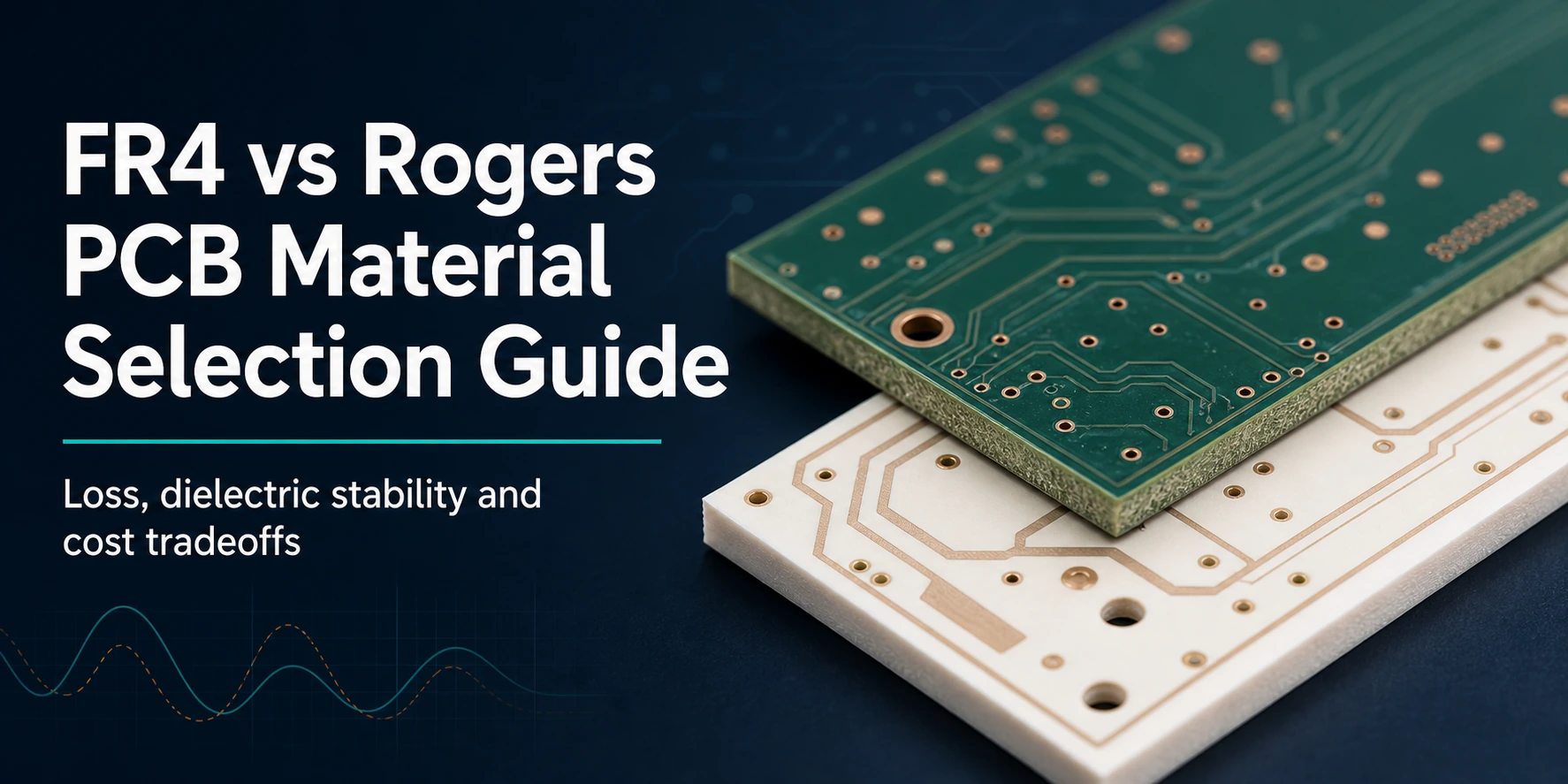
- Start with material family, not with one famous product code.
FR-4is a broad laminate family, whileRogersis a narrower high-frequency and RF material route with multiple distinct subfamilies. - Do not force the board into a false two-option contest. Many designs should stay on ordinary FR-4 or on a low-loss digital laminate route before Rogers even enters scope.
- Treat
RO4350Bas one owner-scoped Rogers example, not as a synonym for the whole Rogers family and not as a universal answer for every high-frequency board. - Ask what the board is trying to protect: ordinary rigid manufacturability, high-speed digital signal integrity, RF loss posture, hybrid-stackup flexibility, or a narrower launch and transition problem.
- If one local RF zone is driving the whole material conversation, pause and check whether the real answer is a hybrid review instead of upgrading the entire board to one premium family by habit.
FR-4 vs Rogers selection is a board-level family-routing decision. A strong review decides whether the board should remain on a broad FR-4 family, move into a lower-loss digital laminate route, enter a Rogers high-frequency or RF family, or stay hybrid until stackup and validation questions are narrowed.
Once the family route is clear, use the FR-4 PCB owner page, our dedicated Rogers PCB Manufacturer service, or the High Frequency PCB overview alongside the PCB quality evidence guide to align the release package with the selected material and acceptance plan.
In This Guide
- What a board-level FR-4 vs Rogers review is actually deciding
- Keep FR-4, Rogers, and RO4350B on the right level
- When a board should stay on FR-4, move into a digital low-loss family, or bring Rogers into scope
- Hybrid stackup handoff, release checklist, and common failures
- FAQ
- Next steps
- Sources
What a board-level FR-4 vs Rogers review is actually deciding
A board-level FR-4 vs Rogers review is often framed as if two single materials are fighting for one winner slot. That is already the wrong starting point. FR-4 is not one fixed material with one fixed Dk, Df, Tg, or thermal profile. Rogers is not one monolithic premium laminate either. The useful engineering question is not which label sounds more advanced. It is which material family the board actually belongs to, and what release burden is forcing that move.
That distinction matters because search demand around this topic mixes several different intents into one surface request. FR-4 material and FR-4 board often point to broad rigid-family planning. High-frequency PCB materials points to a narrower material-routing question that may still sit inside high-speed digital or RF-adjacent material families. RO4350B points to one specific Rogers example, not to a full family-selection framework. A good guide has to address all of those intents without pretending they ask the same question.
The first thing the review should decide is whether the board is still in a broad rigid-material category. Many designs never need a special laminate family at all. They need a cleaner stackup, better reference-plane control, tighter release documentation, or more realistic validation planning. If the board's real issue is still ordinary rigid execution, then upgrading the conversation to Rogers too early only hides the actual engineering work.
The second thing the review should decide is whether the material question is family-level or product-level. FR-4 belongs at family level. Rogers also starts at family level, because Rogers includes more than one processing style and more than one loss posture. RO4350B only enters after the board has already justified a Rogers-family direction and still needs an example of what kind of Rogers route is being considered. If that order is reversed, the board starts optimizing around a product code before it has even defined the family it belongs to.
The third thing the review should decide is whether the board is really asking a high-speed digital question, an RF question, or a hybrid question. A strong boundary is needed here: high-speed digital low-loss families and RF or microwave families should not be flattened into one generic low-loss bucket. The board may need a lower-loss digital laminate without needing a PTFE-style RF route. It may need an RF-family laminate in only part of the structure. Or it may need a hybrid review because one local RF region is distorting the whole-board conversation.
The fourth thing the review should decide is what the material choice is supposed to protect. Is the board trying to preserve ordinary FR-4-like processing ease? Is it trying to open a lower-loss but still multilayer-friendly digital route? Is it trying to support a narrower RF-family behavior? Is it trying to keep a hybrid path open until stackup and launch decisions are more stable? If the board cannot answer that question, then the material label is still decorative.
The fifth thing the review should decide is what the material selection does not mean. A family-level material review is not a finished-board performance claim. It is not a channel-budget proof, an insertion-loss proof, an antenna-efficiency proof, or a supplier-capability proof. Safe release writing keeps the subject at family routing, processing posture, hybrid boundary, and validation ownership unless stronger evidence exists.
In practical terms, a board-level FR-4 vs Rogers review is approving a narrower statement than many teams expect:
- which material family the board currently belongs to
- whether the issue is ordinary rigid, lower-loss digital, RF-family, or hybrid-stackup routing
- which product examples are only examples and not universal defaults
- what the first build or next design review still needs to confirm
If those four items are still unclear, the project does not yet have a material-selection decision. It only has a premium-material debate with too little board context.
Early rule table for FR-4 vs Rogers selection
| Review area | What to decide | Why it matters | How to verify | If ignored |
|---|---|---|---|---|
| Family level | Decide whether the board is still broad FR-4 family, lower-loss digital family, Rogers family, or hybrid | Material labels are not interchangeable | State the family before naming product examples | The discussion jumps to a product code too early |
| Problem type | Decide whether the board is mainly ordinary rigid, high-speed digital, RF-adjacent, or hybrid | Different routes need different evidence and validation | Write the main board burden into the release notes | One local requirement hijacks the full material decision |
| Product-example scope | Decide whether RO4350B or another named grade is only an example or a real candidate |
Example and commitment are not the same thing | Mark named grades as directional unless the stackup truly depends on them | One example silently becomes a default family rule |
| Processing posture | Decide whether the board needs FR-4-like processing, RF-family processing, or hybrid treatment | Processing burden is part of material fit | Review what fabrication and assembly path the board expects | The material choice assumes a manufacturing route that was never stated |
| Hybrid check | Decide whether one local RF or loss-sensitive region should stay local instead of upgrading the whole board | Hybrid logic is often the real answer | Review whether one zone is distorting whole-board selection | The board over-upgrades the entire laminate strategy |
| Validation handoff | Decide what the prototype must prove about family fit | First builds should close one material question clearly | State the prototype question in writing | Material choice remains philosophical instead of testable |
The table is most useful before the draft starts sounding like a parameter contest. Once the article collapses into FR-4 versus Rogers as if it were one universal scoreboard, the board has already lost the routing logic that made the material choice meaningful.
Keep FR-4, Rogers, and RO4350B on the right level
The most important discipline in this topic is naming control. A board can only be reviewed clearly if family terms stay separate from product terms.
Start with FR-4 as a broad family. Local source coverage is already clear on this point: FR-4 should be treated as a broad laminate family, not as one material with one fixed property block. Product-level anchors such as FR408 and FR408HR are useful examples inside the wider FR-4 world, but they are not permission to turn FR-4 into a universal property table. That is the right starting point whenever the board is still asking whether it can remain on ordinary rigid or low-loss FR-4-like material without moving into a specialty family.
That family-level discipline matters because phrases like FR-4 material, FR-4 board, and colored FR-4 naming do not justify a global claim about what all FR-4 materials do. They justify a board-level article that says FR-4 is a family with multiple product examples, multiple process postures, and multiple levels of performance fit. A board can stay in FR-4 family review even when it needs better skew control, better stackup discipline, or a lower-loss digital route than commodity rigid material normally implies.
Now move to Rogers. The same rule applies. Rogers selection is not one single ranking. A broader selector view is more accurate: some Rogers materials are framed around FR-4-like processing behavior, some around lower-loss RF or microwave use, some around higher-Dk compactness, and some around other narrower tradeoffs. That means Rogers should enter the article as a material-family route, not as a one-line synonym for premium high-frequency laminate.
This is exactly why RO4350B has to stay in scope control. RO4350B is useful in this article because it is a concrete, owner-scoped Rogers example. Rogers positions it as a low-loss laminate that keeps epoxy/glass-style processing behavior rather than PTFE-style through-hole handling requirements. That is a strong family-routing signal. It helps explain why some boards bring Rogers into scope without immediately jumping to the most exotic PTFE-family route. What it does not justify is the claim that RO4350B stands in for every Rogers choice or every high-frequency board.
That example boundary matters for RO4350B. The correct path is not to turn this article into an RO4350B mini-datasheet. The correct path is to explain why a board that starts from one familiar Rogers code is usually still asking a family-level question:
- does the board simply need an FR-4-like process route with a narrower high-frequency posture
- does it need a lower-loss digital route instead of a full RF-family move
- does it need a different Rogers family altogether
- or does it only need one Rogers-oriented zone inside a broader stackup
That is also where the FR-4 versus Rogers framing stops being a binary fight. Between broad FR-4 family and narrower Rogers-family routes sits a large middle ground of lower-loss digital material families. Local high-speed material coverage already reinforces that boundary. High-speed digital multilayer families and RF-family laminates should not be flattened into one generic low-loss bucket. A board can need better digital loss posture without becoming an RF-laminate board by default.
That means the article must resist two common shortcuts.
The first shortcut is collapsing FR-4 into basic and Rogers into advanced. That language sounds simple, but it is technically weak. Many boards remain on FR-4 family because the real engineering problem is stackup discipline, geometry control, reference continuity, or validation method. Many boards that leave broad FR-4 still move first into a lower-loss digital family rather than into a Rogers-family RF route.
The second shortcut is treating one Rogers example as a family verdict. RO4350B is a useful boundary marker because it shows a Rogers route that still keeps epoxy or glass-style processing behavior in scope. But Rogers covers more than that one position. Once the article says that out loud, the board can stop asking FR-4 or RO4350B? as if those are the only two thinking tools available.
If the material question has already reached the point where the project needs a narrower Rogers route, the most natural commercial handoff is toward Rogers PCB or, when the design issue is really broader frequency and loss behavior rather than one brand-family name, toward High frequency PCB. If the board is still fundamentally an ordinary rigid or mainstream multilayer design, the cleaner handoff stays with FR-4 PCB or, when layer-count planning and release structure are the bigger issue, Multilayer PCB.
When a board should stay on FR-4, move into a digital low-loss family, or bring Rogers into scope
Most material-selection confusion comes from asking the family question too late. By the time teams say should we use Rogers?, the board may already have mixed together at least three different concerns: ordinary rigid manufacturability, high-speed digital loss management, and RF-family routing. The safer review is to separate those concerns before the article names any one material as the answer.
The first route is staying on broad FR-4 family. This is the right default when the board is still fundamentally an ordinary rigid design and the real burden is not an RF-family material problem. The board may still need better stackup discipline, better release notes, controlled impedance review, fiber-weave management, or a more careful low-loss digital grade example inside the FR-4 world. But if the board has not yet shown that a specialty family is required, staying in FR-4 family review is often the more accurate engineering posture.
That is especially true when the project is still solving board-planning problems rather than laminate-family problems. A board that is early in stackup definition, coupon planning, launch design, or reference-plane review often gains more from better documentation and validation structure than from a fast jump into a specialty material label. The board should not use Rogers as a substitute for clarifying its real release burden.
The second route is moving into a lower-loss digital family without yet making a Rogers-family commitment. High-speed digital material families exist to solve a different problem from microwave or PTFE-oriented families. When the board's real question is digital channel behavior, multilayer stability, or a lower-loss digital posture, it may belong in that middle route first rather than in a broad FR-4 versus Rogers escalation.
That middle route matters because high-frequency PCB materials language can easily drift into overclaiming. Some boards with higher data-rate or lower-loss needs are still not asking a true RF-family question. They are asking whether broad FR-4 family is enough, or whether a more specialized digital family should enter scope before any Rogers-family commitment is made. If the board cannot distinguish that middle route, it tends to over-upgrade too early.
The third route is bringing Rogers into scope. This happens when the board has already moved beyond broad family FR-4 or low-loss digital family logic and now needs a narrower RF or high-frequency material posture. At that stage, Rogers becomes relevant as a family route, not because the brand name is famous, but because the board's actual burden has changed. The review can then ask whether a Rogers route with FR-4-like processing behavior is enough, whether a lower-loss Rogers RF route is required, or whether the board is actually heading toward a different subset of the family.
That is where RO4350B becomes useful as an owner-scoped example. It represents a Rogers-family path that keeps epoxy or glass-style processing logic alive instead of forcing every high-frequency design into PTFE-family assumptions. The board-level lesson is not pick RO4350B. The lesson is some Rogers routes exist because the project needs a narrower RF-family posture without giving up all of the process behavior associated with more mainstream builds.
The fourth route is hybrid review. Many boards do not need a whole-board material promotion. They need an honest review of whether one local region is dragging the entire design into a different family debate. If that local zone is real and structurally important, then the project may need a hybrid FR-4 plus Rogers stackup discussion. If the local zone is not yet stable, the board may simply need to keep that hybrid question open instead of pretending the whole structure has already moved.
That caution exists for physical reasons, not just purchasing logic. Teams often assume they can save money by placing a Rogers outer RF layer such as RO4350B over cheaper FR-4 digital and power layers and calling the result a straightforward hybrid stackup. The failure usually appears later, when the release package never forced a real review of resin-system compatibility, lamination temperature behavior, or Z-axis CTE mismatch across the material boundary. During lamination or later SMT reflow, that thermo-mechanical stress can break loose at the hybrid interface as severe warpage, bow and twist, or localized delamination around blind and buried via structures. Once that happens, the stackup is no longer a cost optimization story. It has become a build-stability problem that can destroy registration, assembly flatness, and long-term reliability before the first serious validation cycle is finished.
That hybrid boundary is important because cores, bondplys, and hybrid Rogers build language should not be flattened into ordinary whole-board laminate naming. A board can mention hybrid FR-4 plus Rogers logic as part of release planning, but it should not turn that mention into a recipe page. The safe public statement is narrower: hybrid review exists because not every board burden belongs on one material family across the whole stackup.
- Stay on FR-4 when the board is still fundamentally an ordinary rigid design.
- Use a lower-loss digital route when the main burden is high-speed multilayer behavior, not RF-family routing.
- Bring Rogers into scope only after the board has justified a narrower high-frequency or RF-family posture.
- Use hybrid review when one local region should not automatically control the whole stackup.
This routing logic also prevents the most common writing failure in this topic: overusing material names as substitutes for validation. A board does not become safe because it moved from one family word to another. It becomes safer when the material family matches the real signal, process, and release burden, and when the prototype is designed to test that specific family decision. The family name should help the team narrow the question, not make the question disappear.
That is why a disciplined material-selection article does not rush toward a winner. The better board-level answer is often one of these narrower conclusions:
- stay in FR-4 family but review grade examples and stackup more carefully
- move into a lower-loss digital family before making an RF-family jump
- open Rogers-family review because the board has truly changed category
- keep hybrid scope open because one local zone should not dictate the whole design yet
Once the article says those options clearly, the board stops asking for a prestige laminate and starts asking the right engineering question.
Hybrid stackup handoff, release checklist, and common failures
Before a board is released with FR-4, Rogers, RO4350B, or hybrid material language, the package should be able to close a short list of questions in writing.
First, the board should state its family level clearly. Is it still broad FR-4 family, a lower-loss digital family, a Rogers-family route, or a hybrid review? If the file cannot answer that question in one line, it is too early to freeze product-level names.
Second, the review should say whether any named material is a family example or a true current candidate. This is especially important for RO4350B. The file should make clear whether RO4350B is only being used to explain one Rogers route, or whether the design really depends on that kind of family posture.
Third, the release notes should identify what burden is forcing the family move. Is it ordinary rigid limitation, digital loss planning, RF-family routing, or a hybrid stackup problem? If the burden is not named, the material decision is still acting as a placeholder for unresolved design work.
Fourth, the handoff should state whether one local zone is controlling the decision. If the answer is yes, the team should explicitly re-check hybrid scope before promoting the entire board to a specialty family.
Fifth, the package should say what processing posture matters. That does not mean publishing lamination windows or build recipes. It means stating whether the board is trying to stay closer to broad epoxy or glass-style processing behavior, or whether it has truly entered a narrower RF-family treatment category.
Sixth, the prototype question should be narrow enough to interpret. A first build should not be asked to prove the entire material story, the whole SI story, and every downstream manufacturing outcome at once. The useful question is smaller: does the chosen family route fit the board's actual burden, or should the project reopen FR-4, lower-loss digital, Rogers, or hybrid scope?
Those checklist items catch most of the real failure modes:
- treating FR-4 as one fixed material
- treating Rogers as one fixed premium answer
- using RO4350B as a whole-family synonym
- turning high-speed digital material problems into RF-family problems too early
- skipping the hybrid check when one local zone is driving the decision
- using material names as a substitute for validation planning
The most persistent failure is turning family labels into performance promises. A draft moves from FR-4 to Rogers and starts sounding as if the board is already proven. That is weak release language. Family names describe routing logic. They do not prove channel outcomes, antenna outcomes, process ease, or supplier readiness by themselves.
Another recurring failure is writing the article as if family choice starts from datasheet numerics. Exact product values are useful when the board already knows which product family example is under review, but they are not the best first step in a board-level guide. The stronger early review is still about family fit, process posture, hybrid boundary, and what the next build has to confirm.
The last failure is delaying the product handoff too long. Once the board can name its material family, its dominant burden, whether hybrid scope still matters, and what the prototype must prove, the next step is not another abstract family debate. It is a scoped manufacturing conversation. On HILPCB, that usually means moving the board toward FR-4 PCB when it remains in mainstream rigid scope, toward Rogers PCB or High frequency PCB when it truly enters a narrower route, and toward a formal Request a quote once the stackup intent and validation burden are documented clearly enough for manufacturing review.
FAQ
Is Rogers always better than FR-4?
No. A safer statement is that Rogers is a narrower material-family route for boards with more specific high-frequency or RF-family burdens. Many boards should stay on broad FR-4 family or move first into a lower-loss digital family before Rogers becomes necessary.
Is RO4350B the default answer whenever a board mentions Rogers?
No. RO4350B is a useful owner-scoped example of one Rogers route, especially when the board wants a narrower high-frequency posture without immediately behaving like a PTFE-family build. That does not make it a synonym for all Rogers materials or all high-frequency boards.
Does FR-4 mean one standard material table?
No. FR-4 is a family term, not one fixed Dk, Df, Tg, or CTE block. Product examples inside the FR-4 world can be useful, but they should not be generalized to every FR-4 board.
When should a board move from FR-4 family review into Rogers-family review?
When the board has already shown that ordinary rigid or lower-loss digital family logic is no longer enough, and when the dominant burden is truly a narrower high-frequency or RF-family problem rather than a general stackup or validation problem.
Does a local RF region mean the whole board should switch to Rogers?
Not automatically. That is the point where hybrid scope should be reviewed carefully. One local zone may justify a hybrid stackup discussion instead of a whole-board family promotion.
Can this article be used as a finished-board performance proof?
No. The useful takeaway is narrower: decide which family route the board belongs to, keep named product examples in scope control, and define what the prototype still needs to confirm. Finished-board performance still requires stackup-specific design and validation evidence.
Next steps
If the current design is already running into insertion-loss budget pressure, still arguing over whether Rogers is truly necessary, or carrying a hybrid stackup that has never been checked for lamination yield and warpage risk, this is the point to stop guessing. A weak material decision does not stay local. It usually reappears later as failed coupons, unstable reflow flatness, or a prototype that proves only that the stackup question was left open too long.
Send the current Gerber package, impedance requirements, and target frequency band to [email protected], or upload the data through the Quote page. HILPCB's high-frequency material and CAM engineering team will return a stackup review within 24 hours. That review is meant to do three things before money is burned in fabrication: calculate the real ROI between insertion loss and material cost, expose CTE and hybrid lamination risk, and lock the safest material route before prototype release.
Sources
Isola: FR408 Laminate and Prepreg and FR408HR Laminate and Prepreg
Support the boundary that FR-4-family discussion should be anchored to named product examples when property detail is needed, rather than generalized to all FR-4.Rogers: RO4350B Laminates and RO4000 Series Data Sheet
Support the owner-scoped posture that RO4350B is a Rogers-family low-loss route with epoxy/glass-style processing behavior, not a universal stand-in for every Rogers or high-frequency board.HILPCB: FR-4 PCB, Rogers PCB, and High Frequency PCB
Support the public product-routing boundary between mainstream FR-4 builds, narrower Rogers-family builds, and broader high-frequency material discussions on the site.