
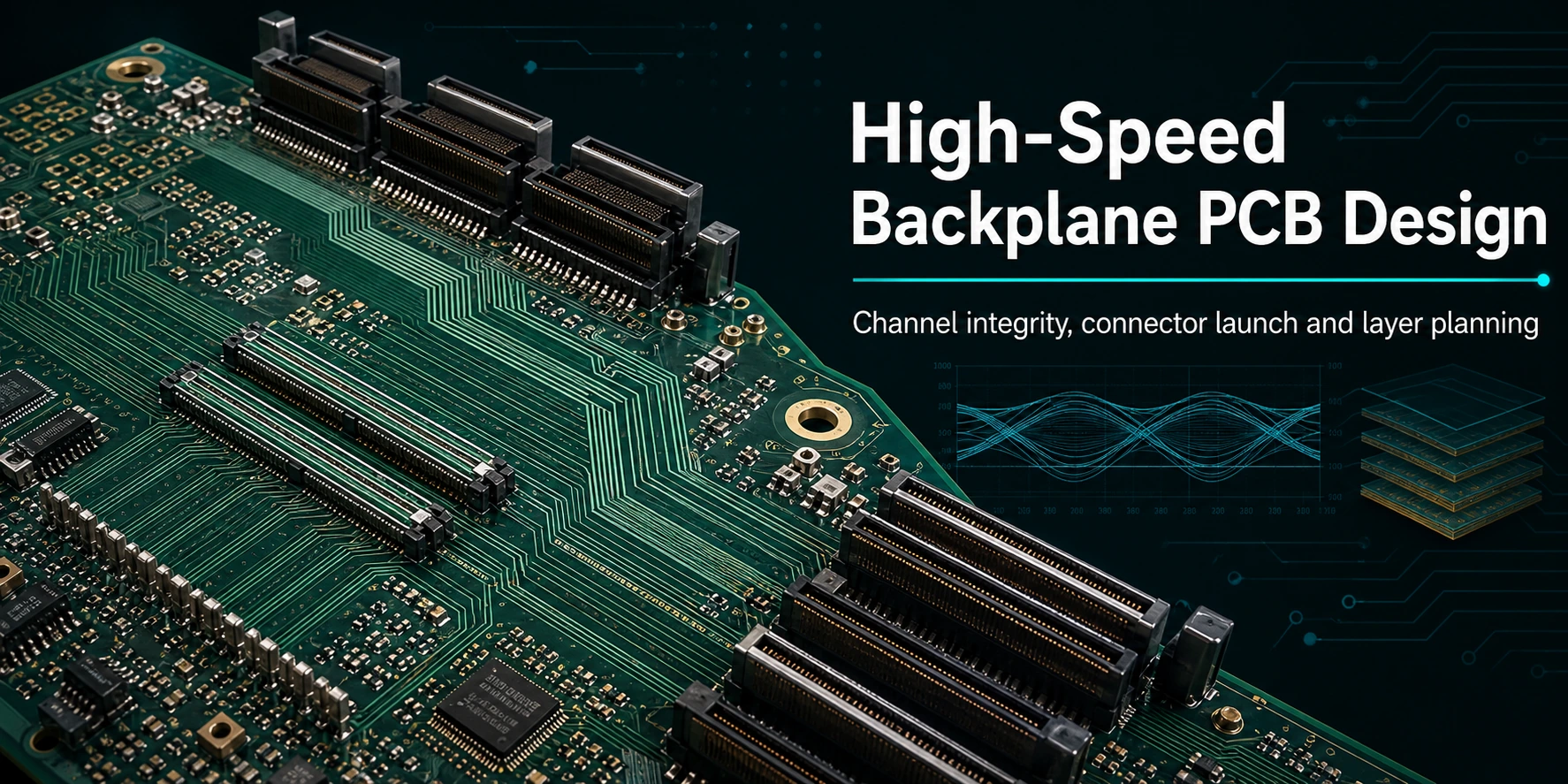
- A high-speed backplane review should start with the coupled manufacturing problem, not with one isolated keyword. Stackup, drilling, transition cleanup, connector zones, and validation have to be planned together.
- Do not let service labels fragment the discussion.
quick-turn,turnkey,flying probe,THT,inspection, andcomplianceare not separate backplane answers by themselves. They are route, access, or evidence-layer questions inside one release package. - Separate path classes early. A connector-heavy backplane usually contains different burdens across power paths, controlled-impedance paths, and mechanical connector zones. Treating them as one generic routing problem hides the real release risks.
- Keep test and inspection methods on the right level. AOI, X-ray, flying probe, first-build confirmation, impedance correlation, and later SI validation each answer different questions. One method should not be allowed to stand in for the whole backplane proof story.
- Decide whether the board is still a general server-review problem or has already escalated into a true backplane route. Once connector integration and long transitions dominate the release burden, generic motherboard wording is no longer precise enough.
A high-speed backplane PCB review is most useful when it behaves like a release-control document. It should explain what kind of backplane this is, where connector zones start to govern the design, how evidence layers stay separate, and what the next build still needs to confirm before manufacturing assumptions are trusted further.
In This Guide
- What a high-speed backplane review is actually deciding
- Where path classes, connector zones, and transition cleanup split the problem
- How inspection, electrical access, and assembly routes fit without proving the whole channel
- Release checklist and common backplane review failures
- FAQ
- Next steps
- Sources
What a high-speed backplane review is actually deciding
A high-speed backplane review is often described too narrowly. Teams inherit labels around datacenter backplanes, AI-server motherboard stackups, flying probe, through-hole soldering, or turnkey assembly and start treating each label as a standalone content category. That is not the real engineering task. The useful question is what the backplane must freeze before release so that connector integration, routing intent, and validation ownership stop drifting apart.
That distinction matters because backplane search terms tend to mix three different kinds of signals. Some point to real board-architecture burden, such as stackup control and long transition cleanup. Some point to connector-zone execution problems, such as press-fit or THT route choice, hole preparation, or mechanical integration. Others point to later-stage assembly, inspection, or workflow language that should not be promoted into whole-board proof. A strong guide has to address all of those signals without pretending they each justify a separate public promise.
The first thing the review should decide is whether the board has truly become a backplane problem. Some designs still belong in a broader server or motherboard review, where stackup and controlled routing matter but connector-heavy execution has not yet taken over. A backplane route begins to deserve its own article when board format, connector density, transition count, drill discipline, and validation layering become coupled enough that a generic server-board explanation no longer captures the real release burden.
The second thing the review should decide is what the board is actually carrying. Many backplane structures are not only signal structures or only power structures. They often carry both. The safer review posture is to separate path classes while still explaining that they have to coexist in one released package. The power path, the controlled-net path, and the connector-zone path are different review items even when they share one board.
The third thing the review should decide is where connector zones start to govern the board. A connector-heavy backplane is not difficult only because it has more layers or longer routes. It becomes difficult because drilling, hole preparation, anti-pad space, connector seating, transition cleanup, finish posture, inspection access, and later validation start to interact. Once those interactions dominate the release burden, the board is no longer helped much by generic high-speed wording alone.
The fourth thing the review should decide is which evidence layers are being confused. Search terms often treat flying probe, inspection, or turnkey as if naming one process step is enough to prove the board is ready. That is weak review language. A backplane package should instead say which questions belong to visible inspection, which belong to hidden-joint inspection, which belong to electrical access methods, which belong to impedance correlation, and which still belong to later SI-oriented validation. The point is not to stack more method names into the copy. The point is to keep each method attached to the question it can actually answer.
The fifth thing the review should decide is what the next build is supposed to close. A first build is not useful when it tries to prove connector execution, whole-board channel behavior, assembly stability, and system readiness all at once. A better first build closes a narrower question: is the released backplane package coherent enough at stackup, connector-zone, transition, access, and validation-handoff level? If that answer is still unclear, the build may create activity without reducing uncertainty.
The sixth thing the review should decide is what this backplane review does not prove. It is not protocol compliance proof. It is not a universal connector guide. It is not a backdrill or drilling numeric table. It is not a turnkey capability statement. It is not a quick-turn promise. It is not proof that one inspection or access method covers the whole structure. Its practical role is to show why connector-heavy backplanes become unstable before release and how to keep the release package coherent.
In practical terms, a high-speed backplane review is approving a smaller set of statements than many legacy labels imply:
- what kind of backplane structure is actually under review
- which path classes and connector zones must be separated explicitly
- which methods belong to inspection, access, impedance, or later validation layers
- what the next build still needs to prove before the package should be trusted more broadly
If those four items are still vague, the project does not yet have a backplane decision. It only has a cluster of service-like or test-like keywords attached to an under-specified board.
Early rule table for high-speed backplane review
| Review area | What to decide | Why it matters | How to verify | If ignored |
|---|---|---|---|---|
| Board route | Decide whether the board has truly escalated into a connector-heavy backplane route | Not every server-context board is a backplane problem | State the dominant board route before RFQ or build planning | Generic server wording hides the actual execution burden |
| Path classes | Decide how power paths, controlled-impedance paths, and connector zones differ | One board can contain more than one routing and validation burden | Write the main path classes into the release notes | Conflicting requirements stay merged until too late |
| Connector governance | Decide whether connector zones are now driving drilling, hole preparation, and transition review | Connector execution often becomes the first real hold | Mark which zones have special integration burden | The board treats connectors as afterthoughts |
| Evidence layers | Decide what belongs to inspection, electrical access, impedance correlation, and later SI validation | Methods are not interchangeable proof | Pair each method with one question it is supposed to answer | One method quietly becomes a universal quality claim |
| Assembly route | Decide whether the board is mainly press-fit, THT-heavy, mixed technology, or another combined route | Assembly route changes what must be frozen early | Name the dominant assembly path and where it affects the board | Assembly and layout assumptions diverge |
| Next build question | Decide what the first build must close before broader claims are made | Early hardware should reduce one core uncertainty clearly | State the build question in one sentence | The build generates data without closing the main risk |
The table is useful because it keeps the board framed as an engineering release package. Once the article starts acting like a menu of tests or services, it stops helping the reader decide what actually governs the backplane.
Where path classes, connector zones, and transition cleanup split the problem
The most important discipline in a backplane article is route separation inside the board itself. A connector-heavy backplane almost always carries multiple engineering burdens at once, and the package becomes unstable when those burdens are flattened into one generic high-speed story.
Start with path-class separation. A backplane often contains power-distribution regions, controlled-impedance regions, and connector-dense mechanical zones that share one board but do not behave like one routing class. A review that says only this is a high-speed backplane is missing a key decision. The board still has to say which paths are mainly power-oriented, which paths are controlled-net structures, and which zones are dominated by connector insertion, seating, drilling, or transition cleanup requirements. Without that split, every downstream decision becomes more ambiguous than it should be.
That separation matters because AI-server and datacenter backplane language usually points to a board where stackup and route architecture are already under stress. The safer move is not to publish a universal stackup recipe. It is to explain that the release package must carry clearer ownership over path classes, reference continuity, connector-zone notes, and validation scope than an ordinary server board would require. A backplane becomes harder because more decisions interact, not because one keyword sounds more advanced.
Now move to connector zones. A connector-heavy backplane is rarely governed by raw layer count alone. The harder problem is that connector regions pull drilling control, hole preparation, anti-pad space, seating constraints, transition behavior, and sometimes finish posture into the same decision loop. That is why a backplane route deserves its own article instead of being buried under generic motherboard language. Once the board's dominant uncertainty lives near connector zones, the release package has already changed category.
This is also where the article has to separate press-fit and THT language without turning either one into a universal answer. Some terms push strongly toward through-hole wording. Others imply connector insertion or mechanical seating issues that behave more like a press-fit review. The safe public explanation is not to declare one route correct by default. It is to explain that soldered through-hole hardware, press-fit connector zones, and off-board integration problems belong to different route families. The project has to decide which family the connection problem actually belongs to before the board can be released confidently.
That route separation becomes more important when teams start overloading quick-turn or turnkey style language. A backplane does not become clearer just because the article names a service posture. If the package still has unresolved connector-zone geometry, path-class conflict, or transition uncertainty, a quick build will only expose that lack of definition faster. Likewise, a broader assembly route can be useful when the released package is already coherent, but it is not a substitute for deciding how the connector-heavy structure itself should be reviewed. Service posture is downstream of package clarity, not a replacement for it.
The same rule applies to transition cleanup. A connector-heavy long-channel board often needs stronger attention around vias, transitions, and cleanup strategy than an ordinary motherboard. Naming backdrill alone is not enough. Transition cleanup is only meaningful when it stays attached to the actual path class and connector-zone burden that created the issue. A decorative capability word is weaker than a clear statement about which transitions matter and why the board cannot leave them implicit.
This is the point where route ownership naturally moves toward Backplane PCB rather than staying only with a generic High-speed PCB explanation. The board may still share many high-speed review disciplines, but once connector integration and transition cleanup dominate the release burden, the backplane route becomes the more honest commercial and engineering handoff. When the open question is specifically about documented controlled-net assumptions rather than the whole board route, the planning aid may narrow toward the Impedance calculator, but that still belongs inside a wider package review.
Another reason this section matters is that it helps connect terms that sound farther apart than they really are. Conformal coating, through-hole soldering, and turnkey backplane language can look like different content ideas. In practice they all point back to the same release question: has the backplane package identified the right route, the right connector-zone burden, and the right downstream ownership? Once the article says that clearly, the topic becomes much easier to collapse into one useful answer.
In other words, the board should move through a sequence that stays visible in the public copy:
- identify the backplane route
- split the main path classes
- name the connector-zone burden
- state how transitions and assembly route affect the released package
That sequence stops the article from becoming either too abstract or too commercial. It also keeps it aligned with how real backplane projects usually fail: not because the board lacked one famous keyword, but because too many interdependent decisions remained bundled together.
How inspection, electrical access, and assembly routes fit without proving the whole channel
The second major job of this article is to separate evidence layers. A connector-heavy backplane is especially vulnerable to overclaiming because method and process names can sound reassuring on their own. The safer article explains what each method can help confirm, and what it still cannot prove by itself.
Start with visual and visibility-limited inspection. Dense connector overhang, shields, brackets, and concealed joints can change what the board can actually see during inspection. That means AOI-style visible checks and hidden-joint review methods do not answer the same question. The backplane package should treat visibility as a design and planning input, not as an afterthought. If a connector-heavy zone blocks line-of-sight or changes access, that belongs in the release review long before anyone tries to summarize quality with one inspection acronym.
That is why SPI, AOI, and X-ray language should not turn this page into a process catalog. The stronger answer is that different inspection methods respond to different visibility conditions and defect classes. Visible geometry, concealed joints, and dense mechanical obstructions belong to separate planning decisions. A connector-rich backplane needs method choice that reflects the structure, not a promise that one inspection label solves everything.
Now move to electrical-access methods. Flying-probe language can tempt the article into acting as if access-based electrical test can stand in for the whole high-speed story. That is not the safer boundary. Flying probe, ICT-style access, or similar methods belong to electrical verification and access planning layers. They can be useful in confirming certain electrical conditions or build consistency, but they do not replace stackup review, impedance correlation, transition cleanup, or later signal-path investigation.
This distinction becomes even more important on connector-heavy boards, because access does not equal channel proof. A board can have an electrical-access strategy and still have open questions around controlled-net behavior, transition quality, or broader high-speed correlation. Flying probe belongs in an evidence ladder, not at the top of the architecture discussion.
The same layered logic applies to first-build and validation posture. A backplane project often benefits from PCB prototype routing when the main goal is to confirm whether the released package is coherent enough at connector-zone, stackup, transition, and access level. That is a healthy workflow statement. It is not a claim that the backplane is already proven for every later signal-path or program-level condition. Prototype posture helps organize evidence. It does not eliminate the need to keep validation layers separate.
This is also where turnkey or quick-turn language has to stay disciplined. If the reader arrives from a service-flavored keyword, the useful answer is still about release control: service routes are useful only after the board has already clarified connector-zone burden, path-class separation, and evidence ownership. Otherwise the project is trying to accelerate a package that still has not named its governing decisions clearly enough.
- Inspection methods should follow visibility and obstruction conditions.
- Electrical-access methods should stay separate from signal-path proof.
- First-build confirmation should stay separate from later SI-oriented validation.
- Assembly and service routes should be downstream of package clarity, not a substitute for it.
Assembly-route language has to stay on the same level. A connector-heavy backplane may involve THT hardware, press-fit zones, mixed assembly, or other mechanically stressed interfaces. The safe question is not which assembly service is best. The safe question is where does the connection problem actually live, and which route must the released package document more clearly? Some boards need a stronger Through-hole assembly discussion because soldered hardware and mechanically stressed joints are now central to the route. Some stay mostly in connector-zone planning without needing the whole article to shift into assembly-first wording.
This is also where aspect ratio stops being a fabricator-side footnote and becomes a release risk. Backplanes are often 4.0 mm thick and sometimes move past 5.0 mm, yet teams still try to preserve very small finished holes through connector fields or dense transition regions. That can push drilled structures into 12:1 or even 15:1 aspect-ratio territory. If the DFM review never forced a real check of deep-hole plating capability, the barrel copper in the middle of the hole can come back too thin. The failure usually appears later, during press-fit assembly, when a high-density connector is forced into the hole and the barrel cannot carry the mechanical load. Then the plated wall tears or cracks, inner-layer connection becomes intermittent, and debug starts chasing an open that only appears after insertion stress. That is why backplane review cannot stop at high-speed trace language. Aspect ratio, plating capability, and press-fit mechanical load have to be reviewed as one coupled problem or the board is being released on incomplete evidence.
That separation prevents another common failure: using assembly route to hide unresolved board decisions. If the article starts talking about THT, mixed technology, or broader execution flow before it has named the connector-zone and path-class burden clearly, the route language becomes a substitute for engineering clarity. The board needs the opposite order. First define the governing structure, then decide which assembly and inspection routes align with it.
It is also important to keep the backplane article distinct from the narrower SerDes-validation route. A connector-heavy board can share many high-speed concerns with a SerDes article, but the dominant question here is broader. It is not just whether one critical path is being routed cleanly. It is whether the package that combines connector zones, path classes, transitions, and evidence layers is coherent enough to release. If the real uncertainty narrows to route-specific signal behavior, then the project should escalate toward the sibling SerDes query instead of forcing that whole story into the backplane page.
That is why a disciplined backplane article does not promise too much from any single method or route label. The better answer is almost always one of these smaller conclusions:
- the board has a genuine backplane route and needs clearer connector-zone governance
- the package has not yet separated power, controlled-net, and connector burdens clearly enough
- the current inspection or electrical-access language is standing in for unanswered release-package questions
- the next build should confirm package coherence before the team starts making broader validation claims
Once the article says those options clearly, the topic stops behaving like a list of disconnected services and starts behaving like one backplane review problem.
Release checklist and common backplane review failures
Before a high-speed backplane PCB is released under backplane, connector-heavy, THT, inspection, or turnkey-flavored language, the package should be able to close a short list of questions in writing.
First, the board route should be explicit. The release notes should say whether this is now genuinely a backplane-class structure or whether the board is still better described as a broader server review problem. If the file cannot say that clearly, the article is likely still letting market vocabulary do too much work.
Second, the package should identify its main path classes. Which regions are power-oriented, which are controlled-net paths, and which are dominated by connector integration? The answer does not need geometry numbers to be useful. It needs structure. A backplane release package becomes much clearer when the board stops treating every path as if it were governed by the same review logic.
Third, the connector-zone burden should be stated directly. Does the board need special review around connector seating, hole preparation, transition behavior, or access limitations? If the answer is yes, then that burden should be named in the release package rather than left implicit in a vague backplane label.
Fourth, the package should say what assembly route actually matters. Is the board mainly a press-fit connector-zone problem, a soldered THT hardware problem, or a mixed route that needs both to stay visible? This does not require a universal answer for all programs. It requires clarity about which route is governing this board right now.
Fifth, the evidence ladder should be written in plain terms. Which questions belong to visible inspection, hidden-joint visibility, electrical access, first-build confirmation, impedance correlation, and later SI-oriented validation? If the article cannot separate those layers, then method names are still being used as comfort words instead of review tools.
Sixth, the package should say what the next build is meant to prove. A useful first build should answer one central package question clearly. It might confirm that connector zones, transitions, and stackup ownership are aligned. It might confirm that the board route classification is correct. It should not be burdened with proving every later performance claim the article never had evidence to make.
Those checklist items are simple, but they catch most of the real failures in backplane writing:
- treating
backplaneas a synonym for high layer count instead of a coupled connector-zone problem - treating press-fit, THT, quick-turn, turnkey, or inspection terms as if each were a whole content category
- merging power paths, controlled-impedance paths, and connector zones into one generic route description
- letting one inspection or electrical-access method imply broader channel proof
- using first-build, prototype, or NPI wording as if it replaced later validation layers
- delaying route separation until after manufacturing feedback arrives
The most persistent failure is turning process names into confidence signals. A draft says quick turn, turnkey, flying probe, THT, or X-ray, and the tone becomes more definitive even though the package itself has not become clearer. That is backward. On a connector-heavy backplane, stronger language should come from stronger route definition, not from stacking more service terms into the copy.
Another recurring failure is letting connector language collapse into capability language. A board may absolutely need more disciplined connector-zone planning, but that does not authorize universal statements about connector families, insertion behavior, or transition performance. The safer level of guidance is still the release review: explain what connector zones change in the package and what must be checked because of them.
The last major failure is delaying the commercial and engineering handoff too long. Once the board can name its route, its path classes, its connector-zone burden, its assembly posture, and the one next-build question that still matters, the next step should move to the route that actually owns execution. On HILPCB, that usually means Backplane PCB when connector-heavy execution is now the dominant route, High-speed PCB when the board still needs broader high-speed release framing, and PCB prototype when the next step is still evidence-gathering rather than a final manufacturing commitment.
FAQ
Does a high-speed backplane automatically mean a connector-qualified or protocol-proven design?
No. A safer statement is that a backplane usually has stronger connector-zone, transition, and validation burdens than an ordinary board. That does not prove protocol compliance, connector qualification, or whole-channel success by itself.
When does a server-context board really become a backplane review problem?
When connector density, board format, drilling discipline, transition cleanup, and validation layering start to govern the release burden more than generic motherboard review. At that point the board has crossed into a connector-heavy route that deserves its own package logic.
Can flying probe or another electrical-access method prove backplane signal quality?
No. Electrical-access methods belong to one evidence layer. They can help confirm certain electrical conditions and build consistency, but they do not replace stackup review, impedance correlation, transition cleanup, or later SI-oriented validation.
Should a backplane article choose between THT and press-fit as one universal answer?
No. The safer public question is which route the connection problem actually belongs to on this board. Some boards are dominated by soldered THT hardware, some by press-fit connector zones, and some by mixed routes that need both to stay visible.
Does quick-turn or turnkey wording make a backplane package clearer?
Not by itself. Those routes become useful only after the board has already clarified connector-zone burden, path-class separation, and validation ownership. Service posture is downstream of package clarity.
What should the next build prove on a connector-heavy backplane?
It should prove the release package is coherent enough for the chosen route: board classification, path-class separation, connector-zone ownership, transition governance, and evidence-layer handoff. A first build is most useful when it closes one package question clearly instead of trying to prove the whole system story.
Next steps
If the current backplane is already carrying deep-hole plating risk, backdrill tolerance pressure, or uncertainty about whether large press-fit zones will damage manufacturing yield, this is the point to stop treating those questions as downstream details. On this class of board, they usually decide whether the first serious build becomes useful evidence or expensive noise.
Send the full Gerber package, stackup, drill chart, and backdrill notes to [email protected], or upload the data through the Quote page. HILPCB's backplane CAM engineering team will return DFM feedback within 24 hours. That review is meant to close the coupled risks before prototype spend escalates: real aspect-ratio calculation, drill-compensation review around press-fit holes, and the safest manufacturing and test route for the released backplane package.
Sources
HILPCB: Backplane PCB
Supports the public route for connector-heavy backplane structures, large-format execution, and high-speed transition review boundaries.HILPCB: High-speed PCB
Supports the public route for broader high-speed stackup, controlled-net, and validation posture when a board has not yet narrowed all the way to a connector-heavy backplane execution question.HILPCB: Impedance Calculator
Supports the planning posture that controlled-impedance assumptions belong to documented review and calculation workflow rather than to isolated capability slogans.HILPCB: Through-hole Assembly
Supports the route distinction between soldered connector hardware and other connector-zone or mixed-technology paths in board-level release planning.