
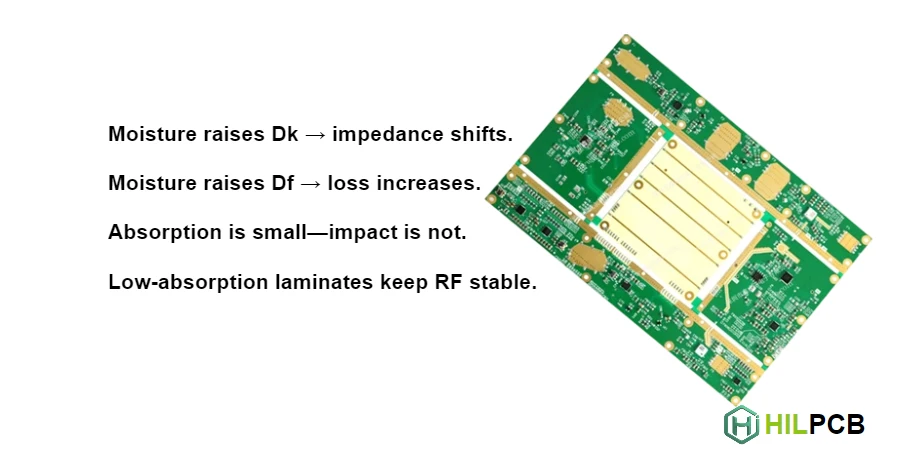
Moisture absorption changes the electrical properties of PCB materials in ways that directly affect high frequency performance. Water has extremely high dielectric constant (Dk ~80) and significant loss—even small amounts absorbed into PCB material alter Dk, increase Df, and degrade signal integrity. Understanding moisture effects enables material selection and design choices that maintain stable performance across humidity conditions.
This guide provides comprehensive knowledge of moisture effects on HF PCB material performance, from fundamental mechanisms to practical mitigation strategies.
HILPCB offers low-absorption high frequency materials including PTFE-based laminates that maintain stable properties in humid environments.
Moisture Absorption Mechanisms
PCB materials absorb moisture through several mechanisms that depend on material composition and environmental conditions. Understanding these mechanisms guides material selection and design for moisture resistance.
At HILPCB, we can recommend materials with appropriate moisture characteristics for your operating environment.
Diffusion Absorption
Water molecules diffuse into the polymer matrix:
- Rate depends on material composition
- Higher temperature accelerates diffusion
- Equilibrium reached over hours to days
- Reversible with drying (partially)
Different polymers have different diffusion characteristics—epoxy (FR-4) absorbs more readily than fluoropolymers (PTFE).
Capillary Absorption
Water wicks along interfaces and into voids:
- Glass-resin interfaces in laminates
- Microvoids from manufacturing
- Delamination sites
- Via barrels and holes
Capillary absorption can be faster than diffusion and harder to reverse.
Surface Adsorption
Water molecules adhere to material surfaces:
- Quick onset with humidity change
- Affects surface conductivity
- Can penetrate surface features
- Most easily reversed
Absorption Rates by Material
| Material | Absorption (% by weight) | Time to Equilibrium |
|---|---|---|
| Standard FR-4 | 0.10-0.15% | 24-48 hours |
| Low-Dk FR-4 | 0.08-0.12% | 24-48 hours |
| Rogers RO4350B | 0.06% | 48-72 hours |
| PTFE (RT/duroid) | 0.02% | 72+ hours |
Lower absorption materials maintain more stable properties.
Effects on Dielectric Constant
Water's extremely high Dk (approximately 80) dramatically affects composite Dk when absorbed into PCB materials.
HILPCB provides precision RF board manufacturing with materials selected for Dk stability in your operating environment.
Dk Increase Mechanism
When water absorbs into material:
- Water Dk ~80 replaces air (Dk ~1) in voids
- Water associates with polar groups in polymer
- Effective Dk of composite increases
- Effect proportional to water content
Magnitude of Dk Change
For typical materials at saturation:
- FR-4 (0.15% absorption): Dk increase ~2-4%
- Low-loss laminate (0.08%): Dk increase ~1-2%
- PTFE (0.02%): Dk increase <0.5%
Moisture Absorption Comparison
Impedance Impact
Dk increase lowers impedance:
ΔZ/Z ≈ -0.5 × ΔDk/Dk
For FR-4 with 3% Dk increase: ~1.5% impedance decrease
This may exceed tolerance for precision impedance applications.
Frequency Selectivity
Moisture absorption affects different frequencies differently:
- Water relaxation peak around 20 GHz
- Effects more pronounced at microwave frequencies
- Complex frequency-dependent behavior
Effects on Dissipation Factor
Moisture dramatically increases Df because water is a lossy dielectric (Df ~0.15 at microwave frequencies).
For loss-sensitive applications, HILPCB recommends low-absorption materials from our high frequency laminate inventory.
Df Increase Mechanism
Water molecules introduce loss through:
- Dipole relaxation losses
- Ionic conduction (if dissolved salts present)
- Enhanced interfacial polarization
Magnitude of Df Change
Moisture absorption can significantly increase Df:
- FR-4: Df may double or triple at saturation
- Low-loss materials: 50-100% increase possible
- PTFE: Minimal change (<20%)
For low-loss applications, even small Df increases matter significantly.
Loss Impact Example
6-inch 50Ω microstrip at 10 GHz:
- Dry low-loss material (Df 0.004): ~1.2 dB loss
- Same material moisture saturated (Df 0.008): ~2.4 dB loss
Moisture doubled the loss—potentially causing link failure.
Reliability and Mechanical Effects
Beyond electrical effects, moisture absorption affects mechanical properties and long-term reliability.
Mechanical Property Changes
Moisture absorption causes:
- Dimensional swelling (especially Z-axis)
- Reduced glass transition temperature
- Lower mechanical strength
- Increased creep rate
Delamination Risk
Absorbed moisture can cause delamination:
- Moisture vaporizes during thermal excursion
- Vapor pressure creates internal stress
- "Popcorning" during reflow
- Interface separation
Pre-bake boards before assembly to drive out moisture.
Electrochemical Effects
Moisture enables electrochemical degradation:
- Conductive anodic filament (CAF) growth
- Dendritic growth between conductors
- Corrosion of copper features
- Reduced insulation resistance
Long-Term Reliability
Extended humidity exposure accelerates:
- Metal migration
- Surface contamination effects
- Interfacial degradation
- Electrical leakage
Material Selection for Humid Environments
Systematic approach to selecting materials for moisture resistance.
HILPCB provides material consultation for applications requiring humidity resistance, including Rogers laminate options with excellent moisture performance.
Low-Absorption Material Options
For best moisture resistance:
- PTFE-based: Lowest absorption (<0.03%), best stability
- Rogers RO4000 series: Low absorption (0.04-0.06%), FR-4 processable
- Polyimide: Moderate absorption but stable properties
- Ceramic-filled: Low absorption, good stability
Application-Based Selection
| Environment | Recommended Material Class |
|---|---|
| Controlled indoor | Standard materials adequate |
| Variable indoor | Mid-range absorption materials |
| Outdoor sheltered | Low-absorption recommended |
| Outdoor exposed | PTFE or ceramic, conformal coat |
| Marine/tropical | Lowest absorption, sealed enclosure |
Design Considerations
Beyond material selection:
- Conformal coating reduces moisture ingress
- Sealed enclosures protect from humidity
- Edge plating prevents edge absorption
- Proper storage prevents pre-assembly absorption
Pre-Assembly Baking
Remove absorbed moisture before assembly:
- Bake temperature: 105-125°C typical
- Duration: 2-8 hours depending on thickness
- Prevents popcorning during reflow
- Especially important for humidity-exposed boards
Testing and Qualification
Verify moisture performance for critical applications.
HILPCB supports moisture qualification testing and can recommend appropriate test protocols.
Standard Test Methods
IPC-TM-650 methods for moisture characterization:
- 2.6.2.1: Moisture absorption
- 2.5.5.9: Permittivity and loss tangent
- 2.6.3: Thermal stress (includes moisture effects)
Accelerated Testing
HAST (Highly Accelerated Stress Test):
- 130°C, 85% RH, biased
- Accelerates moisture-related failures
- Standard for reliability qualification
85/85 Testing:
- 85°C, 85% RH, extended duration
- Less acceleration, more representative
- 1000 hours typical
Electrical Monitoring
Track electrical parameters during humidity exposure:
- Insulation resistance
- Dk/Df changes
- Impedance drift
- Leakage current
Acceptance Criteria
Define acceptable changes:
- Dk change: Typically <3-5%
- Df change: Typically <50%
- Insulation resistance: Maintain minimum value
- No visible degradation
Related Material Performance Topics
- High Frequency PCB Material Performance: Complete material selection guide
- Dielectric Properties of HF PCB: Dk and Df fundamentals
- Material Loss Factor in HF PCB: Loss mechanisms and minimization
- Thermal Stability in High Frequency PCB: Temperature effects
- Frequency Response of PCB Material: Wideband characterization
HILPCB Moisture-Resistant PCB Services
HILPCB delivers moisture-stable high frequency PCBs:
Material Selection: Low-absorption materials including PTFE, ceramic-filled, and specialty laminates for humid environments.
Process Control: Proper material storage and handling to prevent pre-assembly moisture issues.
Baking Services: Pre-assembly baking available for moisture-sensitive materials and assemblies.
Reliability Support: Qualification testing support for humidity-critical applications.
From prototype development through volume production, HILPCB provides moisture-resistant high frequency PCBs for demanding environments.
Contact HILPCB for moisture resistance consultation and manufacturing quotation.