
Decision first: An old plated-through-hole (PTH) coupon report can inform a test plan, but it does not by itself establish that a changed board can ship. Its direct evidence is limited to the specimens, fabrication history, exposures and responses documented in that report. Transfer to a new stackup or assembly process needs an explicit comparison—and sometimes additional testing.
For the fundamentals, see how to read material data sheets for PCB stackups and thermal cycling testing. For coupon types and selection, see PCB test coupons. The decision here is narrower: what an existing result can support for a changed board, what evidence is missing, and who needs to close the gaps.
Use the method and revision called up by the order when specifying or sampling a test. An illustrative free-expansion calculation in a material guide is not a measurement of finished-board movement or plated-hole strain.
Already comparing a changed stackup? Request a quote with the old coupon report, proposed construction and thermal exposure. Identify the evidence you need so its feasibility and quoted scope can be confirmed before the build.
A completed hypothetical decision
The following case, including the people and decisions, is hypothetical. It is not a customer case or a report of product test results.
A team is considering a 2.4 mm-thick board with a dense array of nominal 0.30 mm drilled PTHs on 0.8 mm pitch. The nominal drill aspect ratio is 8:1. That is a planning description based on board thickness and drill diameter; it does not specify the finished hole diameter or plating distribution.
The board also has a connector hole of unspecified geometry and a BGA near plated holes. An alternate laminate is under consideration, but its identity is not specified.
The planned assembly route has two reflows and, if needed, one rework event. For planning, each is associated with an assumed nominal peak of 245 °C. Those assumptions are not measured local profiles. The intended service range is −40 to 125 °C; the range alone does not define the number, rate or duration of operational cycles.
The team has a report for a previously tested 1.6 mm stackup, with a different drill diameter and no rework exposure. It is not the new board. The old report’s measurements and outcome are not specified in this example, so no passing result is assumed.
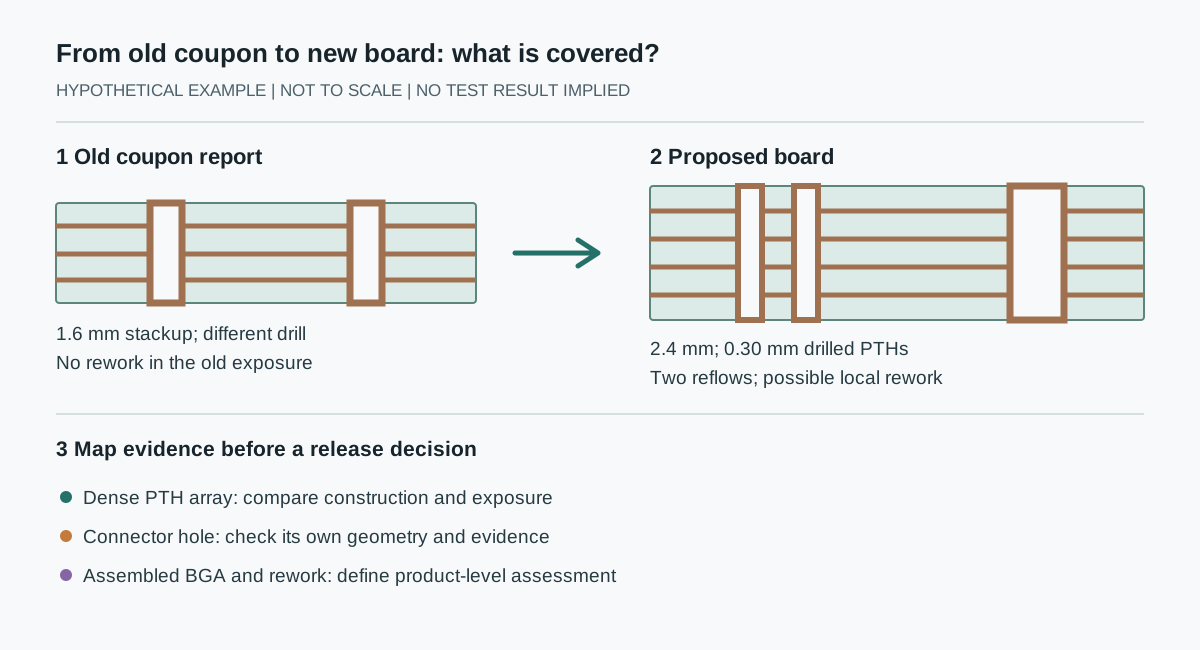
Conceptual comparison only, not a test result or a scale drawing.
View the full-size illustration
In this hypothetical project, Maya is the design authority, Priya leads reliability, Sam owns assembly-process evidence, and Leo owns quality disposition. Actual owners and approval authority vary by contract.
| Old evidence | Changed fact | What cannot be inferred | Concrete next evidence | Hypothetical owner | Decision or hold |
|---|---|---|---|---|---|
| A PTH coupon was tested on the 1.6 mm stackup with a different drill. | The new dense array uses the stated 2.4 mm thickness, drill and pitch. | The old response does not establish strain, fatigue life or acceptance of the new array. | Map the new hole geometry and nearby copper; agree on representative coupon features and exposure before testing. | Maya and Priya | Hold shipment against this gap unless the agreed evidence or an authorized disposition covers it. |
| The old coupon report concerns a different hole configuration. | The connector PTH has its own location and geometry, which are not yet specified. | The dense array is not automatically more severe, and the old coupon does not establish connector-hole performance. | Define hole dimensions and plating, connector attachment and loads; assess whether representative structures and application-specific evidence are needed. | Maya and Priya | Keep connector-hole release open pending that assessment. |
| No assembled-BGA evidence is supplied with the old PTH example. | A BGA is near plated holes and will experience assembly and possibly rework. | A PTH coupon cannot establish BGA solder-joint reliability or the assembled product’s response. | Define representative assembled validation, including measured local assembly and rework profiles. | Sam and Priya | Hold assembled-product shipment pending the agreed validation or authorized disposition. |
| The material history of the old coupon has not been compared with the proposal. | A laminate substitution is being considered. | A data-sheet similarity or old coupon result does not qualify the substitute in this stackup. | Obtain the proposed material’s data and lot traceability; agree whether representative substitute-stackup coupons and product validation are required. | Maya, Priya and Leo | Do not release the substitution on the old report alone. |
These differences identify evidence gaps, not proven failure causes. The project must select the holes, monitoring and sectioning that answer its risks; there is no universal worst-case hole.
The hypothetical decision is to allow an engineering build for evidence gathering, provided Maya and Leo first agree its scope, identification and risk disposition. Leo maintains a shipment hold while the agreed PTH and assembled-product evidence is incomplete. Priya is to assess the test results when available; Sam is to provide the applicable process profiles; Maya and Leo are to make the disposition within their assigned authority. No proposed test is represented as having passed.
That is an example of a project decision, not a mandatory contractual rule. A different agreement may assign authority differently or permit an explicitly authorized concession.
What the old report can support
If the historical report contains the necessary details, it can document how those old specimens responded to those documented conditions. It may also help the team choose monitoring, identify useful controls and avoid losing information in a new test plan.
The team should retrieve the report rather than rely on a summary. Check its stackup, drill and finished-hole information, fabrication and plating records, coupon location, preconditioning, cycling profile, monitored response, interruptions, cross-sections and disposition. Record what is missing. For interpreting the section images, specimen identity and reported measurements, see how to read a PCB microsection report.
Even a well-documented old result does not establish the new board’s barrel strain, fatigue life or finished-board acceptance. In this case, thickness, hole geometry and a possible rework exposure differ. The BGA question is broader still: it concerns an assembled product, not just a plated barrel.
Use laminate data for its proper scope
Material data can explain why the team should investigate a thermal change. It cannot replace PTH evidence.
For example, the supplier’s FR408HR data sheet, Rev E dated 2021-04-15, reports a typical glass-transition temperature of 190 °C by DSC. It reports typical Z-axis CTE values of 55 ppm/°C below Tg and 230 ppm/°C above Tg, and typical total Z-axis expansion of 2.8% over 50–260 °C, measured under the supplier’s stated conditions. Check the applicable data-sheet revision and complete specimen conditions before using the figures.
FR408HR is a material-data illustration here; it is not identified as either laminate in the hypothetical board. The figures are typical supplier values, not measured values for that board or its material lots. In particular, the stated 50–260 °C expansion result must not be extended to the example’s −40 °C service limit or presented as the expansion of a real board.
A laminate specimen’s reported expansion is not the same as strain in a finished PTH. In a board, copper, glass, resin, plating, geometry and local temperature interact. Nor does comparing a nominal assembly peak with a typical Tg predict barrel failure or fatigue life. A PTH coupon tests a selected physical representation; assembled-product validation addresses further interactions that the coupon may not represent.
Keep four evidence scopes separate
A practical evidence package has distinct layers:
- Material data describes supplier-reported properties and test conditions. It supports material comparison but does not establish the properties of every production lot or finished stackup.
- Lot and process evidence provides traceability and records for the material and fabrication used. It helps establish what was built; it does not by itself demonstrate thermal fatigue performance.
- Coupon evidence measures selected structures under a defined sequence. Its relevance depends on how well those structures, fabrication conditions and exposures represent the decision at hand.
- Assembled-product validation addresses the populated board and process interactions selected for the project. It does not automatically replace controls for fabrication quality or establish acceptance of every production board.
For the hypothetical case, the missing connection is not simply “old material versus new material.” It is the relationship between the old coupon and the new product’s actual geometry, fabrication, assembly exposure and intended use.
Specify the new comparison before fabrication
Start with the product, then decide what a coupon can represent. Ask the board-design and fabrication participants to document:
- The stackup sequence, dielectric thicknesses and material identities, including cores and prepregs.
- Drilled and intended finished-hole geometry, plating requirements and available plating-distribution information.
- Local copper around each candidate feature: pads, planes, connections, clearances and relevant layer-to-layer changes.
- The product locations to represent, including the dense array, connector hole and plated holes near the BGA.
- Where the coupon will be fabricated on the panel and how its construction and processing will be traced to the product.
Coupon location matters because a convenient coupon is not automatically equivalent to every product location. If a geometry cannot be reproduced or monitored practically, document that limitation and decide whether product-level evidence is needed.
Request traceability for the actual materials and lots, fabrication records, coupon and board identifiers, and assembly histories. A substitute should not be treated as interchangeable solely because two data-sheet values look similar. The PCB material substitution checklist separates the proposed change, required evidence and approval authority.
Turn the example into a test proposal
The following is a proposed handoff, not an approved test plan. Each quantity, route and acceptance basis remains to be agreed under the applicable order requirements. The table does not imply that HILPCB or any other supplier has accepted the work.
| Product question | Candidate specimen and routes | Measurements and remaining decisions |
|---|---|---|
| Dense PTH array on the new stackup | Discuss a panel coupon with relevant hole and local-copper geometry; compare a no-rework route with a route including the proposed rework exposure. | Agree chain design, monitoring, section locations, specimens per route and panel/lot distribution. All are to be determined. |
| Connector hole | Define the hole, plating, connector type and soldered or press-fit attachment; assess a representative feature or product specimen. | Define thermal evidence separately from connector insertion, retention or other mechanical-load tests. Sample count and acceptance are to be determined. |
| BGA and nearby holes | Determine whether assembled product specimens and the intended local rework process are needed in addition to bare-board PTH evidence. | Agree local profile measurement, inspection, sample count and the product-level acceptance basis. All are to be determined. |
The fabricator, assembler and test provider should state whether each proposed specimen and route is feasible and who will perform it. The design or product authority decides whether the resulting coverage supports the intended product decision.
Define exposure as a sequence, not a peak
For the hypothetical board, 245 °C is an assumed nominal planning peak, not a measured full profile at any hole. Before claiming relevance to the assembly route, Sam’s team would need an agreed measurement strategy and actual process profiles at representative accessible locations.
Define measurement locations and the limits of what they reveal. A surface measurement near a hole does not automatically measure the plated barrel throughout the board thickness. Record the profile features relevant to the project, including heating and cooling behavior, time at temperature, local differences and the sequence of heat applications.
Treat these as separate parts of the plan:
- Thermal preconditioning: the agreed representation of the planned reflows, with material handling and moisture condition documented. Include bake history if a bake is used.
- Possible rework exposure: a separately defined route, based on the intended operation and its measured local profile. One rework event may involve more than one heating step; the plan should describe what is actually intended.
- Subsequent operational cycling: a defined representation of service exposure, including temperatures, transitions and dwell behavior. The stated service limits alone do not supply a complete cycling profile.
The team may need both a no-rework route and a rework route to answer its release question. If rework could occur after some service exposure, its position in the sequence also needs a project decision. Do not count an assembly simulation as proof of operational fatigue life merely because both involve temperature changes.
Identify the actual test method and revision, equipment, specimen temperature measurement or estimation, profile and deviations. Chamber cycling, convection reflow simulation, solder-float stress and current-induced coupon heating are different exposures; the same nominal peak does not make their results interchangeable.
Agree on monitoring, sampling and acceptance
Before testing, identify the response to be monitored and how it will be recorded. Depending on the project, that may include resistance or continuity of selected PTH chains during exposure. Specify when monitoring occurs, the ability to capture intermittent changes, the measurement setup and the treatment of interruptions. An electrical indication can guide investigation; it does not alone identify a physical crack mechanism.
Agree on controls that make the comparison interpretable. A control might represent the current stackup or a baseline processing route, but its value depends on comparable construction, exposure and measurement. Describe any differences rather than assuming the control validates every test condition.
The cross-section plan should state which structures will be sampled, when sampling occurs, where sections will be taken and how findings will be reported. Include a rationale for both selected failures or indications and planned sampling that is not dependent on an indication. Sectioning is destructive and examines a limited area; it can miss features elsewhere.
Document the sample-sizing rationale rather than borrowing a cycle count or specimen count without explanation. Consider the decision risk, the variation the project wants to observe across panels or lots, the test routes, the number of relevant holes and the limits of the resulting evidence. Multiple holes on one board should not automatically be treated as independent boards.
Before testing, identify the applicable purchase order, drawing, customer specification and invoked standards, including their revisions and any approved deviations. Within that framework, agree on the method, monitoring, reporting, acceptance criteria and decision authority. Neither a coupon design nor a cross-section automatically creates a pass/fail decision, and a proposed plan cannot override a binding requirement without the appropriate authorized change. Record deviations and retain observations that fall outside a simple summary.
Make the release decision traceable
At the end of the hypothetical plan, the engineering build and shipment are deliberately different decisions. An identified build can produce evidence without being released as conforming product. Shipment requires the authorized owners to assess the evidence against the agreed scope and criteria—or to document an authorized alternative disposition.
The decision record should connect each conclusion to the actual material lots, product and coupon identifiers, profiles, test reports and assembled condition. It should also identify unresolved gaps. A report that is useful for one release decision should not silently become approval for a later material substitution or rework process.
What to Include in a Quote Request
For a comparable fabrication and evidence quote, send HILPCB the following:
- Board data: current fabrication drawing, design revision, Gerber or ODB++ files, drill files, quantity and delivery target.
- Construction: the released or proposed stackup, finished thickness, material grades and permitted alternatives, copper requirements, and the relevant drilled and finished-hole dimensions. Mark the PTH array and connector locations under review.
- Existing evidence: the old coupon drawing and report, with specimen and panel identity, fabrication history, test conditions, results and any missing details. Do not present an old report as approval for the new design.
- Thermal sequence: planned assembly, possible rework and service conditions, including available measured profiles, exposure order and moisture handling. Mark assumptions and unknowns.
- Requested evidence: the structures and exposure questions to evaluate, applicable method and revision, sampling, monitoring, section locations, acceptance criteria, reports and retained samples where required.
- Release and approval: identify the design and quality contacts, the material-change approval process, and whether an engineering build may proceed while shipment remains on hold.
HILPCB offers multilayer PCB manufacturing and stackup planning, with high-Tg PCB options for suitable projects. The material, construction, testing and documentation must be agreed for the specific order; a high-Tg label or a coupon alone does not establish reliability. In your quote request, ask HILPCB to identify which proposed coupons, thermal exposures, microsections and reports are included, optional or outside the quoted scope, as well as their effect on cost and schedule.
Ask the quoting parties to identify who designs and fabricates each coupon, performs assembly preconditioning or rework simulation, runs any subsequent cycling and monitoring, and carries out sectioning or failure analysis. Request handoff points, sample transport and storage conditions, raw data and report formats, disposition or retention of destructive samples, and separate costs and lead times where applicable. Mark any unavailable or unconfirmed service explicitly; do not assume a specific provider or laboratory is included.
Frequently Asked Questions
Does an old coupon result qualify a changed stackup?
Not by itself. It can document the old specimens’ response and inform a comparison. Transfer depends on the documented differences, the intended decision and the additional evidence agreed by the project.
Can laminate CTE calculate real PTH strain?
A material data-sheet value alone cannot establish real barrel strain. The finished structure includes constrained materials, copper and plating, geometry and local temperature effects. Fatigue life requires further evidence beyond free laminate expansion.
Is the assumed 245 °C peak an actual rework profile?
No. In the hypothetical case it is a nominal planning assumption. The local peak, heating and cooling behavior, duration and number of heat applications must be established for the intended process.
Would a passing PTH coupon prove BGA reliability?
No. Even if a representative coupon met agreed criteria, it would address its selected PTH structures and test conditions. BGA solder joints and assembled-product interactions need their own assessment.
Can a board build proceed while shipment is held?
It can if the parties with the relevant authority agree to an identified, controlled build for evidence gathering. Whether that is permitted, and who can later release or dispose of the product, depends on the project agreement.
For a changed stackup or exposure, bring the old report, proposed geometry and assembly sequence to the quotation discussion. The useful first question is not whether the old coupon “passed,” but what decision its documented scope can support.