
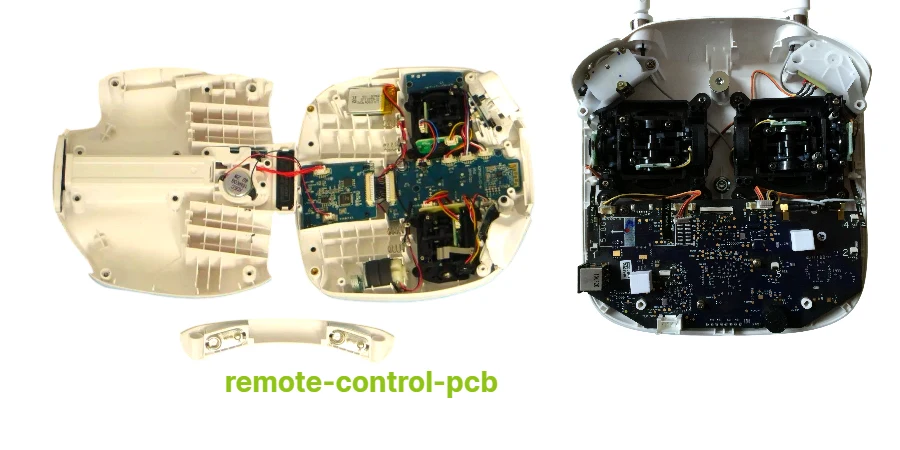
A remote-control PCB connects buttons, sticks, touch or voice inputs to an IR or RF command link. Its manufacturing requirements come from the selected interface, contact system, battery arrangement and enclosure—not simply the product name. A TV remote, car key fob and industrial controller can require very different handling, programming and acceptance tests.
HILPCB provides single/double-sided and multilayer fabrication, SMT/THT assembly, sourcing and enclosure-integration routes, backed by more than 15 years of PCB manufacturing experience. Engineering can integrate project-defined voice, gesture, HSM/secure-boot, haptic and rigid-flex features, and support IR, 315/433 MHz sub-GHz RF, 2.4 GHz, BLE, Wi-Fi, Zigbee or Matter hardware choices; protocol, firmware and product security remain with the approved design. This guide explains the details that make a remote-control build repeatable, from keypad geometry to a test fixture. For the basic IR/RF signal chain, see how remote control circuits work.
Diverse Remote Control Technologies and Circuit Design
TV and entertainment remotes can combine a controller, IR LED/driver, button matrix and battery contacts. Single/double-sided fabrication is a useful cost-conscious route when routing, contacts and mechanics fit it. The IR link also depends on LED drive, protocol timing, optical window and receiver conditions.
Air-conditioner and HVAC remotes may add an LCD, temperature sensing and timers. Those features do not automatically require a multilayer board. Select the layer count from routing, reference paths, size and assembly access; TI's IR remote reference design illustrates one controller/LCD implementation rather than a universal architecture.
Automotive key fobs and access-control remotes need the selected authentication, pairing and radio design. Rolling-code functions, device identities and firmware belong to the approved product architecture; a generic PCB or encryption-chip label does not establish complete security. Define provisioning, permitted access to credentials, functional checks and replacement/substitution authority.
Drone and RC vehicle controllers may include analog sticks, switches, telemetry displays, video interfaces or positioning modules. Select the actual feature set and verify command mapping, calibration and link behavior in the product plan. The receiving-side remote-control car circuit guide explains the separate command/actuator interface.
Smart-home and IoT remotes may combine IR with Bluetooth, Wi-Fi, Zigbee or Thread. Voice and motion input add microphones, sensors and processing/software requirements. Matter is an IP-based interoperability protocol, not another RF frequency; identify the chosen version, underlying transport, commissioning and software responsibilities. Supporting several protocols in one device needs compatible hardware, firmware and coexistence validation.
Remote Control PCB Types and Applications
Consumer Electronics:
- TV and Set-Top Box Remotes: Simple infrared designs using single-double-layer PCB for cost optimization
- Air Conditioner Controllers: LCD-equipped remotes with temperature sensors and timer functions
- Audio System Remotes: Volume, source and playback commands; audio processing only if the product actually includes that function
- Gaming Console Controllers: Wireless connectivity with haptic feedback integration
Automotive and Security:
- Car Key Fobs: Approved authentication/pairing, regional radio and low-battery behavior
- Garage Door Openers: Command transmission, pairing and defined interface to the receiving equipment’s safety functions
- Security System Controllers: Panic buttons, zone control, and two-way communication
- Gate and Barrier Controls: Industrial-grade reliability for commercial applications
Smart Home and IoT:
- Universal Smart Remotes: Multi-protocol support including WiFi, Bluetooth, and IR
- Voice-Enabled Controllers: Microphone integration and cloud connectivity
- Home Automation Hubs: Central control for lighting, climate, and security systems
Professional and Industrial:
- Drone and RC Controllers: High-precision analog controls with telemetry displays
- Industrial Machine Remotes: Ruggedized designs for harsh environments
- Medical Equipment Controllers: Approved controls, contact/cleaning requirements and equipment-specific acceptance
- Presentation and Conference Remotes: Laser pointers and slide navigation
Keypad, Contacts and Enclosure Fit
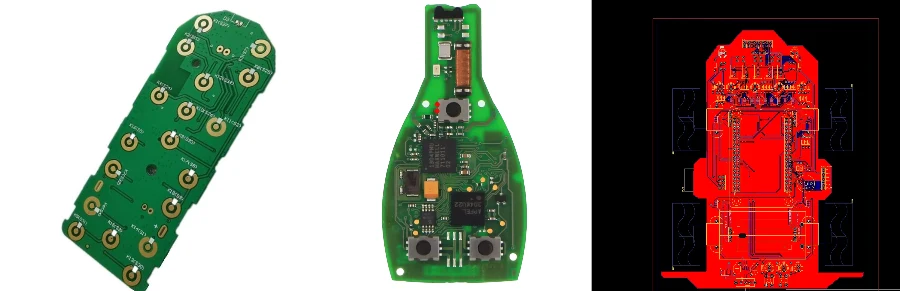
Release the contact system before ordering the PCB. A silicone conductive pill, metal dome, tactile switch, touch electrode and joystick need different pad geometry, finish, assembly and test methods.
- Contact drawing: Specify pad shape/gap, mask keep-outs, required contact finish or printed contact material and its acceptance basis. Confirm any carbon-ink or other special contact process separately; ordinary solder-pad finish is not automatically a wear-qualified keypad contact.
- Mechanical datums: Align button centers, switch height, dome retention, LCD contacts, IR LED angle/window and battery terminals to the enclosure drawing. Include board thickness, outline/finished-hole tolerances and permitted bow.
- Matrix and input tests: Provide the key map, single/multiple-key behavior, debounce/long-press requirements and firmware. For analog sticks, specify calibration points and allowed output range. These checks need a fixture and product limits, not only a continuity test.
- Assembly and service: Identify contact areas that must remain free of flux, coating or adhesive. State battery-spring/connector loads, fastener clearances and rework restrictions. Box-build assembly can extend the order to harness, enclosure and defined final tests.
Power Management: Extending Battery Life
Compare the complete battery-side duty cycle. A low-sleep-current MCU can coexist with a display, microphone, radio connection, backlight or haptic motor that dominates energy use.
Sleep and wake: Measure standby with the actual keypad scanning, pull-ups, regulators and radio state. Validate button-to-command latency and wake behavior at the required battery conditions; deep sleep is not automatically compatible with every interface.
IR and RF events: Include the whole command, repeat frames, receive/listen windows, pairing/reconnection and retries. IR is a useful line-of-sight option, but it is not universally more energy-efficient than every RF design. Antenna placement, grip, enclosure and battery voltage affect the installed RF link.
For an explicit example, assume 100 commands/day, each taking 0.1 s at 20 mA total battery current, with the remaining 86,390 s/day at 5 µA. Active charge is 100 × 0.1 × 20 / 3,600 = 0.0556 mAh/day; standby is approximately 86,390 × 0.005 / 3,600 = 0.1200 mAh/day. The sum is approximately 0.176 mAh/day. These are hypothetical operating states, not a product rating; add any omitted display, voice, haptic, retries and self-discharge terms before estimating battery life.
Energy harvesting and flexible interconnect: Solar or kinetic input is an option only when harvested energy, storage, charger losses and use conditions support the load. Flex or rigid-flex may solve an actual folded or moving interconnect; solar cells, haptics and battery contacts do not inherently require a flexible board.
Power controls: Backlight timeout or supported transmit-power settings can reduce some loads. Define the firmware behavior and verify command delivery rather than assuming transmit power can be set solely from distance.
Innovation Powering Today’s Advanced Remote Control Solutions
Voice, gesture, air-mouse and haptic features need different sensor, software and power arrangements. TI's CC2650 remote reference platform documents one voice-based Bluetooth/RF4CE architecture. Define the actual feature set before releasing the board.
For a manufacturing order, release the microphone/IMU/motor interfaces, firmware, power modes and functional limits. Identify whether speech processing is local or uses an external service, and who owns provisioning, updates and recovery. Security features require the approved device/firmware/service design and validation; a hardware security module is not mandatory for every remote.
HILPCB offers lead-free assembly and halogen-free laminate options, and can support selection and use of recyclable components where supplier documentation, availability and the specified board process permit. Lead-free solder, halogen-free laminate and restricted-substance requirements are separate material/process choices; confirm the applicable declaration and exact material system rather than treating them as proof that an entire controller meets every environmental rule.
Beyond Remote Controls – Why HILPCB is Your Complete PCB Manufacturing Partner
HILPCB can connect fabrication with SMT assembly, through-hole connectors, programming and turnkey sourcing. Single/double-sided routes list standard 150/150 µm trace/space and reviewed advanced 75/75 µm geometry. Standard SMT screening includes 0201 and 0.4 mm pitch, while more demanding packages need actual land-pattern, stencil and inspection review. Use each route for its applicable construction rather than combining all limits.
SPI/AOI, selected hidden-joint X-ray and customer-defined electrical or functional tests inspect different features. For a pilot remote, useful ordered evidence can include key-map results, programmed revision, current-state readings, selected IR/RF checks, enclosure fit and lot/serial linkage. Identify the fixture, receiver/test instrument, firmware and limits for each check.
For a remote-control manufacturing quote, send Gerber/drill/stackup, BOM/CPL, contact and enclosure drawings, quantity and sourcing scope. Add key/axis mappings, battery contacts, optical/radio keep-outs, firmware/programming requirements and acceptance tests. HILPCB can review fabrication, component availability, authorized-source alternatives, tooling and assembly/test scope for prototype builds from five pieces through million-unit production programs; volumes and schedules are confirmed against the project package. Engineering optimization and global sourcing are available for eligible programs. HILPCB reports a historical 99.2% first-pass yield for its production work; IPC-A-610 Class 3 workmanship is available when specified for the build.
Frequently Asked Questions
What types of remote-control PCBs can HILPCB manufacture?
The fabrication and assembly routes can be reviewed for TV/entertainment, HVAC, smart-home, access-control, RC and industrial controller boards. Provide the actual contact, package, radio and enclosure requirements; specialized product approvals and complete-system validation have their own scope.
How are remote-control boards optimized for different applications?
Start with the interface and cost drivers: keypad/contact geometry for simple remotes, LCD and input placement for HVAC, provisioning for access control, or sensor/radio/power integration for smart controllers. DFM/DFA and a pilot build can resolve manufacturing constraints before the released design enters repeat production.
Can you handle prototypes and production volumes?
HILPCB offers prototype/NPI and production assembly routes. State quantities by build stage, sourcing ownership, tooling and tests so the quotation confirms capacity, material readiness and the production schedule. The prototype’s approved BOM, programs and acceptance records support the handoff.
Which wireless technologies can be built into a remote-control assembly?
The approved design may use IR, region-appropriate sub-GHz RF, proprietary 2.4 GHz, Bluetooth, Wi-Fi, Zigbee or Thread. Quote the selected module/transceiver and its integration/test requirements. Matter uses an underlying IP transport; it is not an extra radio band or an automatic feature of a Thread-capable chip.
What should a remote-control functional test cover?
Define the key/axis map, command timing and repeats, display or haptic outputs if present, sleep/wake current and installed IR/RF behavior. Provide firmware, fixture, receiver/reference equipment and pass/fail limits. Test button alignment and contact behavior in the intended enclosure when those are part of the supplied assembly.