

A set-top box PCB may combine a multimedia SoC, DDR, flash, power, wired/wireless interfaces, and broadcast tuners. Success depends on turning the SKU into controlled electrical, thermal, security, manufacturing, and compliance requirements.
Key Takeaways
- OTT, IPTV, terrestrial, cable, satellite, and hybrid receivers create different PCB risks; no universal stackup fits them all.
- Interface constraints come from the selected silicon, connector, cable, stackup, and specification—not a generic impedance tolerance.
- Secure boot, DRM or HDCP credentials, MAC addresses, serial numbers, and firmware signing require a customer-approved provisioning workflow with separated access and auditable records.
- AOI, X-ray, electrical test, programming, and functional test detect different failures; specify coverage and evidence.
- Manufacturing evidence supports approval but does not replace interface, broadcast, EMC, radio, safety, or content-protection compliance.
Table of Contents
- Start with the set-top box SKU
- Translate interfaces into PCB controls
- Select stackup and materials from budgets
- Control power, heat, RF, and EMC together
- Build a manufacturing and test evidence matrix
- Protect firmware, identities, and content keys
- Define compliance and release ownership
- Manage NPI and change control
- Set-top box PCB RFQ checklist
- What can HILPCB support?
- Frequently asked questions
Start With the Set-Top Box SKU
Architecture determines the control plan. Freeze regional, operator, interface, enclosure, and security variants before pricing.
| Product type | Distinct hardware | Dominant PCB or PCBA risk | Release evidence |
|---|---|---|---|
| OTT streamer | SoC, DDR, HDMI, Wi-Fi/BT | Channel margin, antenna detuning, heat | Boot, memory, AV, network and thermal tests |
| IPTV receiver | Ethernet/Wi-Fi, operator software | Ethernet, ESD, configuration control | Link, provisioning and operator acceptance |
| Terrestrial/cable | Tuner, demodulator, RF input | Ingress, supply noise, RF coupling | RF performance and regional validation |
| Satellite | Tuner and LNB supply/control | Protection, current path, switching noise | LNB and RF functional tests |
| Hybrid | Broadcast and IP domains | Coexistence, BOM variants, security | Variant-specific RF, network and provisioning records |
8K video, AV1, Wi-Fi 6, Bluetooth 5, voice control, and smart-home radios are optional platform decisions, not universal features.
Translate Interfaces Into PCB Controls
For each interface, record silicon revision, rate or band, topology, reference, connector/cable, loss/skew/noise limits, test method, and owner.
| Domain | Design control | Manufacturing evidence | Product-level proof |
|---|---|---|---|
| SoC and DDR | Vendor topology, timing and PDN rules | Stackup, specified coupons, BGA inspection | Memory stress in defined operating states |
| HDMI | Channel, return, ESD and connector rules | Controlled construction and transition inspection | Electrical/compliance and interoperability tests |
| USB | Generation, role, routing and protection | Connector inspection and continuity | USB-IF compliance and interoperability |
| Ethernet | PHY/magnetics, isolation and chassis rules | Orientation, joints, specified hipot | Link, packet, surge/ESD evidence |
| Wi-Fi/Bluetooth | Antenna, keep-out, matching and enclosure rules | RF BOM, shield and placement checks | Radio, coexistence and qualification evidence |
| Tuner/demodulator | RF path, filtering, shielding and clean power | Shield, RF BOM and connector records | Region-specific receiver performance |
A high-speed PCB process can control agreed stackup and impedance features, but a coupon does not certify a populated channel. A qualified wireless module also does not automatically approve the final enclosure, antenna, firmware, or product.
Select Stackup and Materials From Budgets
Choose layer count from BGA escape, reference continuity, PDN, RF isolation, thickness, cost, and yield. A compact design may need multilayer PCB construction; a simpler receiver may not. High-Tg or lower-loss material is justified only by thermal or channel analysis.
State approved laminates, dielectric targets, copper, thickness, impedance classes, vias, finish, solder mask, and coupon acceptance on the fabrication drawing. Tie limits to silicon and interface constraints rather than a generic “plus or minus 10%.”
Control Power, Heat, RF, and EMC Together
Derive rails, sequencing, transients, and standby states from the selected devices and energy target. Verify startup, brownout recovery, external loads, and simultaneous processing/network activity.
Keep converter hot loops compact and fast-signal returns continuous. Do not split RF and digital grounds by habit: a plane gap can enlarge a radiating loop. Partition by placement and current flow, then define shielding and chassis references from the EMC strategy.
Validate thermals in the intended enclosure, ambient, and workload. Vias and copper help only within a complete thermal path. Record throttling, resets, video errors, and wireless degradation.
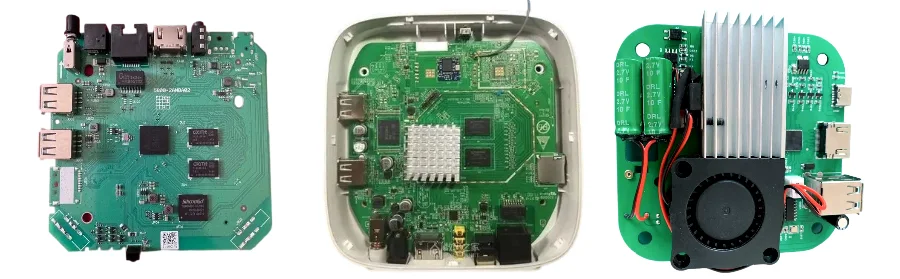
Build a Manufacturing and Test Evidence Matrix
| Gate | Main purpose | Typical evidence | Boundary |
|---|---|---|---|
| Bare PCB | Construction and connectivity | Netlist, material, specified coupon/microsection | Not assembled performance |
| Assembly | Paste, placement, reflow, workmanship | SPI, AOI, profile; risk-based X-ray | Coverage follows package risk |
| Powered PCBA | Assembly/configuration faults | Rail/current, readback, I/O and memory tests | Not enclosure, RF or compliance proof |
| Complete unit | SKU functions and identity | AV, network, tuner, remote, storage and standby | Customer-defined limits/fixtures |
| Qualification | Design and market requirements | Thermal, EMC, safety, radio and interface reports | Product authority/laboratory owns release |
For SMT assembly, name packages, MSL handling, paste/alloy, inspection, rework, cleanliness, and acceptance source. A list of test acronyms is not a test specification.
Protect Firmware, Identities, and Content Keys
Programming becomes a security process when a unit receives secure-boot material, DRM/HDCP credentials, certificates, MAC addresses, or serials. Define supply, encryption, access, duplicate prevention, permitted readback, scrap/rework handling, audit logs, and unused allocations.
HDCP key access follows Digital Content Protection licensing; HDMI adopter obligations are separate. An assembler should execute only the approved workflow, never generate, retain, or reuse secrets by assumption. Include security responsibilities in a turnkey assembly RFQ.
Define Compliance and Release Ownership
Relevant requirements may include HDMI, USB-IF, Bluetooth SIG, Wi-Fi Alliance, DVB or ATSC, regional radio/EMC rules, operator requirements, HDCP licensing, and IEC 62368-1 safety. PCB workmanship inspection cannot replace product compliance.
The product authority owns architecture, licensing, market compliance, security, operator approval, and release. Fabricator and assembler own only contracted controls, records, and tests. Reports should identify hardware, firmware, limits, equipment, result, date, and serial/lot.
Manage NPI and Change Control
Engineering builds close schematic, stackup, antenna, thermal, DFM/DFA, test-access, and provisioning risks. Design validation uses representative units; production validation proves fixtures, process windows, traceability, throughput, packaging, and reaction plans.
Review laminate/stackup substitutions, silicon/module changes, antenna geometry, connectors, protection, assembly process, firmware/key loader, test limits, enclosure/thermal materials, site transfers, and adverse yield or field trends.
Set-Top Box PCB RFQ Checklist
- PCB data, netlist, stackup/drawing, BOM/AVL, centroid, assembly/schematic/mechanical files, panel rules, and revision IDs.
- SKU matrix, regional standards, interfaces, impedance/loss, antenna/shield, power, thermal, and enclosure requirements.
- MSL, paste/alloy, inspection/acceptance, cleanliness, rework, depanelization, coating, and packaging rules.
- Firmware, credentials/serialization, fixtures, golden units, limits, sampling, data retention, nonconformance, and change rules.
What Can HILPCB Support?
HILPCB can review the data package, coordinate an agreed FR-4 PCB or multilayer construction, identify manufacturability risks, and align fabrication, assembly, inspection, traceability, programming, and test deliverables. Confirm box-build assembly, labeling, RF shields, cables, and final test during quotation.
Verify exact materials, equipment, tolerances, fixtures, security controls, external tests, and capacity for the project. HILPCB does not replace interface licensing, content-protection obligations, product security, operator validation, regulatory laboratories, or final release.
Frequently Asked Questions
How many PCB layers does a set-top box need?
There is no fixed answer. Select from package escape, reference planes, PDN, RF isolation, thickness, thermal needs, yield, and cost; then validate against the silicon and enclosure.
Does every set-top box require a low-loss laminate?
No. FR-4 may be sufficient when channel and thermal budgets close. Use lower-loss material only when route length, rate, copper profile, temperature, or margin requires it.
Does an impedance coupon prove HDMI compliance?
No. A coupon verifies fabrication. HDMI performance also depends on silicon, routing, vias, connector, ESD network, cable, firmware, and product-level testing.
Can a PCB assembler program HDCP or DRM keys?
Only through a licensed, customer-approved process covering custody, access, uniqueness, logging, scrap, and audit. Firmware programming alone grants no authority over protected credentials.
Which set-top box tests should run on every unit?
Coverage follows defect risk. Candidates include identity/programming, rail/current, boot, memory, AV, network, tuner/LNB, USB, remote, and standby checks. Qualification is separately controlled.
Quote the Release Evidence, Not Just the Board
A dependable set-top box PCBA needs more than Gerbers and a BOM. Send HILPCB the SKU matrix, interface/security requirements, enclosure/thermal limits, inspection plan, test ownership, acceptance limits, traceability, and change rules so the quote reflects real release evidence.