
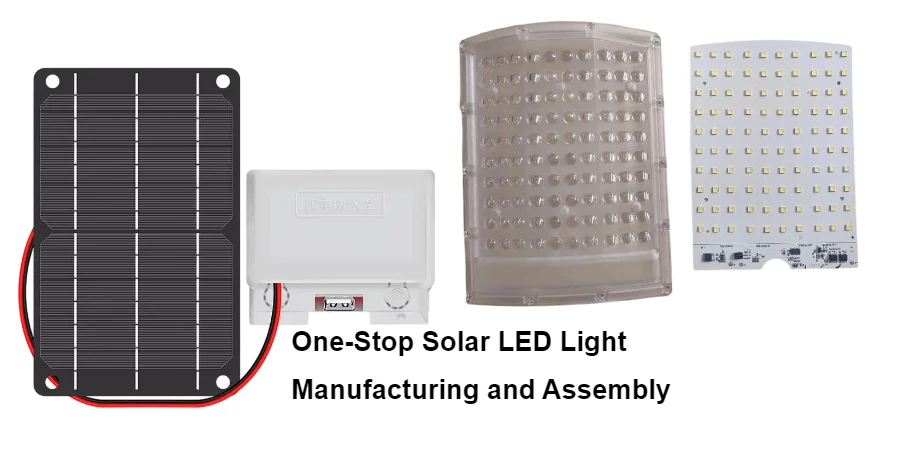
Solar LED lighting is one of the fastest-growing categories in renewable energy products—from off-grid solar street lights and smart city lighting to solar flood lights and solar garden lights. Buyers typically face the same challenge: building a reliable product requires multiple subsystems (solar charging, battery management, LED driving, sensors, communications, enclosure sealing), and quality can fall apart when these parts are sourced from different vendors.
A one-stop manufacturing and assembly approach helps keep performance consistent across the full product: PCB fabrication → PCBA → harness/cable → battery pack integration → enclosure assembly → testing → packaging. This article explains what “one-stop” means in real production terms and how different types of solar LED lights are built for outdoor reliability, stable brightness, and long service life.
What “One-Stop” Means for Solar LED Light Manufacturing
Solar LED lights are not just “a lamp with a panel.” They are integrated photovoltaic products that must operate autonomously through heat, rain, dust, vibration, and seasonal irradiance changes. When production is fragmented, common problems include inconsistent charging behavior, unstable dimming profiles, early battery failures, and field returns due to water ingress.
A one-stop model reduces these risks by keeping component compatibility, process control, and testing in a single workflow.
Key Elements of One-Stop Solar LED Light Production
- PCB fabrication: Stable stack-up, copper weight control, and outdoor-ready material selection
- PCBA: Reliable soldering for power components, sensors, and communication modules
- System integration: Battery pack + LED module + controller + wiring harness integration
- Enclosure assembly: IP-rated sealing, potting/conformal coating readiness, mechanical stress control
- Testing & validation: Functional tests, aging tests, surge checks, and traceability records
For solar lighting OEM/ODM projects, one-stop delivery is often the fastest way to achieve predictable performance at scale.
Solar LED Street Light Manufacturing for Smart City and Roadway Projects
Solar street lights are the most searched and highest-volume solar lighting products. They must maintain brightness through multiple cloudy days, survive surges from long outdoor cables, and meet project requirements such as IP65/IP67 waterproofing, anti-corrosion, and long warranty cycles.
A stable manufacturing approach for street lights must coordinate the controller, LED driver, battery pack, and heat dissipation structure.
Key Manufacturing & Assembly Practices
- Controller and LED driver PCBA: Power-stage solder quality and thermal layout stability are critical for long-term reliability.
- High-current copper design: For higher-power lamps, heavy copper PCBs reduce resistive loss and temperature rise in charging and LED-driving paths.
- Layered layout for mixed-signal control: Smart functions (motion sensor, LDR, wireless) benefit from clean reference planes in multilayer PCBs.
- Battery pack integration: LiFePO4 (LFP) packs require safe wiring, balancing provisions, and mechanical protection against vibration.
- End-of-line testing: Dusk-to-dawn behavior, dimming profiles, motion-trigger boost, and charging cutoffs must be verified before shipment.
A street light that passes these checks is far less likely to show dimming drift, random resets, or early battery degradation in the field.
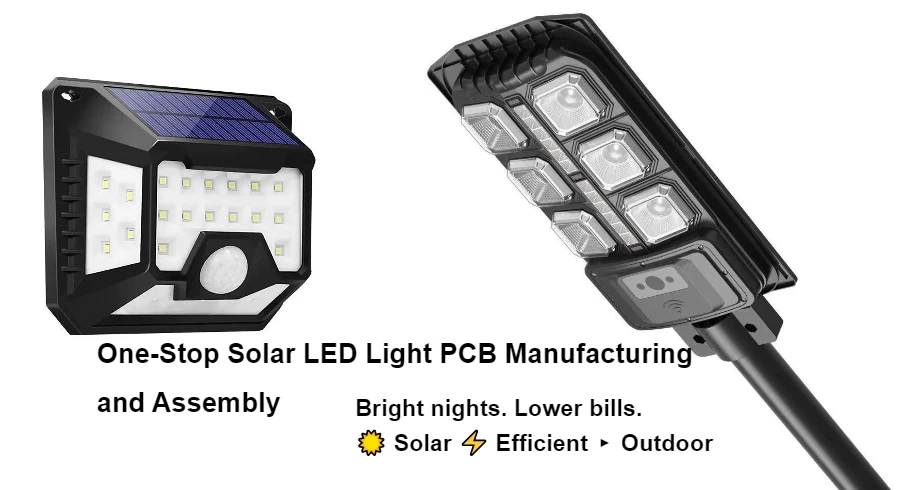
Solar Flood Light Manufacturing for Construction Sites and Security Lighting
Solar flood lights are popular for farms, yards, warehouses, construction sites, and security areas because they deliver high lumen output with simple installation. The biggest failure drivers are thermal stress, inadequate battery protection, and connector corrosion.
Flood lights often run at higher continuous power levels, so thermal and assembly controls become even more important.
Key Flood Light Production Techniques
- Thermal-first mechanical integration: Heat paths from the LED board to the housing must be designed into the product.
- Material stability for outdoor reflow and cycling: high-Tg PCBs help maintain mechanical integrity under lead-free assembly and temperature cycling.
- LED board + driver integration: Stable current regulation and surge protection reduce flicker and extend LED lifetime.
- Cable and connector robustness: Outdoor-grade connectors and strain relief reduce water ingress risk.
- Aging tests: Burn-in helps screen early failures caused by solder voids, weak components, or thermal hotspots.
Flood light production succeeds when thermal design, enclosure design, and PCBA quality are treated as one system.
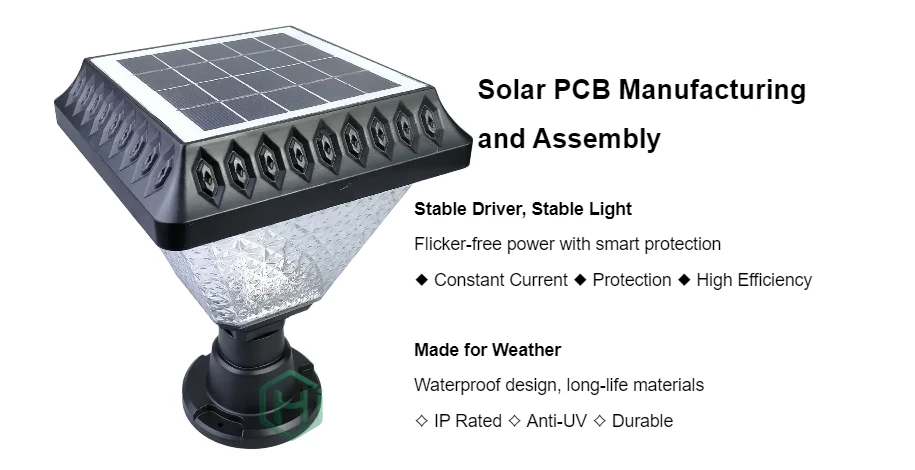
Solar Garden, Pathway, and Landscape Light Manufacturing
Solar garden and landscape lights are consumer-driven products where aesthetics and battery life matter. They are typically lower power but highly cost-sensitive, making yield control and part compatibility important.
Common issues include short runtime, water ingress at seams, and early battery capacity fade.
Key Low-Power Solar Light Manufacturing Practices
- Efficient low-power design: Stable standby current and optimized sleep modes increase nights-per-charge.
- Consistent control PCB quality: Standard FR4 PCBs are widely used for control boards when grounding and moisture protection are handled correctly.
- Optical and mechanical repeatability: Lens placement and LED alignment must be consistent to avoid uneven light patterns.
- Moisture protection readiness: Coating/potting design rules prevent corrosion and leakage.
- Packaging and drop resilience: Shipping protection reduces cosmetic and mechanical damage.
For these products, the best “performance lever” is often reducing parasitic power and improving enclosure sealing consistency.
Integrated “All-in-One” vs Split Solar LED Light Manufacturing
Two popular product formats dominate the market: all-in-one solar lights (panel, battery, controller, lamp in one housing) and split solar lights (panel separated by cable, lamp separate). Each format changes manufacturing complexity and failure modes.
Key Integration Considerations
- All-in-one solar lights:
- Tight thermal enclosure; strong need for heat spreading and reliable sealing
- Fewer cables; simpler installation; higher integration density
- Split solar lights:
- Better thermal separation and easier panel placement for maximum irradiance
- More cable/connector risk; stronger demand for surge protection and strain relief
In both formats, the manufacturing goal is consistent charging behavior, stable dimming profiles, and long-term outdoor endurance.
Electronics Scope in Solar LED Light One-Stop Production
Solar LED lights commonly include multiple PCBs or modules: a solar charge controller (PWM/MPPT), a BMS/protection stage, an LED driver, and optional wireless or sensing boards. If these are built by different suppliers, interface mismatches and test gaps become common.
A one-stop approach keeps firmware assumptions, harness design, and test coverage aligned.
Typical Electronics Delivered in One Workflow
- Charging controller PCBA (PWM/MPPT)
- LED constant-current driver board
- Sensor and control board (LDR, PIR/microwave motion, RTC)
- Wireless module integration (LoRa, BLE, cellular, Wi‑Fi)
- Protection network (surge/ESD, reverse polarity)
- Cable/harness fabrication and verification
For solar lighting platforms that include smart control and remote monitoring, consistent electronics integration is the difference between “works in the lab” and “stable in the field.”
Manufacturing and Assembly Flow for Solar LED Lights
Production success depends on repeatable processes and clear responsibility boundaries. A one-stop workflow typically combines PCB fabrication, PCBA, and mechanical integration with traceable testing.
Key Production-Ready Practices
- High-repeatability PCBA: SMT assembly supports consistent placement and soldering for control ICs, RF parts, and fine-pitch components.
- Pilot builds before volume: small-batch assembly helps validate BOM choices, thermal behavior, and test methods before scale-up.
- Full system build-out: box-build assembly enables complete integration of PCBAs, battery packs, wiring, enclosure, and labeling as a shippable product.
- DFM and test access: Test points, programming pads, and interface verification reduce rework and improve yield.
- Quality and traceability: Documented inspection/testing records support warranty and project deliveries.
This production flow is designed to reduce supplier handoffs, shorten lead time, and stabilize quality across large deployments.
Conclusion
Solar LED lights combine photovoltaic charging, energy storage, LED driving, sensors, and outdoor mechanical protection into a single product. Reliable results depend on controlling the full chain—PCB materials and copper structure, PCBA quality for power components, battery pack integration, enclosure sealing, and end-of-line testing.
HILPCB provides one-stop manufacturing and assembly for solar LED lighting products, covering PCB fabrication, PCBA, and complete system integration. By delivering the controller electronics and the assembled product through a controlled workflow, projects can scale from pilot builds to mass production with predictable quality, clearer accountability, and lower field risk across street, flood, garden, and smart solar LED light applications.
Common Questions
Why are solar LED lights especially well suited to a one-stop manufacturing model?
Because they are inherently multi-subsystem products, combining charging, battery storage, LED driving, controls, wiring, enclosure sealing, and outdoor protection. Once those pieces are split across too many suppliers, troubleshooting and accountability quickly become difficult.
What production problem is most often overlooked in solar lighting projects?
Outdoor system interaction is often underestimated. Battery pack consistency, enclosure sealing, cable reliability, thermal behavior, and controller parameter matching can all look acceptable during bench testing but become major problems after months of field exposure.
What should be validated before scaling a solar LED light product?
Priority should go to charge-discharge cycling, full-lamp aging, sealing performance, temperature rise, nighttime brightness stability, and assembly consistency. Customers do not judge these products by whether they light up in the factory; they judge them by how predictably they perform outdoors over time.