
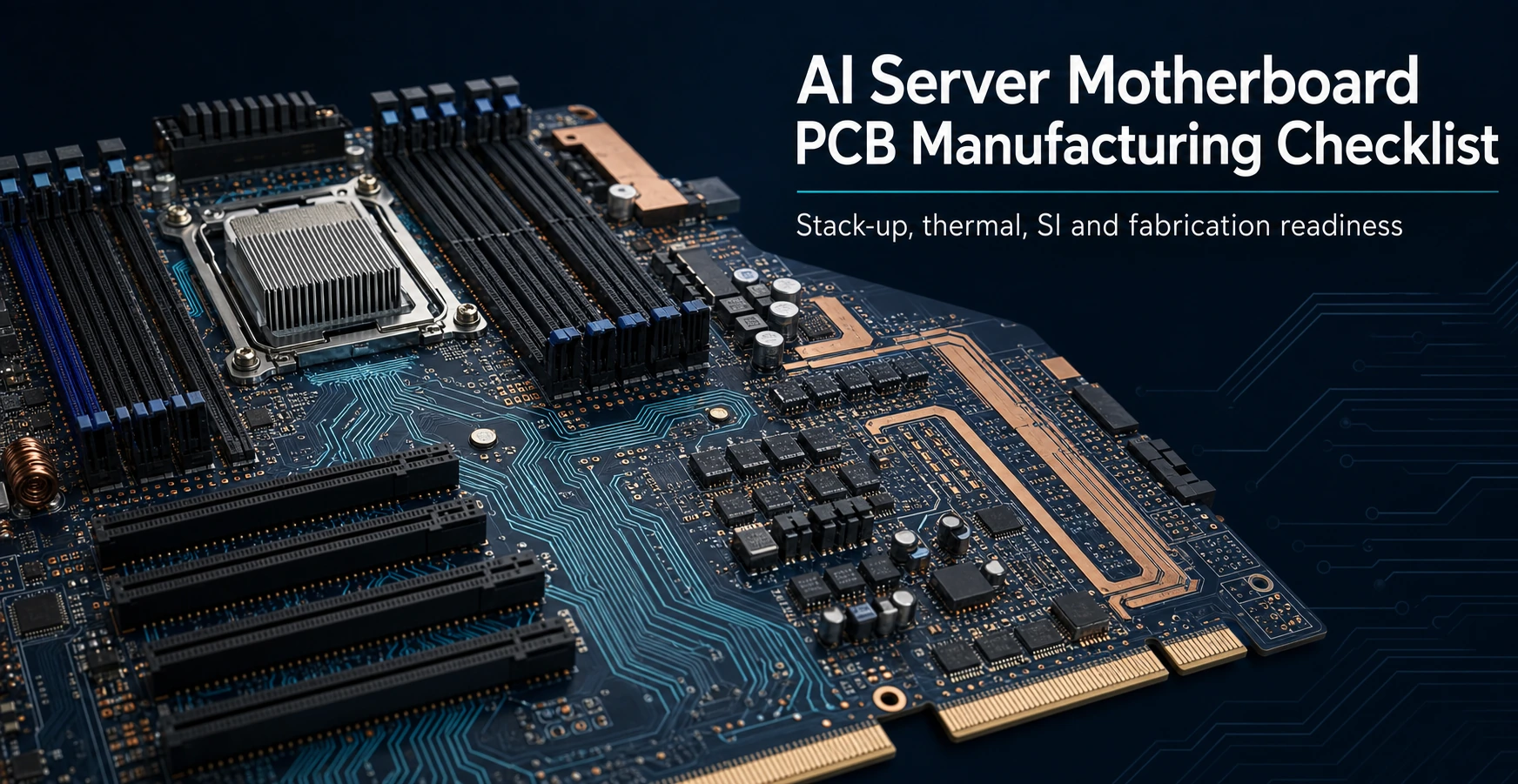
- Start with route classification, not with AI vocabulary. An AI server motherboard is still a board-level release problem that must separate motherboard review, backplane escalation, and narrower SerDes validation.
- Freeze stackup posture, controlled-net ownership, power-path review, and connector-zone escalation before the build package moves into quote-first behavior.
- Treat dense BGA work as a review chain across stencil transfer, measured profiling, concealed-joint visibility, and first-build confirmation rather than as one low-void slogan.
- Keep
NPI,EVT,DVT, andPVTin launch-governance posture. They help organize evidence and ownership, but they do not prove high-speed or system-level success by themselves. - Use
SMT assembly,turnkey, andvalidation handoffas downstream execution routes only after the board package is coherent enough to name what the next build is actually supposed to confirm.
An AI server motherboard PCB manufacturing checklist is most useful when it behaves like a release-control document. It should help the team decide what kind of board is being built, what must be frozen before fabrication and assembly, which adjacent route owns the next risk, and what evidence the first build still has to collect.
In This Guide
- What is this checklist actually deciding for an AI server motherboard PCB?
- What must be frozen before fabrication starts for an AI server motherboard PCB?
- How do dense BGA assembly and inspection fit into the release package?
- How should NPI handoff work and where do teams usually fail?
- What should be included in an AI server motherboard PCB RFQ checklist?
- FAQ
- Next steps
What is this checklist actually deciding for an AI server motherboard PCB?
This checklist does not start by asking whether the board belongs to a fashionable system category. It starts by asking what the released package is trying to freeze before manufacturing. Search demand around this topic mixes AI server motherboard, low-loss, low-void BGA, SMT assembly, turnkey, and NPI / EVT / DVT / PVT language as if those labels all point to one answer. They do not. Some of them describe board architecture pressure. Some describe assembly complexity. Some describe launch-stage control. Some describe downstream service routes. The useful job here is to separate those layers before any reassurance appears.
That separation matters because AI-server programs accumulate many kinds of pressure at the same time. A dense motherboard may carry accelerator-adjacent routing, power-delivery concentration, memory-interface context, connector escalation signals, and hidden-joint assembly burden in one file set. Once those concerns are mixed together, teams often stop naming the governing question clearly. They say AI server and assume everyone understands what must happen next. In practice, the phrase hides several different decisions:
- Is the board still a motherboard-style release review or is it already behaving like a backplane problem?
- Is the main risk in stackup and controlled-net ownership or in concealed-joint assembly discipline?
- Is the next build mainly for launch stabilization or for deeper route-specific validation?
- Are service-route words such as
SMTorturnkeybeing used to describe execution, or to cover unresolved engineering ambiguity?
The checklist is valuable only if it turns those hidden questions into explicit release items.
The first thing it should decide is what type of board is under review. A dense compute motherboard is not identical to a connector-heavy backplane, even if both boards live in an AI-server program. A motherboard review usually centers on stackup posture, controlled-net ownership, power-path organization, dense BGA assembly, and staged validation handoff. A backplane review usually centers more heavily on connector zones, drilling and backdrill posture, long transitions, press-fit integration, and larger-format channel management. A narrower SerDes review is different again: the dominant uncertainty shifts toward route-specific channel cleanup and validation separation. If the article does not separate those routes, the checklist becomes too generic to govern a release.
The second thing it should decide is what the interface and application vocabulary is doing in the conversation. AI server, PCIe, DDR5, 112G, and similar names are safe only as system-context pressure. They explain why the board review is more demanding. They do not prove the board is manufacturable, protocol-ready, or already validated. Public copy becomes risky when those names quietly stop acting as context and start acting as promise words. The checklist needs to hold that line early, because once the title and description drift into capability language, every later section becomes harder to constrain.
Decision Matrix: AI Server Board Review Route
| Review Area | Motherboard Route | Backplane Route | SerDes Validation Route |
|---|---|---|---|
| Primary Focus | Stackup posture, controlled-net ownership, power-path organization, dense BGA assembly. | Connector zones, long transitions, drilling/backdrill posture, press-fit integration. | Route-specific channel cleanup, validation separation, high-speed loss budgets. |
| Dominant Risk | Fragmented ownership between fabrication and assembly for dense joints. | Interconnect continuity, thick-board drilling tolerances, structural warpage. | Signal integrity degradation over long traces or at interface boundaries. |
| Checklist Output | Staged process-review logic, NPI handoff boundaries, process learning. | Mechanical and signal verification at connector fields, tooling checks. | Exact measurement procedures, VNA setups, TDR pass/fail criteria. |
| When to Use | General compute nodes, standard AI server mainboards with moderate density. | Multi-node interconnection boards, switch fabrics, heavily connectorized architectures. | Specific daughtercards or test vehicles for cutting-edge interfaces (e.g., PCIe Gen 6, 112G). |
The third thing it should decide is how the board burden is coupled. On AI server motherboards, stackup planning, controlled impedance, return-path continuity, dense package selection, hidden-joint inspection planning, and launch-stage control are not independent conversations. They reinforce each other. If the release package still treats them as separate checkboxes, the project enters build flow with ownership gaps. A checklist is most useful when it exposes that coupling and forces the team to write down which linked decisions are already frozen and which are not.
The fourth thing it should decide is what the first build is for. Early builds are often overloaded in AI-server projects. Teams hope one NPI run will confirm manufacturability, dense-BGA process stability, signal-path sanity, thermal plausibility, and release readiness all at once. That is too much weight for one build to carry. A safer checklist defines one next-build question clearly. Maybe the build is for stackup and package coherence. Maybe it is for route classification. Maybe it is for concealed-joint process learning. Maybe it is for later validation handoff. If the package cannot say that in one sentence, the board is not ready for stronger manufacturing language.
The fifth thing it should decide is what this checklist does not prove. It is not protocol proof. It is not workload proof. It is not cooling proof. It is not a supplier-capability sheet. It is not a void-threshold guide. It is not a turnkey guarantee. Its practical role is to define what must be frozen, what route owns the board, what the first build should confirm, and what evidence must still travel into later validation.
What must be frozen before fabrication starts for an AI server motherboard PCB?
The first real manufacturing decision is not whether the board should be called AI, high-speed, or advanced. The first real decision is what the board package must freeze before fabrication and assembly begin. On AI server motherboards, the most common failure is trying to accelerate procurement or build routing while the package still treats stackup, controlled nets, connectors, and power-path burden as loosely related topics. The checklist puts those items into one release frame.
Start with stackup posture. This does not mean publishing loss tables or turning low-loss material names into performance proof. It means deciding whether the released package has identified the path classes that truly govern the board. Which regions are controlled-net paths, which are power-distribution structures, which zones are dense package breakouts, and which sections may trigger escalation into a connector-heavy route? If the answer is still implied rather than written, the stackup discussion is not mature enough yet. The point of a manufacturing checklist is not to impress a reviewer with advanced vocabulary. It is to make sure the board stops pretending every path class can be governed by one generic note.
Controlled-impedance ownership belongs in the same freeze decision. On dense server boards, impedance cannot live as a decorative callout on a drawing package. It needs ownership: which structures are sensitive enough to govern stackup choices, how verification posture is expected to align with those structures, and where the board still depends on later path-specific validation rather than on manufacturing language alone. The useful public statement is not a tolerance promise. The useful public statement is that controlled-net planning and verification posture must be frozen together, or the build package will not mean the same thing to layout, fabrication, assembly, and later validation owners.
The next thing to freeze is route separation. Many AI server motherboards begin as motherboard-style reviews and gradually become something else. Dense connector fields, long transitions, backdrill-sensitive structures, or chassis-level interconnect zones can shift the board toward the Backplane PCB route even when the project still uses motherboard language internally. That shift matters because this checklist does not promise a universal answer. It tells the reader when a board can stay in motherboard review and when it needs a different release logic. If connector-zone burden begins to dominate, the board is no longer helped enough by generic AI-server wording.
Power-path review also has to stay visible at the same level. AI-server motherboards often combine dense compute regions with concentrated power-delivery demands. The public checklist does not need current tables or thermal claims to be useful. It needs to say that power-path organization, copper usage, and return-path discipline are not downstream optimizations. They are part of the release package that shapes whether stackup, package breakout, and assembly route are coherent. If the power discussion is postponed until after build kickoff, the checklist is already too late.
This is also where low-loss wording has to stay disciplined. Low-loss language is most useful when it acts as a routing signal: certain paths may be sensitive enough that stackup and material posture must be reviewed more carefully. It is not useful when it becomes a floating performance adjective. A good checklist turns low-loss into two questions instead of one claim. First, which path classes are forcing that review? Second, does that path burden still belong in motherboard review, or does the board now need the additional controls covered by a high-speed or backplane review? That framing keeps the checklist specific without creating unsupported material hierarchies or capability promises.
The freeze decision should also cover package-level assembly consequences before the build is launched. Dense BGA areas, hidden joints, thermal-mass variation, breakout congestion, and access limits are not assembly issues that can be cleanly deferred until after fabrication. They shape what kind of first build will actually teach the team something. If the board has not already named those assembly sensitivities during release review, the first build becomes an expensive discovery tool instead of a controlled confirmation step.
The practical way to think about this is simple: the release package should be able to answer five questions before build routing accelerates.
- What is the dominant board route right now: motherboard, backplane-adjacent, or narrower SerDes-sensitive work?
- Which path classes are governing stackup and controlled-net posture?
- Which connector or transition zones may force escalation out of motherboard-only treatment?
- Which dense-package areas create hidden-joint and inspection burden before assembly begins?
- What single build question should the next run answer?
If the package cannot answer those five questions directly, it is not yet ready for stronger manufacturing words. Readers who need broader interconnect-sensitive board support can move toward High-speed PCB. Readers whose board is still early enough that the next hardware pass is primarily for evidence gathering may be better served by PCB prototype. But those links should come after route classification, not before. A service route is useful only when the board already knows what kind of board it is.
How do dense BGA assembly and inspection fit into the release package?
Dense BGA assembly is where many AI server motherboard pages become thin or misleading. The usual failure is to compress the whole topic into one phrase such as low-void BGA and let that phrase imply everything from soldering discipline to performance confidence. That is not how a safe manufacturing checklist works. For dense compute boards, BGA language is useful only when it is treated as a staged process-review chain.
The chain starts before placement and reflow. Package density, breakout congestion, board thickness interactions, thermal-mass imbalance, and access constraints all shape what the assembly route needs from the released package. If those inputs are still vague, no later inspection method can fully compensate. The checklist therefore needs to ask whether the board has already identified which package regions are driving assembly sensitivity and whether those regions are visible to the rest of the release package, not hidden inside a generic fine-pitch label.
The second part of the chain is print-transfer and process planning posture. The article does not need to publish stencil values or recipe windows to be specific. It needs to say that dense BGA reliability depends on upstream print and paste planning being reviewed as part of the same release package. On an AI server motherboard, hidden-joint behavior is influenced by the real board context: local thermal mass, neighboring copper distribution, package density, and inspection access. A useful checklist keeps that logic visible. It does not reduce low-void work to a single oven setting or a marketing promise.
One physical failure pattern makes that caution unavoidable. AI server motherboards are often 24 layers or more, carry heavy internal copper for PDN transport, and then place very large ASIC or GPU packages that can exceed 60 x 60 mm. In the peak reflow zone, the board and the package do not simply heat up together. They fight each other. The thick board absorbs heat like a sink, the large package substrate warps under its own thermal gradient, and the two bodies can separate dynamically just enough for outer-corner solder balls to lose contact with molten paste. After cooling, the defect is not dramatic from the top side. It appears as head-in-pillow or non-wet open under an expensive device that may cost more than the rest of the assembly. That is why AI motherboard release cannot stop at Gerber completeness. Step-stencil planning, thermal mapping, and mandatory X-ray review of the hidden-joint region have to be treated as NPI prerequisites, not optional cleanup after the first failed build.
Decision Matrix: Hidden-Joint Inspection Logic
| Aspect | Baseline Verification | Dense Server Package Verification | What it confirms |
|---|---|---|---|
| Inspection Method | Standard AOI and visual inspection. | Mandatory 2D/3D X-ray (AXI) on all dense arrays. | Presence, gross alignment, and absence of major bridging. |
| Voiding Criteria | Generic IPC Class 2/3 limits (e.g., 25% max void area). | Specific limits per thermal/ground pad vs. signal pins. | Thermal dissipation capability and mechanical joint strength. |
| Thermal Profiling | Basic profiling on generic test boards. | Multi-zone profiling on the actual board with representative thermal mass. | Ensuring heavy copper planes do not starve BGA corners of heat. |
| First-Build Goal | Verify pick-and-place programming and basic soldering. | Characterize warpage, identify head-in-pillow risks, validate step-stencil choices. | That the assembly process is ready for larger NPI batches. |
The third part of the chain is measured profiling on the real assembly. Again, the point is not to make process numerics public. The point is to keep the article honest about what kind of evidence matters. Process planning should be described as measured and board-specific rather than transferable by slogan. That is especially important on dense server motherboards because application pressure is high and readers are tempted to assume that modern system language automatically justifies stronger process claims. It does not.
The fourth part of the chain is concealed-joint visibility. Dense BGA and other hidden-joint packages can limit what ordinary visual inspection can confirm. That is why the checklist describes X-ray or related hidden-joint review in operational terms: visibility, anomaly investigation, and evidence gathering inside a broader quality flow. It does not imply that one inspection method settles final release or system behavior by itself. This distinction is essential when a board also carries high-speed or AI-server language, because assembly inspection must not collapse into route or performance proof.
The fifth part of the chain is early-build confirmation. A first build is useful when it confirms whether the released package, the staged process review, and the inspection assumptions are aligned well enough to move into the next evidence stage. It is not useful when the project expects it to prove everything. Dense BGA review becomes more valuable when the first build is asked a smaller question clearly: do the package assumptions, process assumptions, and inspection assumptions align well enough to support the chosen route? That is a manufacturing checklist question. It is much safer than pretending the first run has already proven high-speed behavior or downstream field outcomes.
This is the point where SMT assembly should be handled carefully. AI server motherboards often depend on coordinated SMT execution, dense-package handling, staged inspection, and traceability-aware quality flow. The useful question is what the board must clarify before SMT assembly or Turnkey assembly becomes the right commercial conversation. Once the release package is stable, those routes become meaningful. Before that, they are just labels.
How should NPI handoff work and where do teams usually fail?
Once the board route, stackup posture, and dense-package review are visible, the next question is how the package moves through NPI and into later validation ownership. This is another place where AI-server content often becomes messy. The draft collects EVT, DVT, PVT, NPI, prototype, turnkey, and mass production words until the release flow sounds complete, even though no one has said what evidence is actually moving forward. A useful checklist does the opposite. It simplifies the handoff into a controlled evidence package.
First, the release package should identify the stage honestly. Is the next build mainly a prototype-style evidence run, an NPI stabilization step, or a later release-stage build with more repeatable posture? The answer does not need universal unit counts or stage formulas. It needs ownership logic. Prototype posture means the build is still learning. NPI posture means launch controls, assembly alignment, and early evidence accumulation are being stabilized. Later production posture means the flow is repeatable enough that the release discussion has changed. The article becomes stronger when it says which of those questions the next build actually belongs to.
Second, the package should separate stage labels from proof language. EVT, DVT, and PVT are useful as program labels around launch stages. They are not universal pass-fail milestones. A good checklist treats them as gated vocabulary: each label may gather DFM, assembly review, first-build confirmation, inspection findings, and test-access notes in a different way depending on the program. The article does not need to flatten those labels into one universal path to be helpful. In fact, flattening them usually makes the checklist less trustworthy.
Third, the validation handoff is best described as a manufacturing boundary. What travels with the board? Revision identity, build history, inspection notes, traceability linkage, test-access notes, and unresolved items. That package is strong enough to support meaningful handoff language. It is not strong enough to prove system-level performance or final release authority. The checklist keeps those categories separate because AI-server projects often carry too much symbolic weight. Once the board is described as strategic or advanced, every handoff word starts sounding more final than it really is.
Fourth, the package should make explicit what first-build confirmation does and does not prove. A first build can confirm that the released package, staged process review, and documentation are aligned enough to move into the next evidence stage. It cannot settle every high-speed, system, or deployment question. This matters because AI-server programs often combine dense assembly with high-speed sensitivity. Early confirmation is a release gate, not a substitute for downstream technical validation.
Fifth, the checklist decides when the board is actually ready for an execution-first discussion. Once revision identity, route classification, stackup posture, dense-package review, inspection logic, and handoff ownership are clear, the reader can meaningfully move toward Turnkey assembly or a broader production path. Before that, an execution-first conversation is premature. The manufacturing route will only mirror the ambiguity already present in the package.
The most common failure is vocabulary inflation. The package sounds more advanced because it uses more sophisticated words, but the actual release logic is still weak. An article mentions AI-server context, controlled impedance, low-loss materials, low-void BGA, NPI, and turnkey assembly in one breath, and the reader assumes the board must be close to solved. The checklist needs to interrupt that pattern. More vocabulary should lead to stricter route control, not to looser promises.
Another common failure is missing the handoff split between motherboard review and sibling routes. Some boards begin as motherboard-centric reviews and gradually become connector-heavy enough for backplane treatment. Others narrow until the real uncertainty is route-specific validation and should move toward a SerDes checklist. If the page refuses to make that split, the handoff package becomes less useful over time, because it keeps answering the wrong question. A good checklist protects against that drift by saying what remains in motherboard scope and what should leave it.
What should be included in an AI server motherboard PCB RFQ checklist?
Before seeking a quotation, ensure your data package provides unambiguous evidence of your design intent, rather than a loose collection of files.
PCB Fabrication Data
- Controlling Data Format: Specify whether ODB++, IPC-2581, or Gerber X2 is the master file format, and definitively rule out any ambiguous overlap.
- Stackup and Impedance Definitions: Include a fully constrained stackup drawing that links specific dielectric materials (e.g., specific low-loss designations, not just generic FR4) to the target impedances and trace geometries.
- Drill and Backdrill Files: Ensure all blind, buried, and backdrilled vias are explicitly detailed with start/stop layers and tolerance limits.
- Surface Finish and Plating: Specify the finish (e.g., ENIG, ENEPIG) and any hard gold requirements for edge connectors.
Assembly and PCBA Data
- BOM and CPL: Provide a clean Bill of Materials paired with a Centroid (Pick and Place) file, clearly defining DNP (Do Not Populate) components.
- Thermal and Stencil Requirements: Document step-stencil requirements for large BGAs and any specific thermal profiling requests due to the heavy copper planes.
- Inspection and Testing: Detail the requirements for 3D AXI on dense BGAs, ICT (In-Circuit Testing), or Flying Probe, and specify the pass/fail limits.
- NPI Stage Identification: State clearly whether this RFQ is for EVT (engineering verification), DVT (design verification), or mass production, as this dictates the supplier's feedback loop and process adjustments.
FAQ
Does an AI server motherboard checklist prove protocol or workload capability?
No. The safer use of AI-server and interface vocabulary is as system-context pressure. Those names explain why stackup, route ownership, dense-package review, and handoff governance become more demanding. They do not prove performance, compatibility, or deployment outcomes by themselves.
When should a board stay in motherboard review instead of escalating to a backplane route?
When the main work is still board-level release control: stackup posture, controlled-net ownership, power-path organization, dense BGA review, and staged handoff. If connector zones, long transitions, drilling and backdrill posture, or press-fit integration begin to dominate, the board is likely crossing into backplane treatment.
Can low-void BGA language be used as proof that a high-speed board will validate cleanly?
No. A safer statement is that low-void BGA review helps strengthen concealed-joint process planning, inspection visibility, and first-build learning. High-speed route proof still belongs to separate validation work, even when the same board is sensitive to both assembly quality and signal-path control.
What should the first build prove on an AI server motherboard?
It should prove one route question clearly: that the released package is coherent enough around route classification, stackup posture, dense-package assumptions, inspection planning, and handoff ownership. A first build is most useful when it answers one controlled question instead of trying to prove every downstream result at once.
When does turnkey assembly become a meaningful next step?
After the board already has a coherent release package. Turnkey becomes useful when BOM review, assembly route, traceability, and test-access expectations can travel together without hiding unresolved engineering ambiguity. Before that, turnkey wording sounds comprehensive but does not actually reduce release risk.
Does EVT, DVT, or PVT define one universal checklist for AI server boards?
No. Those labels are safer as staged ramp vocabulary around launch control. The actual gate contents depend on the program and can include route review, inspection findings, first-build confirmation, sourcing posture, and handoff evidence. The label is not the proof.
Next steps
If the current AI motherboard is already carrying HDI microvia reliability pressure, dynamic-warpage risk under ultra-large BGA packages, or concern that signal integrity will drift after lamination and assembly, this is the point to stop treating the package as mostly ready. On server-class builds, those risks do not surface cheaply.
Send the full ODB++ or IPC-2581 package, stackup specs, and BOM to [email protected], or contact HILPCB through the Quote page. HILPCB's server-grade CAM and SMT engineering team will return DFM and thermal-profile risk feedback within 24 hours. That review is meant to close the real pre-build threats: warpage driven by asymmetric PDN copper distribution, assembly yield on ultra-large BGA devices, and the manufacturing route that keeps expensive AI pilot hardware out of avoidable scrap.
Sources
HILPCB: High-speed PCB
Supports the public route for interconnect-sensitive motherboard review, controlled-net posture, and validation-aware manufacturing planning.HILPCB: Backplane PCB
Supports the route boundary for connector-heavy escalation when a board stops behaving like an ordinary motherboard review.HILPCB: Turnkey Assembly
Supports the execution-route framing for BOM review, assembly coordination, traceability, and staged handoff once the release package is coherent enough.Public system-context references: PCI-SIG FAQ, Micron DDR5 SDRAM, and Ethernet Alliance
Support the narrower system-context posture that modern interface families increase board-review pressure without acting as finished-board proof.