
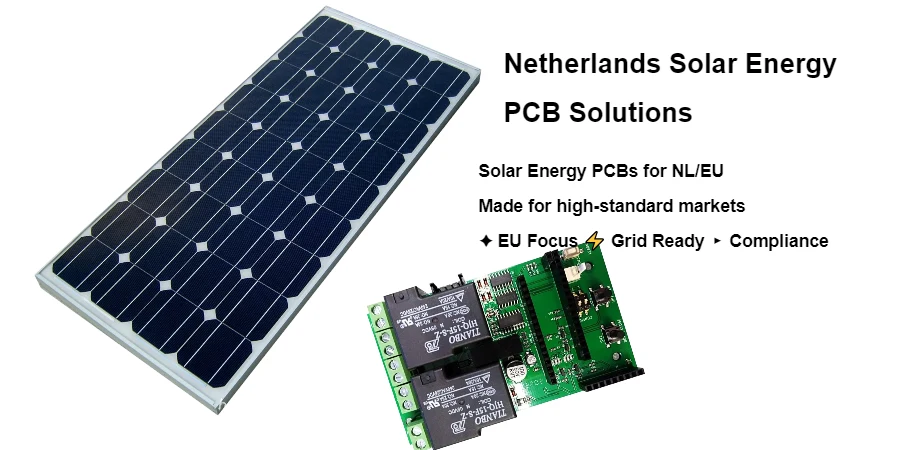
The Netherlands is one of Europe’s most active solar markets—dominated by rooftop PV, rapidly expanding commercial installations, and innovation areas like floating solar. For product teams, the real challenge is not only performance, but reliability under humidity, temperature cycling, and strict EU compliance.
This guide breaks down what engineers and procurement teams typically search for when building solar electronics for the Dutch market: EU regulatory constraints, environmental risks, PCB design priorities for inverters and monitoring devices, and practical manufacturing considerations that reduce field failures.
Why the Netherlands Solar Market Creates Unique PCB Demands
Dutch PV deployments often operate in humid, coastal, and temperature-variable environments. These conditions accelerate corrosion, increase leakage risk in high-voltage areas, and amplify solder-joint fatigue from thermal cycling—especially in sealed outdoor enclosures.
At HILPCB, we focus on environment-driven PCB engineering for EU solar electronics, helping teams improve yield, pass EMC/safety testing faster, and reduce warranty risk in the field.
Key Dutch Market Drivers Engineers Should Design For
- High rooftop density: Space-limited enclosures push power density and thermal design.
- Maritime humidity & salt exposure: Corrosion protection and surface finish choices matter.
- Grid sophistication: Smart inverter features require stable control and communication electronics.
- Warranty expectations: 10–25 year product lifetimes demand robust materials and process control.
By planning for the Dutch environment early, you avoid late-stage redesigns and speed up qualification.
Meeting EU Compliance for Dutch Solar Electronics
Solar electronics shipped into the Netherlands must satisfy EU requirements (e.g., LVD, EMC, RoHS/WEEE). Many compliance issues trace back to PCB-level decisions: creepage/clearance, return-path integrity, and material declarations.
At HILPCB, we help teams design boards that are compliance-ready by construction, minimizing re-spins during CE evaluation.
Key Compliance-Focused PCB Practices
- Creepage & clearance planning: Isolation distances and slots are designed around voltage class and pollution degree—not only layout convenience.
- EMC-first layout habits: Short switching loops, clean return paths, and sensible partitioning reduce noise at the source.
- RoHS-aligned material strategy: For teams prioritizing low-halogen materials, halogen-free PCBs support compliance documentation and reduce risk in EU supply chains.
- Lead-free reflow resilience: Higher reflow temperatures increase laminate stress; selecting the right Tg is critical for long-term stability.
If your product targets broad EU deployment, designing for compliance early is one of the fastest cost savers.
Managing Humidity, Salt Spray, and Condensation in Coastal Deployments
Outdoor PV electronics in the Netherlands frequently face condensation cycles and salt-laden air near coastal areas. Moisture-driven leakage, corrosion, and connector failures are common root causes of field returns.
At HILPCB, our process planning emphasizes moisture risk containment—from laminate choice to layout decisions that reduce leakage paths.
Key Moisture-Resistance Techniques
- Higher thermal stability laminates: high-Tg PCBs reduce delamination risk during lead-free assembly and repeated thermal cycling.
- Leakage-aware spacing: Larger spacing in high-impedance sensing zones reduces moisture sensitivity.
- Copper balance and warpage control: Stable flatness reduces micro-cracking and improves enclosure sealing consistency.
- Protection-ready design: Keep-out zones and test access are planned to support coating/potting strategies during product integration.
For marine-adjacent deployments, moisture control is not optional—it’s a reliability requirement.
Designing Solar Inverter PCBs for Dutch Grid Requirements
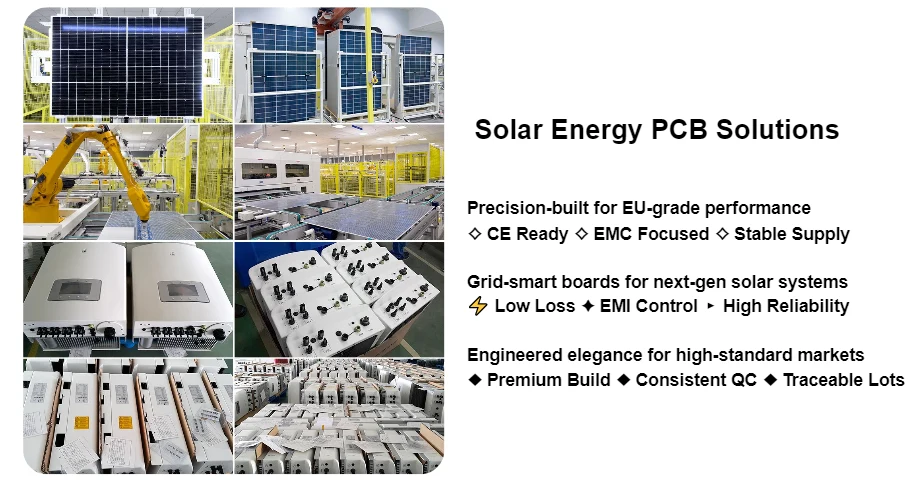
Dutch grid integration often requires reactive power control, frequency response, remote management, and strict power-quality limits. These functions increase control-board complexity and push higher switching frequencies, tighter sensing accuracy, and more robust communications.
At HILPCB, we support inverter teams by combining power-stage robustness with control-board signal integrity.
Key Inverter PCB Design Techniques
- High-current power paths: heavy copper PCBs improve current carrying capacity, lower resistive losses, and reduce temperature rise in power distribution.
- Low-impedance stackups: Well-planned multilayer PCBs provide clean reference planes for stable sensing, reduced noise coupling, and better EMC behavior.
- Thermal conduction planning: Thermal via arrays and copper planes move heat away from switching devices and rectifiers.
- Noise containment: Partitioning of switching, gate-drive, sensing, and RF areas improves compliance margins.
Strong inverter PCB fundamentals reduce EMI debugging cycles and stabilize performance under real grid conditions.
Building Reliable Monitoring and Smart-Grid Interfaces
Residential and commercial PV in the Netherlands relies heavily on monitoring gateways, smart meters, and energy management devices. These products must combine reliability with connectivity—Wi‑Fi, Ethernet, cellular, Zigbee, or wired field protocols.
At HILPCB, we design and manufacture boards that keep connectivity stable even in noisy inverter environments.
Key Connectivity PCB Techniques
- Signal-integrity-friendly stackups: high-speed PCBs help maintain clean interfaces where impedance control and low loss are important.
- Grounding and shielding planning: RF and high-speed zones are isolated from switching noise and high-current return paths.
- ESD and surge readiness: Interface protection footprints and short return paths help reduce interface failures in the field.
- Testability for scale: AOI/ICT-friendly layouts support consistent production quality as volumes rise.
For smart energy products, stable connectivity is as important as power conversion itself.
Manufacturing & Supply Chain Options for EU-Bound Solar Products
Dutch customers typically value consistency, documentation, and responsive support. When scaling from pilot deployments to production, supply chain stability becomes a competitive advantage.
At HILPCB, we support both prototype and production programs, helping teams reduce vendor handoffs and keep build quality consistent.
Key Production Strategies for Faster Ramp-Up
- Prototype-to-volume continuity: Same material systems and process controls reduce “prototype surprise” in mass production.
- Documentation discipline: Material declarations and test records support EU audits and customer QA.
- Integrated production workflow: turnkey assembly can simplify procurement and reduce scheduling risk across components, PCB fabrication, and assembly.
If your Netherlands program is expanding, aligning manufacturing strategy early helps avoid shortages and line delays.
Quick Checklist: What Buyers Ask Before Ordering Solar PCBs for the Netherlands
Before you send files for quotation, these are the details Dutch/EU customers commonly expect:
Pre-Order Checklist
- Operating voltage and required creepage/clearance targets
- Expected ambient range and enclosure thermal limits
- Humidity/condensation risks and planned protection method
- Power-stage current levels and copper weight targets
- EMC test plan assumptions (filters, shielding, grounding strategy)
- Compliance needs (RoHS/low-halogen documentation)
A clear checklist accelerates DFM feedback and improves first-pass yield.
Conclusion
The European solar market, including the Netherlands, demands reliable, high-performance products that can withstand various environmental conditions while meeting strict compliance standards. Whether you're designing inverters, monitoring systems, or smart-grid interfaces, PCB design choices—materials, stack-up, copper strategy, and EMC fundamentals—are crucial in ensuring long-term reliability and successful deployment.
At HILPCB, we offer comprehensive turnkey PCB assembly services that cover PCB design, manufacturing, component sourcing, wire harness customization, and final product assembly. With global delivery capabilities, we support your projects from prototype to mass production—ensuring timely, high-quality results. Our European customers enjoy seamless production and shipping, with all necessary compliance certifications such as RoHS, CE, and WEEE.
Partner with us for end-to-end PCB solutions, and rest assured that your solar electronics will meet both the performance expectations and regulatory requirements for markets across Europe and beyond. HILPCB is committed to delivering world-class service and reliable products, no matter where you are located.