
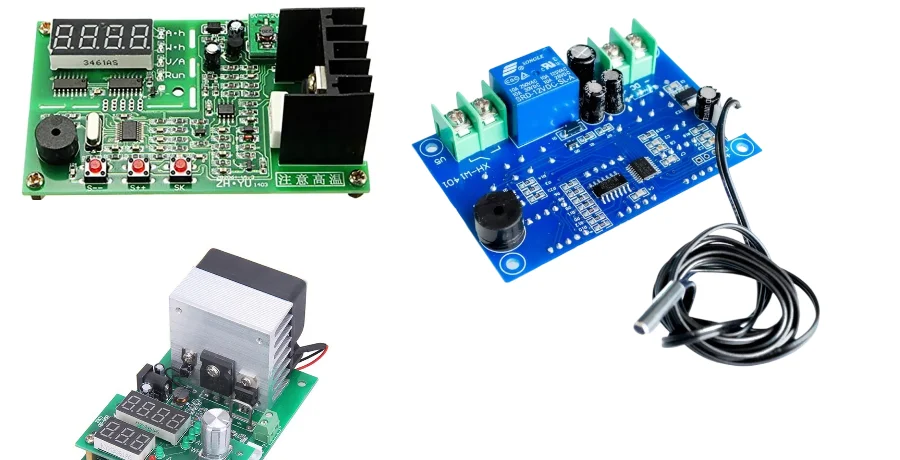
Smart thermostat PCBs connect room-temperature sensing, HVAC outputs, a user interface and optional network services. A multilayer PCB can support routing and return paths, while a high-speed PCB construction is needed only where the selected interfaces require it. Define the HVAC equipment type, installation wiring, sensing error budget and power source before choosing the board construction. HILPCB provides control-electronics design, PCB fabrication and assembly support for thermostat programs, including project-scoped HVAC safety-circuit SMT, line-transient protection, battery management and prototype-to-volume design consultation.
HVAC Interface and Safety Systems
HVAC control requires interface circuits matched to the connected equipment. Place the ambient sensor away from regulators, relays, radios and display heat paths; enclosure airflow and wall coupling also affect the reading. Check room-temperature error with the assembled enclosure under idle, transmitting and display-on loads, as illustrated by TI’s localized heat-compensation reference design.
Line-voltage interfaces: Some HVAC installations use low-voltage 24 VAC control while others switch mains loads. Apply the correct isolation, protective devices, contact ratings and creepage/clearance requirements to the actual circuit; relay isolation alone does not establish appliance safety.
Multi-Stage System Support: Modern HVAC systems feature multiple heating and cooling stages for improved efficiency. Heat pump controls require reversing valve operation and auxiliary heat management. Variable-speed equipment may use analog or digital interfaces; use the equipment’s specified commands, feedback and sequencing rather than assuming a universal thermostat output.
Safety Interlocks: Equipment-level pressure limits, temperature cutouts and flame supervision may reside in a separate HVAC controller. Define which functions the thermostat actually owns, including sensor faults, output defaults and restart behavior. SMT assembly inspection supports board workmanship; it does not establish the safety function or replace equipment interlocks.
Load Management: Demand response programs require automatic load shedding during peak energy periods. Smart grid integration enables utility communication and control. OpenADR or IEEE 2030.5 may be implemented by the thermostat or a gateway. Confirm the required client profile, utility integration, authorization and local comfort limits; PCB fabrication alone does not provide protocol compliance.
Emergency Operation: Backup power can maintain sensing, settings or selected control functions for a defined duration. It cannot keep a furnace, compressor, blower or pump running without power to that equipment. A manual override must preserve required equipment interlocks. Specify and test behavior on loss of power, communications or valid sensor data, including recovery and restart delays.
Advanced Display and User Interface
Intuitive user interfaces balance functionality with ease-of-use while supporting diverse user preferences and accessibility requirements.
High-Resolution Color Displays: Modern thermostats feature high-resolution touchscreens enabling rich graphical interfaces. Display controllers handle complex graphics while maintaining low power consumption. Select OLED, e-ink or LCD interfaces from the required refresh rate, visibility, operating temperature and power budget. HILPCB can support OLED, e-ink, LCD and touch-interface PCB design, with display and touch implementation reviewed against the selected controller, enclosure and EMC requirements.
Capacitive Touch Interface: Multi-touch capabilities enable smartphone-like interactions. Gesture recognition supports swipe navigation and zoom controls. Haptic feedback provides tactile confirmation improving user experience. Review electrode routing, grounding and supply noise, then test false activation and recovery with the actual cover and required EMC exposure.
Ambient Light Adaptation: Automatic brightness adjustment improves visibility while conserving energy. Proximity sensors activate displays when users approach. Sleep modes minimize display power consumption while maintaining essential information visibility.
Voice Integration: Voice control PCB features enable hands-free temperature adjustment and system control. Integration with smart speaker PCB systems provides whole-home voice control. Far-field microphone arrays may improve voice capture, but recognition performance needs testing with fan noise, room acoustics and the selected voice service. Retain a local control path when voice or network services are unavailable.
Accessibility Features: Accessibility requirements depend on the installation and applicable rules; PCB design alone does not establish ADA compliance. High-contrast displays, large fonts, and audio feedback support visually impaired users. Physical button alternatives accommodate users with motor disabilities.
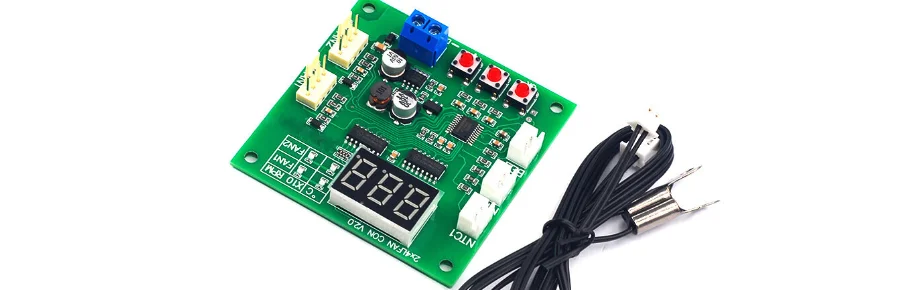
Wireless Connectivity and Smart Home Integration
Comprehensive connectivity enables remote monitoring, control, and integration with broader home automation systems.
WiFi Module PCB: Review antenna keepout, enclosure detuning and coverage at the installed wall location. Mesh support depends on the selected network and product role; it does not guarantee a working cloud connection. Define authenticated firmware updates, rollback behavior and the supported update period.
Smart Home Protocol Support: Choose the protocols needed by the target platform rather than requiring every radio. Matter is an application protocol over supported IP transports such as Thread, Wi-Fi or Ethernet; a Thread radio alone does not establish Matter interoperability. For a specified product or gateway, HILPCB can scope OpenADR/IEEE 2030.5 interface support and BACnet/Modbus or enterprise-platform integration with the required hardware and engineering deliverables; software, commissioning and system compatibility remain project-defined. Zigbee and Z-Wave integration needs their respective stacks or a suitable bridge, as distinguished in the CSA Matter FAQ.
Home automation PCB coordination enables sophisticated energy management scenarios. Integration with smart outlets, lighting controls, and appliances optimizes whole-home energy consumption. Demand response capabilities automatically adjust settings during peak energy periods.
Cloud Services Integration: Machine learning algorithms analyze usage patterns optimizing schedules for comfort and energy savings. Weather forecast integration enables predictive heating and cooling. Remote diagnostics can flag unusual operating data for investigation; they do not predict every equipment failure.
Geofencing and Occupancy: Smartphone location services enable automatic away/home transitions. PIR sensors indicate motion and may miss stationary occupants; camera-based inference has its own coverage, privacy and power requirements. Combine occupancy inputs with user overrides and suitable timeout policies. Learning algorithms adapt to family schedules reducing manual programming requirements.
Power Management and Energy Harvesting
Efficient power design can support battery-powered thermostats, but always-on radios, displays and sensing loads change the energy budget. Estimate battery life from realistic sleep, wake-up, communication and temperature conditions.
C-Wire and Battery Hybrid Operation: A missing common wire may call for batteries, an approved wiring adapter or a compatible power-stealing circuit. Power stealing draws limited energy through the control circuit and can unintentionally energize or chatter an incompatible load. Verify current limits and operation in each HVAC state; TI’s power-stealing reference design illustrates a specific 24 VAC implementation, not universal equipment compatibility.
Solar and Energy Harvesting: Indoor photovoltaic harvesting needs enough light, and thermoelectric harvesting needs a sustained temperature gradient. Compare measured harvest energy with sensing, display and radio duty cycles. An appropriate harvesting converter and supercapacitor may buffer bursts, but leakage, conversion loss and dark periods remain in the budget.
Ultra-Low Power Design: Advanced processors enable complex algorithms while maintaining minimal power consumption. Power gating unused circuits and dynamic voltage scaling optimize energy usage. Real-time clock and communication radios operate independently allowing main processor sleep.
Wireless Charging: Inductive charging requires a powered transmitter, alignment and an acceptable enclosure gap; it does not make a wall-mounted thermostat maintenance-free. Review coil heating, charging controls and sensor-temperature error. A rigid-flex PCB may help packaging where bend and assembly requirements justify it. HILPCB can engineer a rigid-flex route for a thermostat charging coil or antenna when the approved stackup, bend zone, coil clearance and thermal limits support the integration.
Energy management PCB integration enables whole-home energy optimization. Load monitoring and control capabilities manage total energy consumption. Integration with smart panels and energy storage systems optimizes renewable energy usage.
Building Automation and Commercial Applications
Enterprise thermostat applications require advanced networking, security, and management capabilities supporting large-scale deployments.
BACnet and Modbus Integration: Commercial building systems require standard protocols for interoperability. BACnet/IP and Modbus TCP enable integration with building management systems. Specify the supported device profile or register map, physical interface, network configuration and commissioning tests; a protocol name alone does not establish compatibility.
Professional Installation Features: Commissioning tools simplify setup and configuration for HVAC professionals. Built-in diagnostics and monitoring capabilities identify installation issues and ongoing maintenance needs. Service technician interfaces provide advanced troubleshooting and adjustment capabilities.
Enterprise security: Use authenticated device provisioning, current transport encryption, access controls, patchable firmware and segmented building networks where appropriate. Certification support and network protection must be evaluated at the finished-system level.
Scalable Management: Cloud-based management platforms enable centralized control of hundreds or thousands of thermostats. Bulk configuration, firmware updates, and energy reporting streamline facility management. Confirm provisioning, update bandwidth, access controls and service capacity at the intended device count.
Performance Analytics: Detailed energy usage analytics identify optimization opportunities. Predictive algorithms can flag trends for maintenance review; detection coverage and false alerts require evaluation against actual equipment data. Integration with energy management systems provides comprehensive facility insights.
Your Complete Control Systems Partner
For a HilPCB thermostat build, provide the schematic, BOM, stackup, sensor placement, HVAC terminal ratings, enclosure drawings and firmware/test responsibilities. Agree inspection, programming, temperature calibration and functional-test coverage for the quoted order.
Qualification should address the complete thermostat and connected equipment: sensor error under self-heating, staged-output timing, power-stealing compatibility, abnormal-state recovery, EMC and required product safety or protocol assessments. Board fabrication and assembly evidence support this work but do not constitute regulatory approval or guarantee energy savings.