

Solar electronics projects don’t fail because “a PCB couldn’t be made.” They fail when quality drifts during scale-up, lead times slip at the worst time, or field reliability turns into warranty exposure. That’s why solar PCB procurement is as much a risk-management task as it is a price negotiation.
This guide is written for teams sourcing PCBs and assemblies for PV and energy storage products—where long service life, outdoor conditions, and production consistency matter. It explains how to structure RFQs, qualify suppliers, control total cost, and reduce delivery friction using a one-stop manufacturing model.
Solar PCB Procurement in the Broader Solar Supply Chain
In real projects, procurement rarely happens in isolation. A single solar deployment may involve solar equipment procurement (BOS and monitoring), solar panel procurement (modules), and solar inverter procurement (string inverters, microinverters, or hybrid inverters), plus batteries, cables, and site hardware. Each category has its own specs and vendor ecosystem—but the reliability of the overall system often depends on the electronics hidden inside those devices.
That’s where solar PCB procurement becomes a use point. PCBs (and PCB assemblies) sit inside inverters, optimizers, monitoring gateways, combiner boxes, battery management systems, and protection units. When the electronics supply chain is unstable, project timelines and long-term O&M costs can move in the wrong direction even if module and inverter brands are “acceptable on paper.”
What This Means for Procurement and Investors
- A quality escape in electronics can create site-wide downtime, even if modules and inverters are sourced from reputable channels.
- Warranty exposure scales with deployed volume, so repeatable manufacturing matters as much as unit price.
- Fewer supplier handoffs reduce coordination risk, especially during ramp-ups or multi-site rollouts.
Think of solar PCB procurement as the part of the solar supply chain that quietly decides whether performance stays predictable after installation.
Why Solar PCB Procurement Is Different From “Normal” Electronics Purchasing
Solar hardware typically runs hotter, longer, and in harsher environments than many consumer products. Designs also include power stages, sensing, and communications on the same platform—so minor process variation can become major performance variation.
If procurement focuses only on unit price, the hidden costs usually show up later: rework, retesting, delayed shipments, and field returns.
Key Procurement Risks to Address Early
- Scale-up instability: A prototype that “works” does not guarantee stable volume yield.
- Power and thermal stress: Copper structure, solder quality, and heat paths influence lifetime.
- Mixed assembly requirements: Many solar products include both SMT and large power/connector hardware.
- Change management: Uncontrolled revision changes create mismatch across PCB, BOM, and test.
A strong sourcing strategy turns these risks into controllable procurement criteria.
How to Write a Solar PCB RFQ That Produces Accurate Quotes and Fewer Surprises
A good RFQ makes suppliers price the same target—and exposes capability gaps early. The goal is not a longer document; it’s a clearer one.
Key RFQ Inputs That Matter Most
- Application profile: PV inverter / optimizer / monitoring / storage control, plus operating temperature and expected service life.
- Board construction: layers, thickness, copper weight, and any high-current regions (define continuous and peak current).
- Stack-up expectations: if noise control or power distribution is sensitive, specify whether a multilayer PCB approach is required.
- Material and thermal stability: for higher thermal stress, define whether high-Tg PCB materials are needed.
- Surface finish and cleanliness: align finish choice with storage, handling, and coating plans.
- Testing and acceptance: AOI, electrical test, impedance/hi-pot (if needed), and what “pass/fail” means.
Clear RFQs shorten sourcing cycles and reduce mid-project cost changes.
Supplier Qualification: What to Verify Before You Commit
For solar electronics, the best supplier is the one that can deliver repeatable outcomes, not the one with the boldest promise. Qualification should focus on process control, traceability, and engineering responsiveness.
Key Supplier Checks
- Process capability evidence: samples, yield history (where available), and process controls tied to your requirements.
- DFM discipline: whether DFM feedback is specific (not generic), and whether it addresses your real risks.
- High-current know-how: if your design carries meaningful current, confirm copper structure options such as heavy copper PCB and how they manage manufacturability.
- Change control: how ECOs are tracked, approved, and locked for production.
- Quality traceability: lot tracking, inspection records, and how issues are isolated and contained.
Qualification is not about “finding zero risk.” It’s about ensuring the remaining risk is managed and measurable.
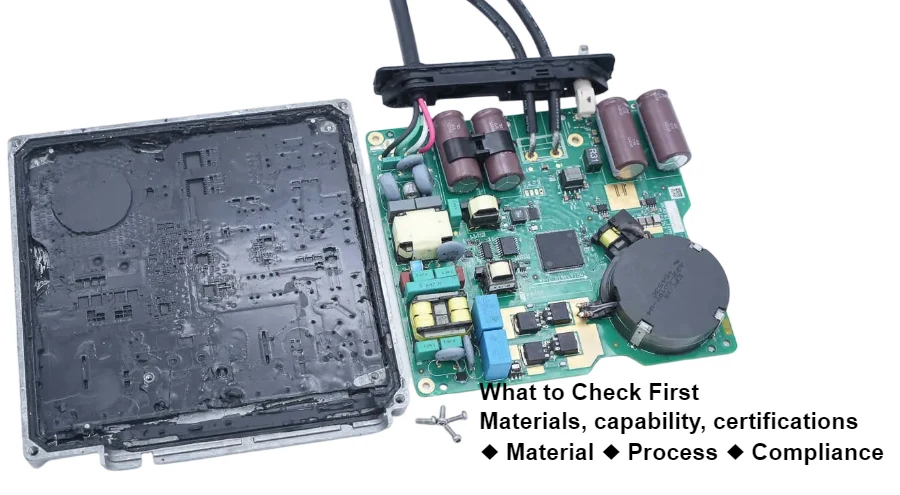
Total Cost of Ownership: The Procurement KPI That Actually Protects Margin
Solar programs often lose margin through indirect costs—especially when deliveries slip or quality fluctuates during ramp. Procurement can protect margin by measuring total cost, not just price.
Practical TCO Levers
- First-pass yield: poor yield increases effective unit cost, even if the quote looks attractive.
- Rework and retest time: long debug loops delay shipment and overload engineering.
- Inventory and buffering: unstable suppliers force higher safety stock and cash tied up in inventory.
- Field reliability exposure: one quality escape can cost more than an entire year of “savings.”
A procurement strategy built on TCO typically produces better long-term pricing—because the supply chain becomes more predictable.
One-Stop PCB Manufacturing + Assembly: Why It Simplifies Solar Procurement
When PCB fabrication and PCBA are split across vendors, the most common problem is not technical—it’s operational: unclear responsibility, mismatched revisions, and slower failure analysis.
A one-stop model reduces friction by shortening communication paths and aligning process ownership.
Key Advantages of a One-Stop Workflow
- Clear accountability: one team owns PCB build quality and assembly quality.
- Faster issue resolution: fewer handoffs means quicker root-cause turnaround.
- Consistent process control: stack-up, soldering profile, inspection, and testing are aligned.
- Better schedule control: fewer external dependencies during ramp.
For assembly execution, reliable production often combines SMT assembly for fine-pitch electronics with through-hole assembly for terminals, transformers, and mechanically stressed components—under a single production plan.
Procurement-Ready Delivery Models for Solar Electronics
Different teams want different levels of outsourcing. The best suppliers can support multiple delivery models without changing the quality system.
Common Sourcing Models
- PCB only: suitable when assembly is already standardized in-house.
- PCBA only: customer supplies bare boards or requires assembly support only.
- Turnkey (PCB + PCBA + sourcing): ideal when procurement wants fewer vendors and faster ramp—often delivered as turnkey assembly with unified BOM control and testing alignment.
Choosing the right model should be driven by your program’s risk profile, timeline, and internal bandwidth.
Conclusion
Solar PCB procurement is not just about selecting a vendor—it’s about selecting a delivery system that can hold quality and lead time steady from prototype through volume production. The most reliable outcomes come from clear RFQs, capability-based supplier qualification, TCO-driven decision making, and delivery models that reduce handoffs.
HILPCB is an electronics manufacturing factory providing both PCB manufacturing and PCB assembly for solar and energy-related products. By offering an integrated workflow—from board fabrication to PCBA and structured testing support—projects can move faster, with clearer accountability and fewer coordination burdens. If you want solar electronics sourcing that is straightforward, scalable, and easier to manage, a one-stop PCB+PCBA partner is often the most efficient path to a dependable supply chain.
Common Questions
Why can’t solar PCB procurement be handled like ordinary consumer electronics sourcing?
Because solar products are usually judged by long-term reliability, outdoor durability, delivery stability, and lifecycle cost rather than by bare unit price alone. A low board price can quickly become expensive if field failures, certification gaps, or lead-time swings appear later.
What information is most often missing from a solar PCB RFQ?
Teams commonly forget to define environmental conditions, test expectations, ramp profile, key component constraints, and required quality documentation. When that context is absent, the initial quote may look attractive but the downstream cost grows.
Why is total cost of ownership more important than piece price in solar programs?
Because margin is often lost through delays, defects, rework, and unstable quality rather than through a few cents on the PCB itself. For long-running energy products, steady supply and low failure rates usually matter more than the cheapest first quote.
What is the main value of a one-stop PCB plus PCBA model for solar procurement?
It removes handoff points across the supply chain. For products that need stable production and structured test support, fewer interfaces usually mean less information loss, clearer accountability, and better schedule control.