

Turnkey HDMI PCB assembly lets engineering and sourcing teams ship faster by using one supplier to manage PCB fabrication, component sourcing, SMT placement, connector anchoring, inspection, and delivery. With a unified process, you get clearer accountability, fewer handoffs, and a smoother path from prototype validation to stable volume production—especially for HDMI products with dense layouts and connector-heavy mechanics.
What Turnkey HDMI PCB Assembly Includes at HILPCB
A true turnkey scope is designed to remove coordination friction. Instead of juggling separate vendors for PCB, parts, assembly, and documentation, your team works with one build plan—so the validated configuration is the same configuration that scales.
At HILPCB, turnkey programs are delivered through turnkey assembly services, integrating procurement, manufacturing, and quality control under one workflow.
Key Turnkey Delivery Elements
- PCB fabrication + PCBA as one build plan: board parameters and assembly constraints aligned from day one
- Component sourcing and kitting: lead-time checks, risk flags, and approved alternates control
- SMT + connector anchoring execution: port-area process focus for stable connector joints
- Inspection and documentation: AOI baseline with optional records aligned to your QA needs
- Prototype-to-volume continuity: repeatable process logic from EVTs to mass production
- Single point of responsibility: clear ownership for schedule, quality, and deliverables
Project Outcomes You Can Expect
Turnkey delivery improves schedule predictability and reduces “handoff errors,” such as mismatched revisions, missing parts, or ambiguous responsibility. It also shortens the feedback loop for DFM changes—helping teams validate faster and ramp with fewer surprises.
PCB Fabrication Planning for Turnkey HDMI PCBA
A successful turnkey build starts with a PCB that is manufacturable, consistent, and compatible with the connector and assembly process. Layer count, surface finish, and board flatness are not just PCB choices—they affect connector coplanarity, solder joint stability, and overall yield.
At HILPCB, we align fabrication choices with assembly realities and volume scalability, using FR-4 PCB manufacturing as a common baseline and upgrading processes when the product requires tighter control.
Key Fabrication Techniques
- Manufacturable stackups: choose layer structures that avoid extreme geometry and reduce lot variation
- Flatness-focused decisions: select thickness and build structure that support stable connector seating
- Multilayer readiness: for multi-port and dense systems, multilayer PCB builds improve plane control and routing flexibility
- High-speed discipline when needed: if your HDMI channel margin is tight, high-speed PCB manufacturing improves repeatability
- Clear RFQ build notes: define finish, thickness, copper weight, and any special processes early
Build Stability You Gain
When PCB fabrication is planned around assembly yield, you reduce reflow warpage risk, prevent connector joint inconsistency, and keep the same fabrication recipe across prototype and production—so the electrical and mechanical behavior you validate is the one you ship.

Component Sourcing and Alternates Policy for Turnkey HDMI Builds
HDMI BOMs often include connector variants, ESD/EMI devices, and active components where “same package” does not always mean “same behavior.” A good turnkey partner should control substitutions and make your sourcing rules enforceable.
At HILPCB, we build a sourcing policy around your priorities: lead time, cost, traceability, and change control—so every build matches the approved configuration.
Key Sourcing Techniques
- BOM review before quoting: identify long-lead and allocation risk parts early
- Approved alternates policy: define which categories allow substitutions (passives vs connectors vs ICs)
- Authorized sourcing options: reduce counterfeit and mismatch risk for critical components
- Kitting and staging control: reduce line stoppages caused by missing parts or incorrect reels
- Change control discipline: substitutions are documented and aligned to your approval rules
Supply Chain Predictability Benefits
A controlled sourcing workflow reduces schedule slips and avoids “silent changes” that create hard-to-debug validation differences. It also helps you scale smoothly because the procurement strategy remains stable as volumes rise.
HDMI SMT Assembly Process Control for Dense PCBA
HDMI assemblies commonly include dense passives, fine-pitch ICs, and protection parts near the port. A stable SMT process is how you maintain repeatable solder joints and consistent electrical behavior across builds.
At HILPCB, HDMI projects follow production-grade workflows through SMT assembly, with process planning aligned to your package mix and inspection requirements.
Key SMT Techniques
- Stencil strategy: aperture design that balances fine-pitch parts and standard components
- Placement accuracy: controlled centering for tight pitch and dense arrays near the connector
- Reflow profile tuning: stable wetting and reduced warpage for connector-adjacent regions
- Mixed thermal mass management: prevent uneven soldering when large connectors sit near small parts
- DFM-driven refinements: small footprint/land pattern improvements that raise yield and reduce rework
Assembly Results That Matter
A well-controlled SMT process improves first-pass yield, reduces rework, and stabilizes functional validation. For teams ramping quickly, consistent SMT output is one of the biggest drivers of predictable delivery.
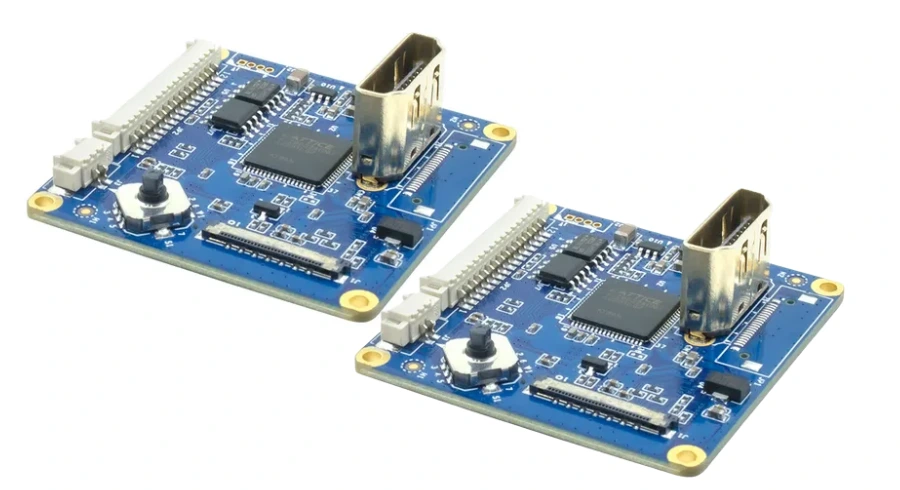
HDMI Connector Anchoring and Through-Hole Operations
HDMI connectors are mechanically stressed. Many designs require through-hole anchor pins/tabs for retention, and those joints must be consistent to support long-term durability under repeated insertion/removal.
At HILPCB, connector anchoring can be executed using dedicated through-hole assembly workflows that integrate cleanly with SMT.
Key Connector Reliability Techniques
- Anchor joint strength control: robust solder fill and stable fillets for retention pins/tabs
- Connector-zone work instructions: repeatable methods that do not depend on “who is on shift”
- Coplanarity awareness: process choices that keep the connector seated consistently
- Post-solder verification: targeted inspection of the connector area where field failures usually originate
- Multi-port consistency: uniform anchoring quality across every port on the same board
Durability and Field Reliability Gains
Connector anchoring discipline reduces mechanical fatigue risk and keeps the HDMI port stable over product life. For industrial and automotive environments, this connector-zone control often has a bigger impact than many “nice-to-have” electrical tweaks.
Inspection, Testing, and Documentation for Turnkey HDMI PCBA
Inspection and test strategy should match your production stage. Prototypes need fast fault isolation; volume needs stable screening and traceable output. A turnkey partner should help you choose the right coverage without slowing delivery.
At HILPCB, we structure quality gates around your package types, risk level, and acceptance needs.
Key Quality Techniques
- AOI baseline: coverage for placement, polarity, and visible solder quality
- X-ray options when applicable: additional verification for hidden joints (package-dependent)
- Electrical screening planning: continuity/power checks aligned to build stage and cost targets
- Functional test alignment: support your fixture strategy and validation sequence where required
- Documentation depth control: from basic build records to FAI photos and traceability, based on your QA needs
What This Improves for Your Program
A clear inspection and documentation plan reduces defect escape and improves customer confidence. It also speeds internal approvals because your team receives consistent evidence and repeatable quality output across builds.
RFQ Checklist for Turnkey HDMI PCB Assembly
A complete RFQ makes quoting faster and prevents build ambiguity. For HDMI projects, the most important items are connector definition, anchoring requirements, sourcing rules, and inspection/testing expectations.
At HILPCB, we recommend a consistent RFQ package and provide an end-to-end reference here: HDMI PCB manufacturing and assembly guide.
Key RFQ Techniques
- PCB data: Gerber/ODB++/IPC-2581, thickness, copper, surface finish, and any controlled-impedance notes
- Assembly package: BOM (MPNs), pick&place, assembly drawing, polarity/orientation notes
- Connector details: exact HDMI connector model, anchor method, mechanical constraints/keepouts
- Sourcing rules: authorized sourcing preference, alternates policy, traceability requirements
- Inspection & testing scope: AOI baseline, optional X-ray, electrical checks, functional expectations
- Quantity and schedule: prototype quantity, pilot run volume, production forecast, target lead time
How This Speeds Your Build
A complete RFQ reduces clarification cycles, locks the approved configuration earlier, and prevents late-stage process changes. The result is faster quoting, smoother DFM, and a cleaner ramp from prototypes to production.