

Radio frequency circuit assembly presents unique challenges that separate it from conventional electronics assembly. High-frequency circuits demand precise component placement, specialized soldering techniques, and careful attention to parasitic effects that would be insignificant at lower frequencies. Success requires understanding both the electrical and mechanical aspects of RF component integration.
At HilPCB PCB Factory, we've developed assembly processes specifically optimized for RF applications spanning DC to 77 GHz. Our approach combines precision placement equipment, controlled thermal profiles, and comprehensive testing to ensure your RF designs achieve their full performance potential.
RF Component Characteristics and Handling
For RF components, precision is key. Unlike digital components, RF parts require specialized handling to ensure top-tier performance. Here’s why our approach to RF component handling stands out:
- Packaging Excellence: We use advanced packaging solutions like QFN that minimize parasitic inductance and capacitance. This results in superior RF performance, with precise placement and thermal management that make all the difference during assembly.
- Optimal Component Orientation: Each RF component has specific orientation requirements to optimize signal flow and performance. By following detailed placement instructions, we ensure every component is positioned for peak efficiency.
- RF Geometry Control: Confirm placement tolerances for the specific package and RF path. Placement accuracy alone does not ensure parasitic inductance, impedance, or performance remains within specification.
- Protecting Your Investment: RF components are sensitive to environmental factors like ESD and moisture. Our controlled assembly environments, complete with ESD protection and humidity control, prevent damage and ensure long-lasting performance.
At every step, our handling process ensures that your RF components are treated with the care they deserve, protecting your investment and optimizing performance.
Precision Assembly Processes
Assembly precision capabilities:
| Metric | Capability |
|---|---|
| Placement accuracy | ±0.05 mm |
| Minimum component size | 01005 |
| Inspection coverage | 100% |
RF assembly demands precision that exceeds typical surface mount assembly requirements. Component placement accuracy directly affects circuit performance through parasitic effects and impedance matching.
Placement control uses fiducial alignment and optical feedback to meet package-specific assembly tolerances; verify the stated accuracy against the assembled package and inspection method rather than treating ±0.05 mm as a universal RF threshold.
Stencil design optimization controls solder paste application for consistent joint formation. RF components often require specialized stencil apertures to account for different thermal masses and joint requirements compared to digital components.
Reflow profiling should follow the component and laminate manufacturer’s thermal specifications, considering copper mass, moisture sensitivity, and assembly geometry. PTFE-based and RO4000 laminates cannot be grouped under one universally lower processing-temperature limit.
Fine pitch capability handles the increasing miniaturization of RF components. We routinely assemble components with 0.4mm pitch while maintaining high yield and reliability standards.
The precision assembly process ensures that the electrical performance designed into the PCB is preserved through the assembly operations.
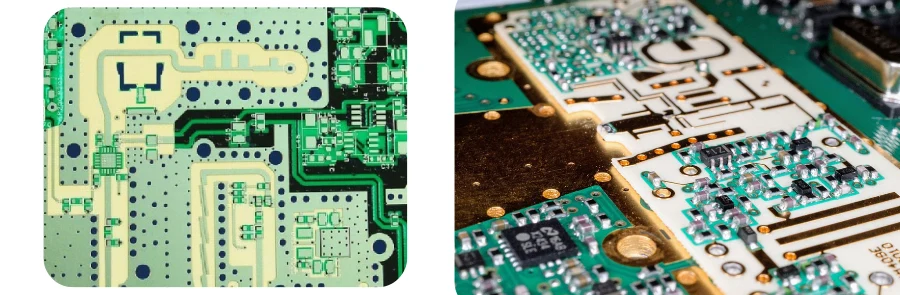
RF PCB Assembly Best Practices
Achieving success in RF PCB assembly requires more than just technical precision, it demands a strategy that balances cost efficiency, speed, and quality assurance. By focusing on these three pillars, you can reduce overall project expenses, shorten delivery cycles, and ensure your RF designs perform reliably under real-world conditions.
Cost Efficiency
- Mixed-Material Usage: Apply high-frequency laminates (e.g., Rogers, Taconic) only where needed, use FR-4 elsewhere to reduce cost without sacrificing performance.
- Panel Optimization: Maximize board utilization per panel to lower material waste and cut per-unit cost.
- Early DFA Reviews: Catch layout or footprint issues before production to avoid re-spins and wasted materials.
Time Savings
- Rapid Prototyping: Automated SMT lines with ±0.05 mm accuracy ensure quick turnaround for prototypes, even with 01005 components.
- Streamlined Workflows: Pre-defined thermal profiles and optimized placement sequences shorten assembly time without compromising yield.
- Express Options: 3-5 day assembly available for urgent projects to accelerate time-to-market.
Quality Assurance
- Controlled Atmosphere Reflow: Stable solder joints with minimal thermal stress for sensitive RF components.
- AOI and X-ray: AOI inspects visible features and solder joints; X-ray can reveal selected hidden joints and voids. Neither guarantees defect-free assembly, so define inspection coverage and acceptance criteria.
- RF Performance Testing: Specify frequency span, fixtures, calibration planes, and S-parameter limits. A claim of VNA measurement to 77 GHz requires current equipment and fixture qualification; it is not a universal production capability.
Quality Control and Testing
HILPCB offers ICT, RF gain, return-loss and isolation measurements, functional and environmental-stress testing, and a qualified VNA option up to 77 GHz when the fixture, calibration and site scope suit the job. Agree the tested device, reference plane, fixture, calibration, sample count and acceptance limits. Existing ±0.05 mm placement, 01005 component and 3–5-day express options remain subject to package, material, process and inspection coverage. These options do not guarantee defect-free assembly or universal 77 GHz production testing.
- Automated Optical Inspection (AOI): Inspects visible component placement, orientation, and detectable solder features; coverage and defect escape rate depend on the package geometry and inspection program.
- X-ray Inspection: Reveals hidden defects in BGA and QFN components that optical inspection cannot detect, crucial for RF power amplifiers and other critical components where joint defects could lead to catastrophic failures.
- In-circuit Testing: Validates basic electrical connectivity and component values. While full RF performance testing requires specialized equipment, in-circuit testing can quickly identify major assembly defects cost-effectively.
- RF Performance Testing: Validates critical electrical parameters using network analyzers and RF test equipment, ensuring key performance metrics like gain, return loss, and isolation meet specification requirements.
- Functional Testing: Validates overall system performance under actual operating conditions, often revealing system-level issues that component-level testing cannot detect.
- Environmental Stress Testing: Simulates extreme conditions (e.g., temperature, humidity) to verify product robustness and ensure it operates under a wide range of environmental factors.
The comprehensive testing approach ensures that assembled boards meet both assembly quality standards and RF performance requirements.
Choosing an RF PCB Assembler: What Procurement Should Check
Sourcing rf pcba assembly work is mostly a capability question. The difference between a general-purpose EMS line and a true RF build partner shows up in a few specific places:
- High-frequency process control. A shop quoting high frequency PCB assembly should already run modified reflow profiles for PTFE and low-Tg RF laminates, not treat them as FR-4 jobs.
- Placement accuracy and inspection. For rf printed circuit assembly with 0402/01005 passives and QFN RF ICs, ask for documented placement capability (±0.05 mm class), 3D SPI, and X-ray under RF shields.
- RF-aware test. In rf printed circuit board assembly programs, functional test should include return loss, insertion loss, or VNA spot checks on production samples, not only continuity.
- Manufacturing and assembly traceability. Request controlled-impedance fabrication coupons when applicable, and correlate the board lot with assembly process and RF measurement records.
The fastest screen when comparing vendors is to ask for a first-article report from a recent rf pcb assembler job: placement data, reflow profile, and RF test evidence tell you more than a capabilities slide.
Optimized RF PCB Assembly for Scalable Production
When scaling RF PCB assembly from prototype to full production, it's essential to optimize both performance and cost. We help you achieve the perfect balance between high-quality assembly, cost-effectiveness, and efficient throughput.
- Consistent Assembly Standards: We standardize all critical processes to ensure every RF PCB assembly meets precise specifications, regardless of production volume. This consistency guarantees high-quality results every time, no matter the scale.
- Minimized Defects and Maximized Yield: Our specialized focus on RF PCB assembly allows us to identify and eliminate defects that uniquely affect RF components. With targeted analysis and custom corrective actions, we enhance yields and reduce costly rework.
- Efficient Equipment and Technology: Our advanced equipment is optimized for RF PCB assembly, ensuring that your designs are produced efficiently without sacrificing quality. We keep our assembly lines flexible to accommodate the variety of RF components used in your circuits.
- Expert Supply Chain Management: Sourcing and managing RF components can be complex, with longer lead times and specialized requirements. We have established strong relationships with trusted RF suppliers and employ efficient inventory management to keep your production on schedule.
- Accurate Cost Modeling for RF Assembly: We provide clear and precise cost breakdowns for every stage of the RF PCB assembly process. Our cost modeling ensures competitive pricing, offering you value without compromising on the quality and reliability your product needs.
Why Choose Our RF PCB Assembly Services?
Our experience in RF PCB assembly ensures your projects are built with the precision required for high-frequency applications while achieving cost and throughput targets. By focusing on both the technical and financial aspects of RF assembly, we help bring your products to market faster, more efficiently, and within budget.
Ready to scale your RF PCB assembly without compromising on performance or cost? Let our expert team streamline your production process to ensure your designs meet the highest standards at competitive prices. Contact us today to learn more!
Common Questions
What makes RF PCB assembly different from standard SMT assembly?
RF assembly requires package-specific placement control, suitable reflow conditions, and electrical verification of critical RF paths. It should be qualified using actual production data rather than a universal ±0.05 mm figure.
Why does reflow profiling matter for high frequency PCB assembly?
Different RF laminates have different moisture, thermal expansion, and reflow limits. Validate a profile against the specific material and component ratings rather than assuming every PTFE laminate tolerates less heat than FR-4.
What should I ask for when qualifying an RF assembly supplier?
Ask for placement accuracy data on RF packages, X-ray inspection of joints under shields and QFNs, impedance coupon or TDR records per lot, and sample RF test reports (return loss, insertion loss) from production. These four items separate a real RF shop from a general SMT line.
Can one assembly shop handle both RF prototypes and volume builds?
Yes, if it keeps controlled thermal profiles, component-level traceability, and RF test capability in-house. The same process window that produced your prototype should be locked and repeated at volume, which is where documented traveler and lot records pay off.
Integrated Services: RF PCB Impedance Control | RF PCB Materials | RF PCB Testing