
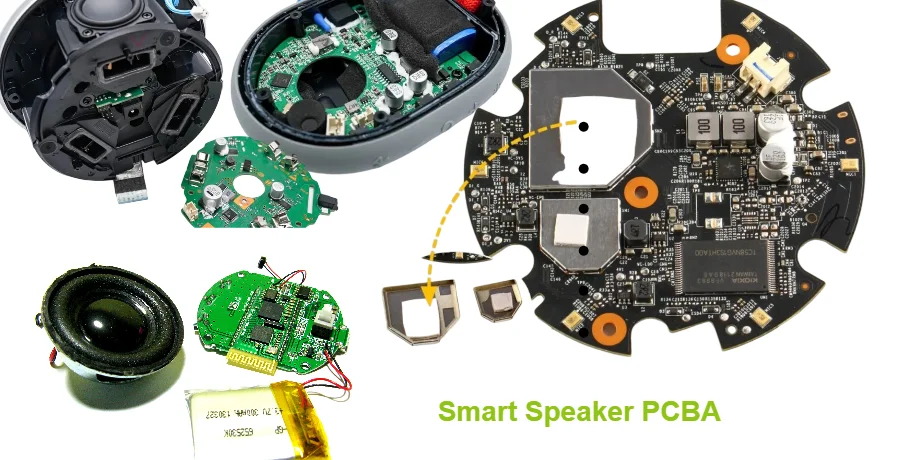
A smart-speaker PCB combines microphone capture, voice processing, wireless links and loudspeaker drive. Priorities include microphone placement, quiet power rails, antenna isolation, amplifier current and assembly test coverage. Choose multilayer PCB construction from the actual routing and return-path requirements; high-frequency PCB material is needed only where its properties justify the change. For a HilPCB build, define the board/assembly and test scope from that design.
Advanced Audio Processing Architecture
Smart speaker PCBs require precise design to deliver both clear voice recognition and high-fidelity music playback. Partition noisy switching/amplifier paths from sensitive capture circuits while preserving the intended signal return paths. Dedicated planes or split grounds are not automatically necessary or quieter; follow the selected codec/amplifier reference design and check coupling.
A selected DSP/processor, codec and firmware can support beamforming, echo cancellation and voice control PCB functions. Surround playback needs an appropriate channel/speaker arrangement. Noise suppression and recognition performance depend on acoustic design, algorithms and measured conditions, not the presence of a codec alone.
Power amplifier design focuses on thermal management and EMI control. With efficient Class-D amplifiers, optimized ground planes, and careful component placement, the assembly can be designed to meet a specified THD+N, output-power and thermal budget at defined loads.
Microphone Array Design and Implementation
Far-field voice capture may use a microphone array; choose the geometry and processing from the acoustic task.
Circular Arrays: Some products use 4–8 microphones, but element count and spacing must be chosen from device geometry, target frequency range, acoustic ports and beamforming objectives. Verify channel timing, gain/phase matching and acoustic response with the selected microphones and algorithms; element count alone does not establish beamforming performance.
Linear arrays: These can suit soundbars or display-integrated devices with a defined pickup geometry. Evaluate element spacing, acoustic paths, mechanical vibration and speaker-to-microphone coupling across the target directions.
Signal processing and integration: Analog microphones need the applicable bias/AFE and conversion path; digital PDM/I2S microphones have different interfaces. Check clocks, timing, decimation where needed and rail noise. A WiFi module PCB requires RF coexistence planning; digital microphone outputs are not immune to supply, clock or RF coupling.
Acoustic Ports: PCB-mounted microphones require optimized acoustic ports to external openings. Evaluate port dimensions, seals, mesh, leakage and enclosure resonances with the microphone guidance and acoustic measurements; the PCB opening alone does not define the response.
Wireless Connectivity and Communication
Smart speakers rely on robust wireless connectivity for cloud services, music streaming, and smart home integration.
WiFi Performance Optimization: High-quality audio streaming demands consistent WiFi performance with minimal dropouts. Measure installed coverage and dropouts with the intended access points and interference. Wi-Fi6 features such as OFDMA and Target Wake Time depend on chipset, access-point and traffic support; they are not guaranteed benefits of any speaker PCB.
Bluetooth PCB design enables direct connection to smartphones and other audio sources. Codec availability and compute/memory needs depend on the selected stack, hardware and licenses. aptX/LDAC support in a Classic Audio implementation does not imply LC3/LE Audio support; verify the intended profile and source-device interoperability.
Multi-Protocol Integration: Some smart speakers support multiple wireless protocols; simultaneous use needs coexistence and firmware support. Smart home PCB integration enables control of connected devices through voice commands. Zigbee, Z-Wave, and Thread support requires additional radio modules or integrated solutions.
Antenna Diversity and MIMO: Antenna diversity or MIMO requires matching radio capabilities, antenna count, isolation and spatial performance. PCB, chip and external antenna options must fit the enclosure and RF design. Measure the actual streaming link; extra antennas do not automatically improve a selected radio.
Power Management and Thermal Optimization
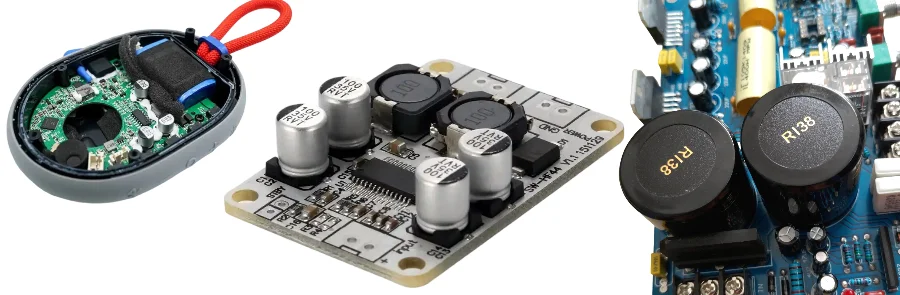
Smart speakers demand multi-rail power systems to support processors, audio codecs, amplifiers, and wireless modules. Choose switching or linear regulation from load, voltage drop, efficiency, ripple, PSRR and layout requirements. Linear regulators are not noise-free; verify rail noise and transient response at the sensitive devices. Dynamic power management further adapts consumption by switching between standby listening, active processing, and full playback. With our SMT assembly expertise, component placement is optimized for both efficiency and thermal control.
Thermal and battery management are equally critical. High-power amplifiers generate substantial heat, managed with high-thermal PCBs, copper pours, and thermal vias to prevent hotspots. For portable devices, define charging control, fuel gauging and battery protections for the selected cells and operating profile. USB-C Power Delivery requires a compatible source, sink/controller and negotiated power budget. Validate charging, playback transients, battery protection and temperature for the assembled product; the connector or protocol label alone does not establish safety.
Manufacturing Excellence and Quality Control
HILPCB designs, fabricates and assembles audio PCBs for professional audio, automotive, medical and industrial applications. Engineering support covers analog/digital and DSP layout, microphone arrays, RF/antenna integration, power and battery design. Our assembly options include 0201 and fine-pitch BGA; contracted audio measurement may cover THD+N and frequency response, with pre-compliance testing as scoped. We also support protocol and edge-AI/security hardware integration, from prototypes through production runs up to millions of units, and can assist with customer approval workflows.
Smart speaker PCB production demands precision manufacturing meeting consumer electronics requirements for cost, quality, and reliability.
High-Density Assembly: Modern smart speakers pack significant functionality into compact form factors. HDI PCB technology with microvias and fine-pitch components enables maximum density. Confirm package/pitch, stackup, soldering, inspection and test requirements for the ordered build; a density label does not establish placement capability or reliability.
Audio Performance Testing: Define audio test coverage across specified frequencies, loads, supply conditions, operating modes and temperatures. THD+N measurements quantify distortion plus noise against a stated frequency, output power, load and acceptance limit; audibility cannot be inferred from a universal threshold. Frequency-response measurements need defined electrical or acoustic measurement points and limits. For turnkey assembly, agree fixtures, calibrated equipment, sample/unit coverage and who performs acoustic or specialist validation.
Environmental Qualification: Consumer devices must operate reliably across wide temperature ranges and humidity conditions. Select thermal, vibration, humidity or corrosion tests from the intended environment and failure mechanisms. Record profiles and acceptance limits; a screening or qualification result covers those conditions and does not by itself establish field lifetime. Salt spray is not a universal consumer-speaker requirement.
Regulatory Compliance: Identify the destination-market radio, EMC, electrical safety and other applicable requirements. FCC authorization and EU conformity assessment/CE marking are distinct processes; board inspection is not either approval. Pre-compliance measurements can expose issues early, while the product owner retains the documented conformity and market-access responsibility.
Integration with Smart Home Ecosystems
Modern smart speakers serve as central hubs for comprehensive smart home automation and control.
Multi-Assistant Support: Select the intended assistant and ecosystem first. Availability, licensing, SDK/platform support and permitted coexistence are product-specific; Alexa, Google Assistant and Siri are not interchangeable models that any board can run simultaneously. Size compute, memory and network resources for the approved implementation.
Home automation PCB integration enables voice control of lights, thermostats, security systems, and appliances. Hub functionality requires support for multiple wireless protocols and edge processing capabilities. Local decision making reduces cloud dependency and improves response times.
Security and Privacy: Voice-controlled devices handle sensitive personal information requiring robust security measures. Use the selected platform's secure boot/update, key protection, access controls and protected communications. An HSM or trusted execution environment is an architectural option, not a mandatory component or complete privacy solution. Define microphone mute behavior, capture indicators and retention/access policies.
Edge AI Processing: Local voice processing reduces privacy concerns and improves response times. Wake-word detection, command recognition and open-ended speech/language processing have different resource needs. Selected MCUs/DSPs may handle limited local tasks; an accelerator is optional. Confirm offline features, model size, memory, latency and power for the chosen workload.
Smart-Speaker Manufacturing Handoff
Provide the released PCB data, BOM/CPL, microphone/antenna and enclosure details, firmware/provisioning requirements and test plan. Separate bare-board acceptance, assembled electrical tests, RF/acoustic validation and market conformity responsibilities. Confirm sample quantities, coverage, records and schedule in the quote before release.
Frequently Asked Questions
What does "pcb speaker" refer to?
The term may refer to a speaker-driver/amplifier board or to a PCB-mounted sounder; clarify which product is required. This guide covers a smart-speaker board with audio amplification, capture/processing and connectivity. For sourcing, specify output power, speaker impedance, and whether the amplifier board shares the main PCB or sits on a separate flex/rigid-flex assembly.