
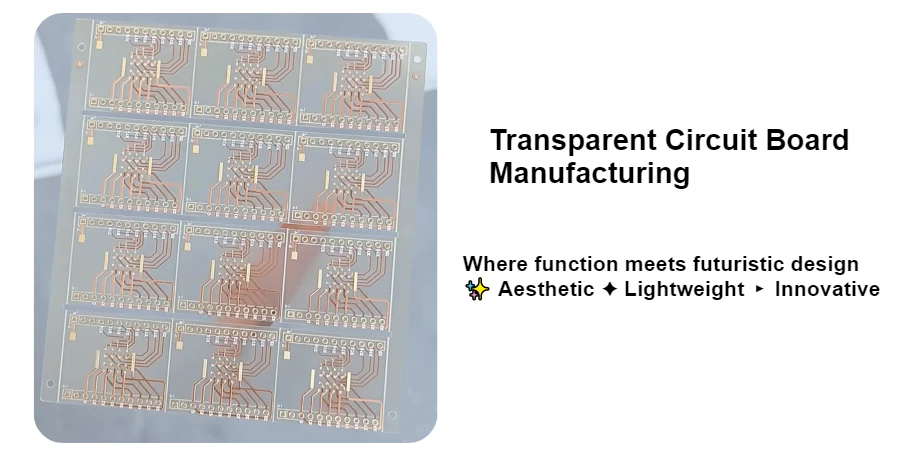
Transparent circuit boards have evolved from experimental concepts into production-ready solutions that enable product designs where conventional opaque electronics would compromise aesthetics, optical functionality, or user experience. From transparent OLED displays to invisible wearable sensors, the application list continues expanding as materials, patterning, and inspection methods improve.
What makes transparent circuit board projects different is that “success” is judged on two fronts at the same time: electrical performance and visible appearance. That combination changes how these boards are specified, designed, built, assembled, and accepted—especially when the PCB is part of the user-facing surface.
This article explores real-world transparent circuit board applications across major industries, highlighting practical implementation requirements and the manufacturing realities that most teams underestimate.
Architectural and Decorative LED Lighting Systems
Transparent circuit boards revolutionize LED lighting design by enabling invisible electrical infrastructure that demonstrates pure illumination without visible wiring or circuit traces. This technology transforms how architects, designers, and lighting engineers approach both functional and artistic installations.
Advanced Lighting Implementation Strategies
Dynamic Edge-Lit Panel Systems Edge-lit transparent panels use LEDs mounted at board perimeters with optical diffusers or prismatic patterns etched into the glass substrate to distribute light uniformly. SMT assembly techniques position ultra-bright LEDs (150-200 lumens) at optimal angles while maintaining peripheral visibility. These systems achieve 85%+ transparency when unpowered, transforming into illuminated displays on demand.
Backlit Transparent Signage Retail and commercial signage incorporates transparent LEDs on clear boards positioned behind acrylic or glass graphics. The board itself remains invisible, creating the illusion of text and images floating in space. Power delivery networks use transparent ITO conductors or ultra-fine copper mesh (line width <10μm) that remains optically invisible at typical viewing distances.
3D Illuminated Sculptures and Art Installations Complex three-dimensional forms integrate flexible PCB sections with transparent rigid boards to create dynamic light sculptures. Programmable LED arrays respond to environmental sensors, viewer proximity, or rhythmic audio inputs, creating interactive experiences impossible with traditional opaque circuits.
Architectural Glass Integration Smart windows and building facades incorporate transparent heating elements, dimming controls, and ambient lighting directly into structural glass. Through-glass via (TGV) technology connects circuits on opposite glass surfaces without obstructing views, while maintaining 90%+ transparency in inactive areas.
Stage and Theater Production Lighting Transparent LED matrices mounted on invisible supports create floating video walls and dynamic scenery elements. High-refresh-rate designs (>1000Hz) prevent flickering in video captures while transparent construction eliminates visual distractions from the performers and audience perspectives.
Display Technology and Touch Interface Integration
The convergence of transparent circuits with display technologies enables breakthrough user interfaces where interaction surfaces seamlessly blend into product designs. These applications demand precise control of optical properties, touch sensitivity, and electrical performance.
Transparent Touch and Display Solutions
Capacitive Touch Sensor Arrays: Transparent electrodes patterned on glass or polymer films detect touch input through changes in mutual capacitance. Diamond or square grid patterns (200-400μm pitch) achieve multi-touch resolution while maintaining >85% transparency. High-frequency PCB design principles ensure noise immunity and reliable touch detection.
Heads-Up Display (HUD) Combiners: Automotive and aerospace applications project critical information onto transparent combiner screens positioned in the operator's line of sight. The transparent circuit board hosts projection optics, brightness sensors, and image processing electronics while maintaining optical clarity for see-through visibility.
Transparent OLED Driver Electronics: Control circuits for transparent OLED panels integrate directly into display stackups, eliminating external driver boards. HDI PCB microvias and fine-pitch traces (50μm line/space) enable high-density interconnections within constrained transparent areas.
Interactive Museum and Retail Displays: Clear touch interfaces overlay physical products and exhibits, providing contextual information without obstructing views. Projected capacitive touch technology differentiated from simple resistive systems offers better transparency and multi-touch capability.
Transparent Smartphone Display Integration: Next-generation mobile devices incorporate transparent sections in displays, enabling augmented reality overlays and notification systems that adapt based on environmental context. These implementations require turnkey assembly expertise to integrate multiple technologies seamlessly.
Medical Device and Healthcare Applications
Transparent circuit technology enables medical devices that minimize patient discomfort, improve diagnostic visibility, and enhance procedural outcomes. These applications demand the highest reliability standards and biocompatibility validation.
Healthcare-Specific Transparent PCB Implementations
Endoscopic Imaging Systems Transparent circuit boards in endoscope tip assemblies position LED illuminators and image sensors without obstructing camera fields of view. Glass substrates withstand repeated sterilization cycles (autoclave temperatures to 134°C) while maintaining optical clarity. Ultra-thin profiles (0.2-0.5mm) enable smaller diameter scopes for less invasive procedures.
Optical Coherence Tomography (OCT) Probes High-resolution retinal and intravascular imaging systems integrate transparent circuits that transmit optical signals alongside electrical control systems. Low-loss transparent conductors minimize signal interference while enabling compact probe designs. These applications use rigid-flex PCB technology to create flexible catheter sections transitioning to rigid tip assemblies.
Transparent Wearable Health Monitors Conformal biosensors for continuous glucose monitoring, pulse oximetry, and electrocardiography use transparent circuits that remain visually unobtrusive on skin surfaces. Flexible transparent substrates conform to body contours while maintaining electrical connection to wireless transmitter modules.
Surgical Instrument Displays Transparent information overlays on surgical instrument handles and optical systems provide real-time data without obstructing the surgical field. These displays integrate miniature transparent LCDs or OLED panels with control circuits, powered by compact batteries or energy harvesting from procedure lighting.
Diagnostic Lab Equipment Spectrophotometers, flow cytometers, and automated microscopy systems incorporate transparent sample stages with integrated LED illumination, photodetector arrays, and temperature control circuits. The transparent construction enables multi-angle observation and analysis without optical path obstruction.
Medical applications require rigorous testing protocols including biocompatibility assessment per ISO 10993, sterilization validation, and long-term reliability testing. Through-hole assembly techniques provide enhanced mechanical reliability for connectors and high-reliability components in critical medical systems.

Automotive Interior and Dashboard Applications
The automotive industry rapidly adopts transparent circuit technology to create sophisticated interiors combining information displays, ambient lighting, and touch controls with sleek, minimalist aesthetics. These applications must withstand harsh operating environments spanning -40°C to +85°C with extreme humidity and vibration exposure.
Automotive Transparent Electronics Integration
Transparent Center Console Touch Controls: Capacitive touch interfaces replace mechanical switches and buttons, offering customizable control layouts that adapt to different drive modes. Backlit transparent circuits provide feedback through LED illumination visible only when active. High-TG PCB materials ensure reliability across automotive temperature ranges.
Panoramic Sunroof Lighting Systems: Ambient LED arrays integrated into transparent roof panels create starfield effects and dynamic lighting sequences. Power distribution networks use transparent conductors or minimally visible copper patterns that disappear when viewed from inside the vehicle.
Heads-Up Display (HUD) Integration: Advanced HUD systems project vehicle data, navigation, and safety information onto windshields using transparent combiner screens with integrated electronics. These systems require precise optical alignment and thermal management to prevent image distortion across temperature extremes.
Steering Wheel Touch Sensors: Transparent capacitive sensors detect driver hand position and grip pressure for safety monitoring and gesture control. Flexible transparent circuits conform to complex steering wheel geometries while maintaining sensitivity through leather or polymer coverings.
Side Window Information Displays: Transparent OLED panels integrated into side windows display passenger information, entertainment content, or environmental data. Window-embedded circuits must maintain 70%+ transparency when inactive to preserve outward visibility and avoid regulatory concerns.
Manufacturing transparent automotive electronics requires IATF 16949 certification and compliance with automotive-specific reliability standards (AEC-Q100/Q200). Small-batch assembly services enable prototyping and validation before committing to high-volume production tooling.
Consumer Electronics and Smart Home Devices
Consumer products increasingly use transparent circuits to differentiate designs, reduce visual clutter, and enable novel form factors impossible with traditional opaque boards. These applications balance aesthetic appeal with manufacturing cost constraints.
Consumer-Focused Transparent Circuit Applications
Smart Speaker Transparent Displays Voice-activated speakers incorporate transparent touch displays that show music information, time, and visual feedback only when active. These displays use transparent OLED technology with integrated control circuits, creating seamless surfaces when unpowered. Low-power design extends battery life in portable variants.
Wireless Charging Pads with Visual Feedback Transparent charging surfaces show alignment guides, charging status, and device identification through embedded LED arrays. Transparent circuit boards position charging coils, power management electronics, and communication chips while maintaining aesthetic clarity. Thermal management prevents overheating during high-power charging (15-30W).
Smart Window Controllers Electrochromic and suspended particle device (SPD) windows use transparent control boards that adjust tint levels, monitor solar load, and communicate with building automation systems. These boards must withstand prolonged UV exposure and temperature cycling from direct sun exposure.
Transparent Gaming Peripherals Keyboards, mice, and controllers with transparent circuitry demonstrate internal RGB lighting effects and mechanical components. Visible circuitry becomes a design feature rather than being hidden, appealing to enthusiast markets. SMT assembly precision ensures aesthetic consistency across production runs.
Wearable Jewelry Electronics Smart rings, bracelets, and pendants incorporate transparent circuits that minimize visual impact while providing notification alerts, activity tracking, and payment functionality. Ultra-thin flexible PCB designs conform to jewelry contours and withstand daily wear mechanical stresses.
Industrial and Scientific Instrumentation
Scientific instruments and industrial equipment benefit from transparent circuits that enable observation of processes while providing sensing, control, and data acquisition capabilities. These applications prioritize measurement accuracy, long-term stability, and harsh environment survival.
Industrial Transparent Circuit Implementations
Transparent Liquid Level Sensors: Capacitive and optical sensors integrated into transparent tank walls monitor fluid levels without interrupting visual inspection. These sensors work with a wide range of liquids including corrosive chemicals requiring specialized transparent substrate materials resistant to chemical attack.
Process Observation Windows with Integrated Sensors: Chemical reactors, bioreactors, and industrial ovens incorporate transparent windows with embedded temperature sensors, pressure transducers, and gas detection elements. The transparent circuit construction allows process monitoring without obstructing operator visibility of internal conditions.
Optical Spectroscopy Equipment: Research-grade spectrometers use transparent circuit boards to position LED arrays, photodetector matrices, and filter control systems directly in optical paths. Precise component placement and minimal stray light generation ensure measurement accuracy and repeatability.
Clean Room Compatible Electronics: Semiconductor and pharmaceutical manufacturing environments require transparent circuit boards that resist particle generation and withstand aggressive cleaning protocols. Sealed transparent assemblies with no exposed conductors prevent contamination while allowing visual verification of proper operation.
High-Voltage Transparent Isolation Barriers: Transparent insulating barriers with embedded voltage sensors and fault detection circuits protect operators while enabling observation of high-voltage equipment operation. These applications demand rigorous electrical isolation testing and long-term dielectric reliability validation.
Aerospace and Defense Specialized Applications
Aerospace and military systems incorporate transparent circuits for applications where size, weight, and reliability constraints push technology boundaries. These demanding applications justify premium costs for specialized capabilities.
Aerospace Transparent Circuit Technology
Helmet-Mounted Display Systems Fighter pilots and astronauts rely on helmet-mounted displays projecting critical information onto transparent visors. Lightweight transparent circuits integrate display optics, tracking sensors, and communication systems while minimizing helmet weight and maintaining peripheral vision.
Transparent Antenna Arrays Aircraft windows and structural panels incorporate transparent antenna elements for satellite communication, radar, and electronic warfare systems. These designs maintain aerodynamic surfaces and structural transparency while enabling RF functionality impossible with traditional metal antennas.
Cockpit Display Integration Modern aircraft cockpits transition from mechanical instruments to integrated glass cockpits with transparent touch interfaces overlaying display panels. These systems require DO-254 and DO-178 certification for airworthiness, demanding extensive documentation and testing to prove reliability.
Space-Qualified Transparent Sensors Satellite and spacecraft instruments use transparent circuits resistant to radiation damage, vacuum conditions, and extreme temperature variations (+150°C to -180°C). Specialized materials and rigorous space qualification testing ensure mission-critical reliability over multi-year operational lifetimes.
Transparent circuit board technology enables breakthrough applications across virtually every industry sector, from consumer products to mission-critical aerospace systems. Success requires understanding not only the electrical requirements but also the optical, mechanical, and environmental constraints specific to each application domain.