

“HDMI PCB solutions” usually means a complete path from design intent to stable production—controlled fabrication, manufacturable stackups, connector-area planning, scalable assembly, and clear QA deliverables. HILPCB does not manufacture HDMI connectors, but we manufacture the PCBs and assemble the PCBAs used in products with HDMI interfaces. We also manufacture all types of PCBs and support mixed-interface designs, so HDMI can be delivered as part of a broader system PCB/PCBA program.
HDMI PCB Solutions for Different Product Types
HDMI appears across many products—adapters, docks, capture devices, AV distribution, industrial displays, and automotive video systems. Each category has different priorities: compact form factor, multi-port density, rugged reliability, or fast validation cycles. The right HDMI PCB solution starts by matching the PCB build and assembly approach to the product’s real constraints.
At HILPCB, we align the solution to your application and delivery stage so the configuration you validate can be scaled without changing the manufacturing logic.
- Single-port compact boards with short routing and fast prototype cycles
- Multi-port switch/matrix boards with tighter isolation and plane control needs
- Conversion/capture boards with dense high-speed IC regions and protection networks
- Rugged or vibration-prone products where connector anchoring and board stability matter
A product-type approach keeps decisions practical: you avoid over-specing where it doesn’t add value, and you add margin where the application truly demands it. This makes quoting clearer, speeds DFM alignment, and keeps the “first validated build” closer to what you ship in volume. For teams managing multiple SKUs, it also helps standardize documentation and acceptance criteria across different HDMI products.
Controlled Impedance Manufacturing for HDMI PCB Solutions
Controlled impedance is a common requirement for HDMI, but the real goal is repeatability across lots and build phases. Impedance results come from stackup execution, copper thickness control, etch repeatability, and plane integrity—not only a single trace width. A good HDMI PCB solution treats impedance as a manufacturing system, not a layout guess.
At HILPCB, controlled-impedance builds start from manufacturable geometry and stable process control, supported by high-speed PCB manufacturing when tighter repeatability is required.
- Impedance-first stackup selection to avoid fragile line/space
- Finished copper awareness and etch compensation discipline
- Continuous reference plane control near HDMI routing layers
- Clear RFQ notes defining targets, layers, and verification expectations
When impedance planning is manufacturing-led, your performance target becomes easier to hold during scaling—especially when moving from prototype panels to production lots. This reduces “works in the lab, drifts in volume” risk and makes cross-team debugging faster because the build is consistent. It also supports stable interoperability across different cables and sinks by reducing the variability that often causes marginal link behavior.
HDMI PCB Stackup and Material Options
Stackup and materials determine insertion loss behavior, assembly stability, and manufacturing repeatability. Many HDMI programs start with FR-4, while connector-heavy products or tighter margins may benefit from higher stability materials and more controlled structures. A practical HDMI PCB solution balances performance, availability, and scalable cost.
At HILPCB, we recommend stackups that are manufacturable at scale and available through standard supply chains.
- Practical baseline builds using FR-4 PCB manufacturing
- Improved assembly robustness using high-Tg PCB materials
- Better return-path and isolation control via multilayer PCB builds
- High-density breakout support through HDI PCB fabrication
- Symmetry and lamination discipline for repeatable lot outcomes
A stackup that is “easy to manufacture consistently” is often the most cost-effective solution over the full product lifecycle, because it reduces rework, respins, and yield fluctuations. The right material/stackup choice also protects assembly quality by improving flatness and thermal stability around connector zones. For sourcing teams, this approach helps avoid long-term supply risk by selecting structures that can be supported reliably during ramp and replenishment.
HDMI Connector Area Integration
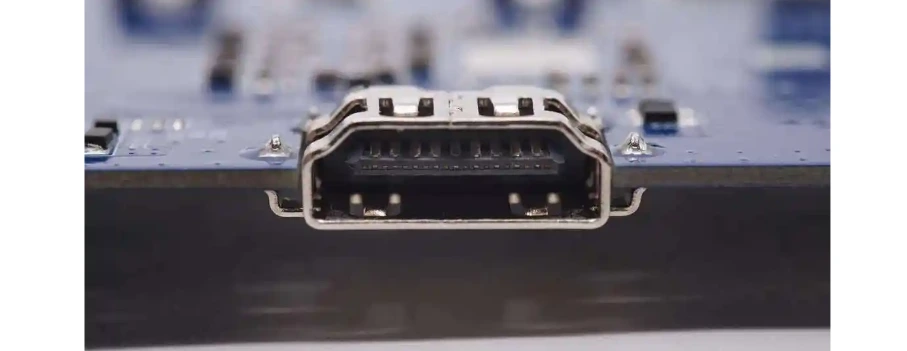
The connector area is the highest-impact zone for both electrical behavior and mechanical durability. A repeatable connector-region structure improves launch consistency, supports ESD/EMI placement, and protects assembly yield. Even when the rest of the board is well designed, inconsistent connector-region implementation can slow validation and add iteration.
At HILPCB, we treat the connector region as a controlled module: the footprint, grounding, and protection layout are planned to remain manufacturable and consistent across builds.
- Stable pad/antipad geometry and via fields near the connector
- Ground and shield strategy aligned to enclosure and EMC needs
- Space reserved for TVS/filters without forcing routing compromises
- Port-to-port uniformity for multi-port boards
- Manufacturing-aligned notes that preserve connector-region intent
A connector-first approach makes the entire HDMI channel easier to validate, because the highest-risk transition is controlled and repeatable. It also improves long-term durability by ensuring the mechanical and grounding structures around the connector are buildable without “hand-tuned” fixes. For multi-port products, consistent connector regions across ports typically yields more uniform performance and fewer “one port behaves differently” surprises during production.
Turnkey HDMI PCB Solutions
Many teams choose turnkey to reduce vendor coordination, shorten schedules, and keep accountability clear. Turnkey HDMI PCB solutions can include PCB fabrication, component sourcing, SMT assembly, connector anchoring, inspection, and delivery. This is especially helpful when you’re moving fast or when the HDMI board is part of a larger system program.
At HILPCB, turnkey builds can be delivered through turnkey assembly services supported by stable SMT assembly execution and connector anchoring via through-hole assembly when required.
- BOM review, lead-time check, and alternates policy control
- Connector anchoring readiness for mechanically stressed HDMI ports
- Consistent build records and stage-appropriate inspection gates
- Ramp continuity from prototypes to pilots to volume production
- Reduced handoffs and faster DFM feedback loops
Turnkey is not just convenience—it’s a way to keep the “approved design intent” intact by controlling parts, processes, and documentation under one plan. It also helps programs scale cleanly because early prototypes and later production builds share the same workflow and acceptance logic. For sourcing teams, turnkey simplifies responsibility and reduces the time spent reconciling multiple vendors’ timelines, revisions, and quality outputs.
Inspection, Testing, and Verification for HDMI PCB Solutions
Verification and inspection protect yield and speed up internal approvals. The most effective plan matches the build stage: prototypes need fast fault isolation, while production needs repeatable screening and consistent documentation. A complete HDMI PCB solution includes quality gates that are practical, scalable, and aligned to what your team truly needs.
At HILPCB, inspection scope can be aligned to package type, risk level, and acceptance requirements.
- AOI baseline for placement and visible solder quality
- X-ray options when hidden-joint visibility is required (package-dependent)
- Electrical screening aligned to volume and cost targets
- Functional test coordination when fixtures/validation steps are provided
- Reporting and traceability depth agreed per build lot
A staged quality plan helps you move faster: prototypes get quick feedback, pilot runs catch systematic issues early, and production builds maintain stable screening. It also supports smoother customer and internal QA approvals because the output is consistent and traceable. Most importantly, verification reduces “uncertainty cost”—less time is spent guessing whether an issue is design-related or build-related.
RFQ Checklist to Get the Right HDMI PCB Solution Fast
A complete RFQ accelerates quoting and prevents scope ambiguity. The best HDMI PCB solutions come from clear inputs: connector definition, stackup expectations, sourcing rules, inspection scope, and delivery targets. When these inputs are consistent, the manufacturing plan becomes predictable and easier to scale.
At HILPCB, you can reference this practical planning resource: HDMI PCB manufacturing and PCBA guide.
- PCB data: Gerber/ODB++/IPC-2581, thickness, copper, finish, special requirements
- Performance expectations: port count, routing constraints, any controlled-impedance notes
- Assembly package: BOM (MPNs), pick&place, assembly drawing, connector/anchoring requirements
- Sourcing rules: alternates policy, traceability level, authorized sourcing preference
- Inspection/testing: AOI baseline plus any additional needs
- Quantity and schedule: prototype quantity, pilot run, volume forecast, target lead time
A strong RFQ reduces back-and-forth and helps you get an accurate quote that matches the real build—first time. It also sets the foundation for smooth scaling because requirements are already structured for production, not just prototypes. For teams running multiple HDMI projects, a standardized RFQ format saves time, reduces misunderstandings, and improves consistency across suppliers and internal stakeholders.
Common Questions
Why do HDMI PCB solutions vary by product type?
Different HDMI products place different demands on routing density, connector count, mechanical form factor, and validation scope. A board for a simple interface adapter is not engineered the same way as a multi-port video product or an embedded system with tighter integration constraints.
Why do controlled impedance and stackup planning matter so much?
HDMI performance depends on predictable high-speed signal behavior, and that starts with the stackup. If impedance targets, reference planes, and material selection are not aligned early, the design may suffer from signal loss, timing margin reduction, and avoidable rework.
Why is the connector area such a critical part of HDMI PCB design?
The connector zone is where signal escape, grounding, mechanical anchoring, and ESD/protection details all converge. Poor execution in this area can undermine an otherwise solid design because physical stress and routing compromise often appear there first.
Why do turnkey support, inspection, and RFQ discipline help scale HDMI production?
Scaling is easier when fabrication, assembly, inspection scope, and sourcing expectations are defined as one package. Turnkey execution plus a disciplined RFQ gives the factory the information needed to build repeatably from prototype through volume without resetting the process each time.